
Once the last subcontractor walks off a job site, the building isn't finished, not really. There's a layer of drywall dust on every surface, debris scattered across floors, and construction residue on fixtures that cost more than most people's cars. Before any ribbon gets cut or any tenant moves in, someone has to clean it.
Knowing where to hire cleanup labor for post-construction cleaning jobs, and how to hire well is one of the most underrated decisions in the entire construction cycle. Get it wrong, and you're dealing with damaged finishes, delayed turnover, and a project manager who won't call you again. Get it right, and you've built a pipeline that keeps paying.
This blog is for cleaning company owners, general contractors, and anyone managing a commercial build who wants straight answers on sourcing, rates, timelines, and what makes post-construction cleaning labor different from general janitorial work.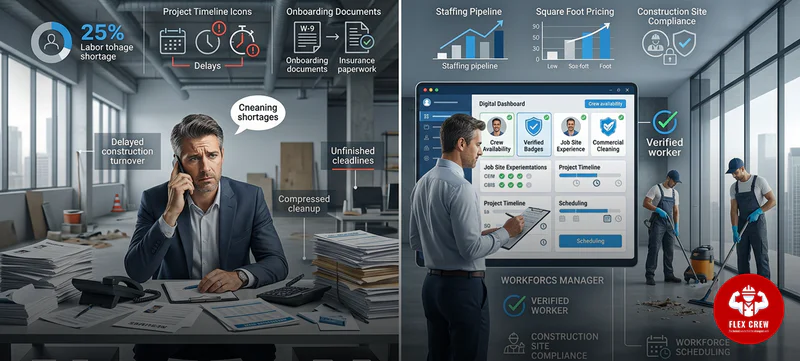
Key Takeaways
The market is growing fast, but so is the labor gap. The global contract cleaning services market was valued at $383.99 billion in 2024 and is growing at 6.4% annually through 2030. Post-construction cleanup is one of the fastest-growing niches inside it. At the same time, the construction industry had 292,000 unfilled positions as of December 2025, meaning qualified cleanup labor doesn't sit idle for long.
Labor is 90% of your cost. It's also 90% of your risk. One worker who applies the wrong product to a specialty finish or skips the cleaning checklist can cost more than the job pays. Vetting matters more here than in general janitorial work.
Final cleaning is almost always the last scope hired. GCs carry a cleaning allowance from the start but don't lock in vendors until the building is near complete. That window is short. Cleaning companies that wait to staff up until after a job is awarded are already behind.
Staffing platforms beat general job boards for this work. Construction-focused platforms bring workers who already understand job site expectations, no crash course required on how to behave around a superintendent or protect a finished surface.
Documentation determines whether you get on the list. Before any GC will let you bid, you need a W-9, general liability insurance, and workers' compensation coverage ready. Companies that respond fast and complete beat companies with more experience and slower paperwork.
Relationships compound. One solid post-construction job, done on time, done right, with clean communication, generates more future work than a dozen cold bids. The referral pipeline from GCs is where steady revenue actually comes from.
Why This is Harder Than It Looks
Post-construction cleaning sits at the back end of the project timeline, which means it's almost always the last scope procured. General contractors typically carry a cleaning allowance in their estimate from the start, but the actual hiring doesn't happen until the building is close to complete. That creates a narrow window, and a lot of pressure.
According to the Associated General Contractors 2024 Industry Workforce Analysis, 54% of contractors reported experiencing project delays because of workforce shortages. That figure covers the full construction labor picture, but it plays directly into post-construction cleaning timelines. When the trades are stretched thin and turnover dates shift, cleaning windows compress fast.
At the same time, the demand side of the equation keeps growing. The global contract cleaning services market was estimated at $383.99 billion in 2024 and is projected to grow at a CAGR of 6.4% through 2030. Commercial cleaning services account for more than 70% of the overall market share, driven by offices, healthcare facilities, hospitality venues, and industrial construction. Post-construction cleanup sits within this commercial segment and is one of the fastest-growing niches inside it.
The challenge isn't demand. It's finding the right labor, fast, without cutting corners on quality.
What Separates Post-Construction Cleanup Labor from General Cleaning
Not every cleaner belongs on a post-construction job site. The work is physically intensive, detail-oriented, and takes place in environments that are still in the process of becoming finished spaces. Workers who haven't done it before make mistakes, using the wrong product on a specialty floor coating, scuffing a newly painted wall moving equipment, or missing the particulate layer that settled on top of ductwork.
Labor accounts for around 90% of the total post-construction cleaning bill, with stairs, multiple surface types, and debris volume all increasing the work required. That makes each hire a high-stakes decision. One worker who doesn't know how to read a cleaning checklist or handle specialty finishes can cost the cleaning company more than the job paid.
Good post-construction cleanup workers are fast, methodical, and understand job site etiquette. They know to check manufacturer cleaning specs before applying any product to a specialty surface. They move through a space with a checklist, not guesswork. And they understand the difference between rough-in cleaning, final cleaning, and touch-up cleaning, because each phase has different expectations and, in many commercial contracts, different billing.
Where to Hire Cleanup Labor for Post-Construction Cleaning Jobs
Staffing Platforms Focused on Construction and Light Industrial Work
This is the most efficient starting point for cleaning companies that need to scale quickly. General job boards generate volume but not quality, you'll spend more time screening than hiring. Staffing platforms that specialize in construction-adjacent and light industrial labor bring you workers who already understand job site environments, safety expectations, and the pace of commercial work.
FlexCrew operates in this space, connecting cleaning businesses and contractors with pre-screened, work-ready labor across Texas, Florida, Georgia, and other active markets. For a cleaning company landing a large commercial contract, a school, a hospital wing, a multi-floor office build-out, the ability to call in verified crew without building a full-time payroll is exactly the kind of flexibility that protects margins. There's no lengthy onboarding loop when a job starts Monday and you need a crew by Friday.
Public Bid Websites and Vendor Lists
Commercial cleaning companies that want recurring post-construction work need to get on general contractor bidder lists. Most reputable GCs maintain formal vendor portals, and getting on those lists is how you access bid opportunities for schools, banks, restaurants, and office buildings before they go to the open market.
The process typically involves submitting a W-9, proof of general liability insurance, and workers' compensation documentation. Some firms run online compliance portals with additional questionnaires. Once you're on a list and you perform well on an initial job, the referral flywheel starts turning on its own.
Industry practitioners confirm this: building direct relationships with project managers before a project wraps tends to generate more reliable work than competing on price alone, and getting on a pre-bid walkthrough list puts you in a position where you're not just fighting for the lowest number.
Direct Site Outreach
Active construction sites are an underused prospecting channel. If a building is visibly going up in a market where you operate, the superintendent on site is the right person to speak with. They often have authority over who gets called for final cleaning, and they frequently don't have a cleaning vendor locked in until the building is close to complete, especially on out-of-market GC projects where local vendor relationships don't exist yet.
Industry experience bears this out: site supervisors have hired cleaning companies they met through a brief, respectful on-site visit, even when they initially didn't want to be approached. The key is being direct, leaving a card, and asking about the process to get on the vendor list. Keep it short. Don't overstay.
Existing Client Referrals
If you already clean commercial spaces, office buildings, medical facilities, retail locations, those clients are your warmest lead source for construction cleaning work. Let them know you've expanded into post-construction cleaning. If they have new locations being built, or if the contractor building their next location needs a cleaning referral, you want to be the name that comes up.
This channel works in both directions. Contractors sometimes ask property owners for cleaning referrals during handoff. Property owners sometimes see their contractor starting a new build and make the introduction proactively. Either way, being top of mind with your existing base costs nothing and often pays more than cold outreach.
Post-Construction Cleaning Rates: A Realistic Breakdown
One of the most common questions from both cleaning company owners and the contractors who hire them is what post-construction cleaning actually costs. The answer depends on project type, size, finish level, and region, but there are reliable benchmarks.
Post-Construction Cleaning Rates by Pricing Model
Flat bids based on square footage are the most common model for commercial post-construction work. They give contractors and property managers predictable numbers during the budgeting phase, and they protect the cleaning company from scope creep, as long as the contract clearly spells out what's included, what's excluded, and how overages are handled.
Commercial Project Size vs. Estimated Cleaning Cost
One pricing note that comes up consistently in the industry: most cleaning companies won't give a firm price early in a project. The site condition at completion is impossible to predict from the ground floor. Experienced GCs respect this and carry an allowance, then get firm bids when the building is near done. Cleaning companies that try to lock in pricing too early often find themselves absorbing costs they didn't see coming.
The Labor Gap You're Competing Against
This is worth understanding before you finalize your staffing strategy. According to the Associated Builders and Contractors (ABC), the construction industry needed to attract an estimated 501,000 additional workers on top of normal hiring pace in 2024. As of December 2025, there were 292,000 unfilled construction positions, with 3.4% of all construction jobs going unfilled in that month alone.
Post-construction cleaning competes for labor in that same tight market. Workers who are physically capable and detail-oriented have options. Cleaning companies that offer consistent work, clear expectations, and reliable pay are better positioned to retain crew than those who staff up reactively and expect loyalty they haven't earned.
94% of construction firms are still having trouble filling at least some positions, particularly among the craft workforce. For cleaning company owners, this means that waiting until a job is awarded to start hiring is already too late in many markets. Building a reliable crew or a staffing partnership before the job comes in is the move that separates companies that grow from those that scramble.
What Documents You Need Before You Can Bid
Getting on a GC's approved vendor list isn't complicated, but it does require preparation. Most reputable general contracting firms will ask for the following before you can bid on a project:
Vendor Onboarding Requirements for Post-Construction Cleaning
Have these ready before you make outreach. When a project manager asks for more information, the cleaning companies that respond within 24 hours with a complete package are the ones that get added to the list. The ones that come back three days later with an incomplete file get forgotten.
Your introductory letter should be brief and direct, who you are, how long you've been in operation, what you specialize in, and why you can deliver a move-in-ready space. Be honest about your experience. Overpromising in a letter and underdelivering on the job ends vendor relationships permanently.
For Workers: How to Get Into Post-Construction Cleanup
If you're a worker looking to enter this space rather than a company looking to staff it, the path is more accessible than most people realize. The work is physical, steady on long commercial projects, and often leads to consistent hours. You don't need specialized certifications to start, but attention to detail and the ability to work efficiently inside a large commercial space are genuinely valued.
Starting with a staffing platform that already has relationships with cleaning companies in your market cuts down the lead time significantly. FlexCrew places workers into construction-adjacent and light industrial roles across markets like Texas, Florida, and Georgia, including with cleaning companies who regularly take on post-construction contracts. The platform also offers an AI-driven resume builder, which helps workers, especially those with informal or self-employed work histories, present their experience in a way that gets them placed faster.
A clear, honest resume showing physical labor experience, reliability, and any commercial cleaning background is enough to get started. Cleaning company supervisors aren't looking for perfection on paper. They're looking for workers they can trust to show up, follow a checklist, and protect a finished space.
Building the Pipeline, Not Just Filling the Next Shift
The cleaning companies that build lasting revenue from post-construction work aren't the ones who hustle the hardest on each individual bid. They're the ones who do solid work on a few jobs, build real relationships with project managers, and become the name that gets called when the next project wraps.
Employment growth for janitors and building cleaners is expected at 2% from 2023 to 2033, and post-construction cleanup is one of the higher-margin segments within that broader category. The cleaning companies positioned to capture that growth are the ones treating vendor relationships, staffing infrastructure, and scope-of-work documentation as core business functions, not afterthoughts.
Whether you're managing your first commercial post-construction job or trying to turn a few one-off contracts into a reliable revenue stream, the fundamentals are the same: know where to find labor, have your documentation ready, bid clearly, and deliver what you said you would.
Stop Scrambling, Start Staffing Smart
Knowing where to hire cleanup labor for post-construction cleaning jobs is not a question you want to be answering the week a job is awarded. The cleaning companies that win, and keep commercial post-construction contracts are the ones with a reliable answer to that question long before the superintendent calls.
If you're in Texas, Florida, Georgia, or another active construction market and need pre-screened, work-ready labor for your next commercial cleaning job, FlexCrew connects you with vetted workers who understand job site expectations.
Visit flexcrewusa.com to explore the workforce available in your market and get ahead of your next staffing need before it becomes a deadline problem.