
Projects are stalling. Deadlines are slipping. And the workers you need aren't showing up to interviews, because they're already working somewhere else. For contractors across Texas, Florida, and Georgia, this isn't a new problem. It's the defining challenge of running a construction business right now.
What is the fastest way to get construction labor has become one of the most urgent questions in the industry, and the answer matters more today than it ever has. According to the Associated General Contractors of America, 92% of construction firms reported difficulty finding qualified workers in their 2025 workforce survey. Nearly half, 45% said labor shortages directly caused project delays. These aren't just operational headaches. Every delayed week on a job site means cost overruns, strained client relationships, and compressed margins.
The construction industry needed 439,000 net new workers in 2025 alone, according to Associated Builders and Contractors. In 2026, the gap remains significant, and the pipeline hasn't kept up. Retirements are accelerating, with nearly 40% of skilled construction workers now over the age of 45. Apprenticeship programs take five to seven years to produce fully trained tradespeople. None of that helps a contractor who needs two electricians and a welder by next Monday.
So what actually works? Here's a practical breakdown, built around how construction hiring actually operates on the ground.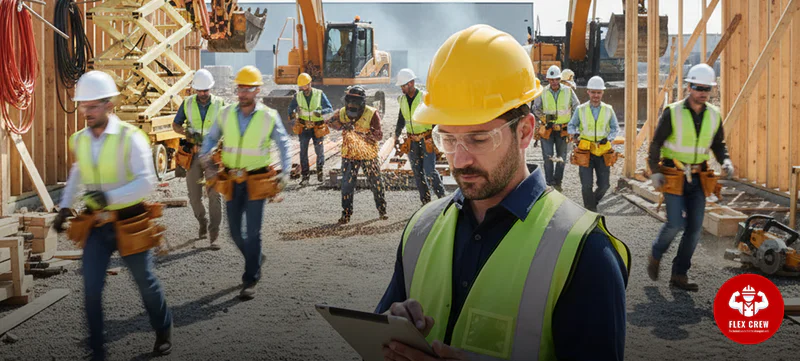
Why Construction Labor Is So Hard to Get Fast
Before getting into solutions, it helps to understand what's creating the friction, because the hiring bottleneck in construction isn't random.
The national average time to fill a role across all industries sits between 36 and 44 days, according to LinkedIn and SHRM data. In construction, direct hiring through job boards tracks similarly. That's six to seven weeks of open headcount on a job site that doesn't have six to seven weeks to spare.
At the same time, demand is outrunning supply in concentrated ways. Texas added 42,300 construction jobs (5.1%) and Florida added 37,100 (5.9%) between September 2023 and 2024, two of the fastest-growing construction markets in the country. Georgia currently has only 65 available workers for every 100 open jobs, one of the most imbalanced ratios in the nation. When you're hiring in markets this tight, conventional approaches hit a wall fast.
There are also structural forces at play. Labor shortages translate directly into higher labor costs, schedule volatility, project delays, safety and productivity risks, and constrained growth for contractors, particularly in infrastructure, manufacturing, and private development. This isn't cyclical noise. It's a structural shift that rewards contractors who build smarter hiring systems over those who scramble when a project kicks off.
The Fastest Way to Get Construction Labor: A Comparison of Methods
Not every hiring channel moves at the same speed. Here's how the main options stack up in practice:
For contractors who need workers this week, not next month, the hiring partner model isn't a shortcut. It's the most reliable way to compress hiring time without sacrificing vetting. Average time-to-fill for construction positionsthrough hiring partners is just 6 days for temporary roles, compared to the industry-wide average of 44 days. That difference is the gap between a project staying on schedule and falling behind.
Method1: Partner With a Construction-Focused Hiring Partner
The reason a construction hiring partner moves faster isn't magic. It's pre-built infrastructure. When a contractor posts a job on Indeed, they're starting from scratch every time, writing the listing, screening applicants, scheduling interviews, running background checks, verifying certifications. A hiring partner likeFlexCrew has already done most of that work before you call.
The pool exists. The screening has happened. When you submit a request, you're pulling from a pipeline of workers who are already verified, available, and oriented toward construction work in your specific market. In fast-moving markets like Houston, Tampa, or metro Atlanta, that pipeline is actively maintained because demand is constant.
What makes this especially useful for contractors is flexibility. If you need five laborers for a four-week concrete pour and then don't need them after that, you're not carrying the overhead of five permanent employees between projects. Staffing fills the operational gaps, surge hiring, seasonal demand, emergency coverage without requiring you to restructure your payroll every time the project scope shifts.
Placements regularly happen within two to seven days of a worker coming through the door, and many staffing placements lead to permanent offers. Temp-to-hire arrangements let workers prove themselves on the job, often resulting in direct employment within 60 to 90 days, especially in construction and skilled trades.
For contractors trying to build a long-term crew, that temp-to-hire pathway is underused. You get to see how someone actually performs before you commit to a permanent hire. That's a better filter than any resume.
Method 2: Build an Employee Referral System That Actually Works
Referrals are the most underrated hiring channel in construction, and most contractors either don't have a formal program or treat it as an afterthought. That's a mistake. A tradesperson who vouches for another tradesperson has more skin in the game than any job board algorithm. They're not going to recommend someone who will embarrass them on site.
A simple referral bonus structure, even $100 to $300 per hire who completes 30 days, creates a meaningful incentive. Post it in your crew WhatsApp. Mention it at toolbox talks. Make it easy for your workers to connect you with people they know. In tight labor markets, your existing crew is often your best sourcing channel.
The caveat is timing. Referrals work best as a steady-state strategy, not a crisis response. If you're three days out from a project starting with an unfilled crew, you don't have time to wait on word-of-mouth. Referrals complement faster channels; they don't replace them.
Method 3: Post Smarter, Not Just More
When contractors do post on job boards, the biggest mistake is generic listings. "Construction workers needed. Must have experience." That attracts volume, not quality, and volume means more time screening people who aren't a fit.
A better job post answers three questions immediately: What is the work exactly? What does it pay? Where is it and when does it start? Specificity filters in the right candidates and filters out the wrong ones before you spend time on them.
The more specific your listing, the faster you get to the right person. A tradesperson who matches all your criteria and sees a clear, honest post will respond faster than one who has to guess whether they're actually qualified. Clarity cuts time.
Method 4: Use Trade Schools and Local Training Programs as a Pipeline; Not a Last Resort
Trade schools and community college construction programs are consistently overlooked by contractors who need workers fast because the lead time feels too long. But the contractors who do build relationships with these programs don't use them for emergency hiring, they use them to fill their pipeline before the emergency happens.
Showing up at a career fair at a Houston community college or sponsoring an apprenticeship through a Georgia technical college isn't just goodwill. It puts your company name in front of motivated, newly trained workers before they've committed to someone else. You're recruiting at the beginning of the decision-making process, not competing with five other contractors at the end of it.
This is a 6–12 month play, not a 6-day one. But contractors who complain about never being able to find workers are often the same ones who haven't built any proactive pipeline at all.
What Fastest Actually Means: A Realistic Timeline for Contractors
"Fast" means different things depending on what you're hiring for. An electrician with specific certifications and five years of commercial experience takes longer to source than a general laborer ready to start tomorrow. Here's an honest range based on role type:
These aren't guarantees, market conditions, geography, and timing affect every search. But they give a realistic frame for what "getting construction labor fast" actually looks like depending on the role. Planning around these windows, rather than assuming all roles fill at the same speed, prevents the panic hiring that leads to bad placements.
The Hidden Cost of Waiting Too Long
Contractors sometimes delay making a staffing decision because they're hoping their direct search will work out. That instinct is understandable. But the cost of carrying an open role in construction is higher than most realize.
Theaverage cost to hire in 2024 was $4,700 or more per role, and the cost of a bad hire runs$14,900 or more. On a construction project where a delayed crew pushes the schedule by two weeks, the downstream costs, penalties, extended equipment rentals, subcontractor schedule disruptions, often dwarf the staffing fee. Speed isn't just a convenience in construction hiring. It's a cost-control decision.
As ABC Chief Economist told Construction Dive: "If you're a builder, particularly a non-residential builder, what this indicates is that your main challenge in 2025 will continue to be finding workers to do the work." The contractors winning in this environment aren't waiting for the labor market to loosen. They're building faster and more flexible hiring infrastructure now.
What is the Fastest Way to Get Construction Labor in Texas, Florida, and Georgia Specifically?
These three states are among the most active construction markets in the country, and each has its own labor dynamics.
In Texas, construction activity remains the highest in the nation by volume.Texas led the country in month-over-month employment gains, adding 17,600 jobs in August 2025 alone. The workforce is large but stretched thin across multiple booming metros, Dallas-Fort Worth, Houston, San Antonio, and Austin all competing for the same trades pool.
In Florida, hurricane recovery and health care construction have created sustained demand that outlasts typical cycles. Weather-related project surges mean labor needs can spike unpredictably, making a reliable staffing partner more valuable than in steadier markets.
In Georgia, the numbers are stark. With only 65 available workers for every 100 open jobs, Georgia sits among the most labor-constrained states in the country. Contractors in Atlanta and surrounding metros are competing aggressively for a limited pool, especially in skilled trades like electrical and HVAC.
In all three states, the contractors filling roles fastest are those with staffing partnerships already in place, not those starting from scratch each time a project ramps up. FlexCrew operates across these markets specifically because the demand is real and persistent, connecting construction companies with pre-screened tradespeople and general labor without the typical lag of conventional hiring.
The Bottom Line
The fastest way to get construction labor isn't one tactic in isolation. It's a system, a hiring partner for urgent needs, a referral program running in the background, specific job postings on the right platforms, and a trade school pipeline feeding your bench for the long term.
Most contractors who struggle to fill roles are over-relying on one channel. The ones who staff consistently without delays use all of them, in the right order, at the right time.
If your project pipeline is growing and your hiring process hasn't kept up, that gap gets more expensive every month. Getting serious about construction labor sourcing now, not when the next emergency hits, is what separates contractors who deliver on time from those who spend every project scrambling.
FlexCrew helps construction companies across Texas, Florida, Georgia, and beyond move faster, with pre-vetted tradespeople in electrical, plumbing, HVAC, welding, carpentry, and general labor, ready to place in days. Visit flexcrewusa.com to submit your hiring request and see how quickly the right crew can be on your site.