
Getting a welding quote back and not knowing whether it's fair is a frustrating spot to be in. Pricing in this trade swings wildly, one shop quotes $80 for a tack weld, another wants $300 for what sounds like the same job. Without a benchmark, it's hard to tell who's charging fairly and who's padding the invoice.
That gap between "what I was quoted" and "what this should cost" is exactly what this guide solves. We'll break down how much does welding cost across common job types, what actually drives the price up or down, and how the welding process itself can swing your cost by hundreds of dollars on a single project.
FlexCrew works on the staffing side of this industry every day, placing certified welders and skilled tradespeople with businesses across Texas, Florida, Georgia, and other growing markets. That puts us in a unique position: we see what welding labor actually costs employers, what welders actually earn, and where the numbers in a quote come from.
This guide is built on that ground-level view, plus published wage and process data, not guesswork.
Key Takeaways
Welding project costs typically range from $305 to $480 nationally, with hourly rates between $100–$150/hour
The U.S. Bureau of Labor Statistics reports a median welder wage of $51,000/year ($24.52/hour) as of May 2024
The welding process used, short circuit, spray transfer, pulse, or flux core, can change cost per foot of weld by 80% or more
Material type, project complexity, and regional labor rates all shift the final price
Businesses in Texas, Florida, and Georgia face real competition for skilled welders, which makes staffing strategy part of cost management
How Much Does Welding Cost on Average?
Welding cost depends heavily on job size, but national pricing data gives a useful baseline. Most standard welding projects fall between $305 and $480, according to aggregated marketplace pricing data. Small repairs can run as low as $150–$240, while complex structural or custom fabrication work can climb past $800.
The table below breaks down typical pricing by job tier.
Hourly billing is the most common pricing model. Structural welding generally runs $80–$120 per hour, pipe welding (a higher-skill specialty) runs $100–$150 per hour, and custom fabrication falls in the $80–$150 per hour range. Many shops also apply a minimum service charge, often $60 or more, to cover setup and mobilization regardless of job size.
How Much Does Welding Cost By Process? The Cost-Per-Foot Breakdown
Here's a factor most customers never see: the welding process itself changes cost per foot of completed weld, independent of the shop's hourly rate. This matters most for production environments running real volume, but it's useful for any buyer to understand.
Welding industry trainers commonly compare four MIG-based transfer methods on identical joints to isolate this variable. The differences are significant.
How Much Does Welding Cost Per Foot
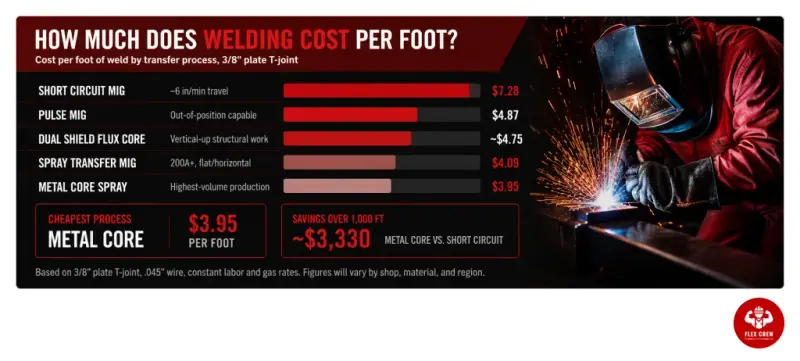
Scaled to 1,000 feet of weld, a realistic daily output for a production shop, the gap between short circuit and metal core processes works out to roughly $3,300 per day. That's not a rounding error. It's the difference between a shop running lean and one quietly losing money on every job.
If your business is welding any real volume, the question isn't just "how much does welding cost per hour", it's which process gets the job done at the lowest cost per foot without sacrificing quality.
What Affects How Much Welding Costs?
A handful of variables explain most of the price variation you'll see between quotes.
Material type changes the baseline. Standard carbon steel is the most affordable metal to weld. Aluminum and stainless steel typically cost 1.5 to 2 times more, since they demand different wire, more careful heat control, and often a slower pace to avoid warping or burn-through.
Project complexity adds time even on jobs that sound simple. A four-cut, four-weld repair might look like a 30-minute job on paper, but careful heat management around sensitive components, fit-up, and inspection routinely push it closer to an hour of total shop time.
Consumables and overhead are baked into every invoice. Shielding gas, wire, and abrasives are recurring costs a shop absorbs weekly, and they show up in the final hourly rate whether they're itemized or not.
Location and labor market play a real role too. Welding costs tend to run higher in metro labor markets across Texas, Florida, and Georgia, where demand for skilled tradespeople is strong and competition for qualified welders pushes wages, and therefore rates, upward.
Operator factor is the variable customers rarely consider. A welder isn't striking an arc for a full eight-hour shift. Between setup, repositioning, grinding, and inspection, actual arc-on time often falls between 30% and 50% of a shift. That reality is priced into hourly rates industry-wide.
How Much Does Welding Cost for Common Jobs?
To make this concrete, here's what typical jobs run based on aggregated industry pricing:
These ranges hold up well against real-world cases. A four-cut, four-weld exhaust repair quoted around $300 sits squarely in line with national averages once labor, equipment overhead, and skill are factored in, not an inflated number, even though it can look that way on the surface.
How Much Does Welding Cost Tie Into What Welders Earn?
Welding cost and welder pay are two sides of the same coin. According to the U.S. Bureau of Labor Statistics' most recently published wage data (May 2024), the median annual wage for welders, cutters, solderers, and brazers was $51,000, or roughly $24.52 per hour. The lowest 10% earned under $38,130, while the top 10% earned more than $75,850.
Pay varies sharply by specialty and industry. The BLS notes that welders in the air transportation and aerospace sector post some of the highest median wages in the field, often exceeding $100,000 annually, reflecting the precision and certification required for that work. Pipeline and structural welders in energy-heavy states like Texas frequently land in the $70,000–$100,000+ range once experience and certifications stack up.
This wage data matters for buyers, too. Skilled welder compensation is a direct input into the hourly rate you're quoted. A shop paying competitive wages to retain certified talent is going to charge accordingly, and that's usually the shop producing more reliable work.
For employers, this is where staffing strategy and welding costs intersect directly. Finding and retaining welders with the right certifications, TIG, pipe, multi-process in competitive labor markets like Houston, Tampa, or Atlanta is a real operational challenge.
FlexCrew works with businesses across these regions to fill exactly that gap, supplying vetted welders and skilled tradespeople for both short-term project needs and longer-term crew building.
For welders themselves, standing out in a competitive labor market often comes down to how clearly your certifications and process experience are presented to employers. FlexCrew's AI-powered resume builder is built for exactly that, helping tradespeople translate hands-on skill and credentials into a resume that actually gets seen by the right hiring managers.
How to Evaluate Whether a Welding Quote Is Fair
A few direct questions cut through most pricing confusion. Ask whether the rate is hourly or flat-fee, and whether materials are itemized separately or bundled in. Ask what's included in setup and cleanup time. And ask what process the welder plans to use, especially on larger or repeat-volume work, since process choice can be the single biggest lever on cost per foot.
A shop quoting an hour minimum on a 40-minute job isn't necessarily overcharging, that's standard practice across the trade and reflects real overhead. The bigger question is whether the weld quality and the welder's credentials match the price being asked. On structural or safety-critical work, the cheapest quote is rarely the one worth taking.
Final Thoughts: Know the Numbers Before You Hire
So, how much does welding cost? The honest range runs from $50 for a minor repair up to several thousand dollars for complex fabrication, with most standard jobs landing between $305 and $480. Hourly rates of $100–$150 are typical, process choice can shift cost per foot by 80% or more, and labor market conditions in states like Texas, Florida, and Georgia push that further in either direction.
For businesses managing welding costs across multiple projects, the real lever isn't just negotiating a lower rate, it's having reliable access to skilled welders who get the job done right the first time.
FlexCrew connects companies across Texas, Florida, Georgia, and other active markets with vetted welding professionals and skilled tradespeople ready to work. And for welders looking for their next opportunity, our platform, including the AI-powered resume builder, helps put your skills in front of the right employers.
Explore current welding roles and hiring solutions atFlexCrew.