
A damp basement rarely announces itself all at once. It starts as a musty smell, a faint water stain, or a patch of drywall that feels soft to the touch. By the time most homeowners notice the problem, water has already been working against the foundation for months, sometimes years. That's exactly why so many people start searching for how much does waterproofing cost the moment they spot the first warning sign.
FlexCrew, a staffing partner serving construction and skilled trades employers across Texas, Florida, Georgia, and other growing markets, put this guide together after seeing firsthand how waterproofing demand spikes every spring and hurricane season. Contractors need reliable crews fast, and homeowners need real numbers, not vague ranges.
Here's what waterproofing actually costs in 2026, and why the price swings so widely from one home to the next.
Key Takeaways
Most basement waterproofing jobs in 2026 fall between $3,000 and $15,000, with major exterior excavation projects reaching $25,000 to $50,000.
According to FEMA, just one inch of standing water inside a home can cause up to $25,000 in damage, which is why early waterproofing often costs far less than delayed repair.
Interior drainage systems are typically cheaper than exterior waterproofing because they avoid excavation entirely.
Soil type, water source, basement size, and finished versus unfinished space all move the final price.
Getting several quotes and comparing scope, not just totals, is the single best way to avoid overpaying.
How Much Does Waterproofing Cost? The 2026 Numbers
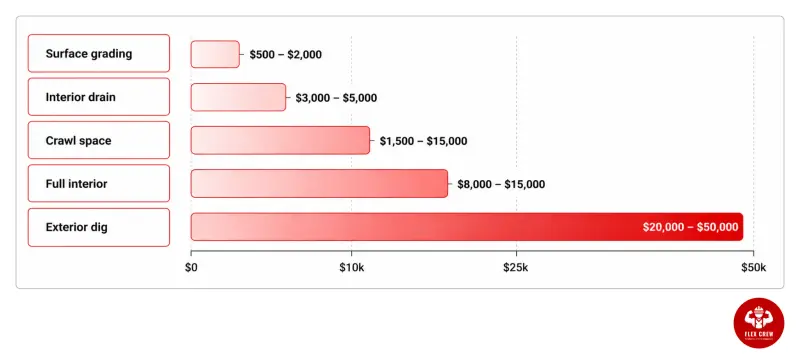
For a straightforward interior job on a small to mid-size basement, expect $3,000 to $5,000. That range typically covers a basic interior drain and sump pump, which is often enough if the problem is caught early.
Once you scale up to a full perimeter drain system with wall sheeting and a battery-backup sump pump, costs climb to $8,000 to $15,000. These jobs are common in states with heavy clay soil, where groundwater builds pressure against foundation walls year-round.
Exterior waterproofing sits in its own category. Because it requires excavating the entire foundation perimeter and applying a waterproof membrane, it regularly costs between $20,000 and $50,000. Some homeowners with deep basements or difficult site access have reported quotes well above that.
Waterproofing Cost by Project Type (Quick Reference)
How Much Does It Cost to Waterproof a Basement by Size
Square footage matters, but contractors usually price by linear foot of wall rather than total floor area, since that determines how much drain tile or membrane is needed.
A 1,000 sq ft basement typically runs $5,000 to $9,000 for interior work. A 1,500 sq ft basement, common across suburban homes in Georgia and the Carolinas, usually falls between $8,000 and $15,000. Larger basements needing two sump pumps on opposite ends of the house can exceed $20,000 before any exterior work is even considered.
If the basement is already finished, add more to the total. Sheetrock, studs, and flooring often need to come out before crews can see the foundation clearly. That teardown and later refinishing can add another $5,000 to $10,000.
Cost Snapshot by Basement Size
Interior vs. Exterior: Why the Price Gap Is So Wide
Interior waterproofing manages water once it's already near the foundation. Crews install a drain along the interior perimeter, connect it to a sump pump, and sometimes add wall sheeting to redirect moisture. All of this happens inside the home, so there's no excavation and far less labor involved.
Exterior waterproofing stops water before it ever reaches the wall. That means digging around the entire foundation, applying a waterproof membrane, and often replacing the foundation drain. It's the more permanent fix, but the labor and equipment involved explain why exterior costs run two to four times higher than interior solutions.
A licensed foundation contractor explained this distinction plainly in an industry training video, noting that interior waterproofing is almost always cheaper simply because exterior work demands so much more physical labor. That single factor drives most of the price variation homeowners encounter when comparing bids.
Why Waiting Costs More Than Waterproofing Does
It's tempting to put off a waterproofing project, especially when the basement isn't actively flooding. But the math rarely favors waiting. According to FEMA, just one inch of standing water inside an average home can cause up to $25,000 in damage once flooring, drywall, and belongings are factored in. The average flood-related insurance claim paid through the National Flood Insurance Program has topped $66,000 in recent years.
The EPA's guidance on mold and moisture control is just as direct: water damage needs to be dried within 24 to 48 hours to prevent mold growth, and the only lasting fix is controlling the moisture source itself. A $5,000 to $15,000 waterproofing investment looks a lot more reasonable next to those numbers.
What Actually Moves the Price Up or Down
Soil composition matters more than most homeowners expect. Heavy clay soil holds water against the foundation longer, increasing hydrostatic pressure and often requiring a more robust system.
Water source changes the entire approach. Surface water from clogged gutters or poor grading might only need a $500 to $2,000 fix, like extended downspouts or regraded soil. Groundwater intrusion through the cold joint, where the wall meets the floor, usually calls for an interior drain system at minimum.
Basement size and linear footage of the wall directly scale labor and material costs. A basement with 180 linear feet of wall will always cost more to waterproof than one with 100 linear feet, even if the square footage looks similar on paper.
Redundancy and warranty length also affect price. Systems with triple-redundant pumps, battery backups, and lifetime warranties cost more upfront but reduce the risk of repeat expenses down the road.
How to Get a Fair Price Without Overpaying
Get at least three quotes before signing anything. It's common for bids on the same basement to differ by $10,000 or more, simply because contractors are proposing different scopes of work.
Ask each contractor whether they're recommending interior or exterior work, and why. A contractor who can explain the reasoning is generally more trustworthy than one who hands over a number with no context.
Confirm exactly what's included. Some quotes cover only the waterproofing system. Others bundle in drywall removal, refinishing, or mold remediation. Comparing quotes without matching scope is comparing two entirely different projects.
Watch for pressure tactics. Any contractor offering a "today only" discount on a five-figure project is using a sales technique, not a pricing strategy. Reputable waterproofing companies stand behind their numbers regardless of when the contract gets signed.
Why the Right Crew Changes the Outcome
Pricing is only half the equation. Execution matters just as much, and execution depends entirely on who's doing the work. This is where staffing quality becomes a hidden cost factor most homeowners never think about, but contractors think about constantly.
Waterproofing companies across Texas, Florida, and Georgia rely on skilled trades like plumbing, carpentry, and general construction labor to keep projects on schedule. When a crew is short-staffed, jobs stretch longer and costs creep up.
FlexCrew works directly with contractors to fill these gaps quickly, connecting construction staffing and light industrial talent to waterproofing crews that need reliable hands on tight timelines.
For businesses bidding waterproofing jobs, a dependable contractor hiring pipeline means fewer delays and more accurate quotes for customers. For workers in the trades, especially those with plumbing, HVAC, or general labor experience, FlexCrew's job placement support connects them to active waterproofing and foundation projects without the usual application runaround. Workers building out their trade resumes can also use FlexCrew's AI-driven resume builder to highlight the hands-on experience waterproofing employers actually look for.
Realistic Timeframes to Expect
Interior waterproofing jobs typically take two to four days from start to finish. Exterior excavation projects run longer, often five to ten days depending on weather, soil conditions, and the length of the foundation perimeter.
Crawl space encapsulation usually wraps up in one to three days for a standard-size home. Add extra time if mold remediation or structural repairs surface once crews open up the space, which happens more often than most homeowners expect.
Final Thoughts on Waterproofing Costs in 2026
So, how much does waterproofing cost this year? For most homeowners, budgeting $5,000 to $15,000 for interior work, or $20,000 to $50,000 for full exterior excavation, is a realistic starting point. The exact number depends on soil conditions, basement size, and how far the water problem has already progressed.
Getting multiple quotes, understanding the difference between interior and exterior methods, and asking the right questions before signing protects both your budget and your foundation. And if you're a contractor trying to keep waterproofing projects on schedule, or a tradesperson looking for your next job in this field, FlexCrew is built to connect the right people to the right project, fast. Visit FlexCrew to see how staffing support can keep your next waterproofing job on time and on budget.