
Most contractors and homeowners get burned the same way, they start a drywall project with a rough number in their head, get quotes back that are 40% higher, and scramble to figure out why. The gap usually comes down to three things: regional labor rates, finish level, and the kind of job complexity that never shows up in an online estimate. That's what this guide addresses directly.
How much do drywallers charge in 2026 varies more than most people expect. According to the U.S. Bureau of Labor Statistics wage data and construction cost benchmarks updated through May 2026, the national average cost to install drywall currently sits at $2.26 to $2.69 per square foot. That figure covers standard residential hanging and finishing. Data puts the broader range at $1.50 to $3.00 per square foot for materials and labor combined, with labor alone accounting for roughly 70% of the total project cost.
For construction businesses across Texas, Florida, and Georgia managing multiple jobs at once, those labor costs only hold if you have the right workers on-site at the right time. That's where FlexCrew comes in as a skilled trades staffing platform that connects contractors with vetted drywall hangers and finishers across high-demand construction markets.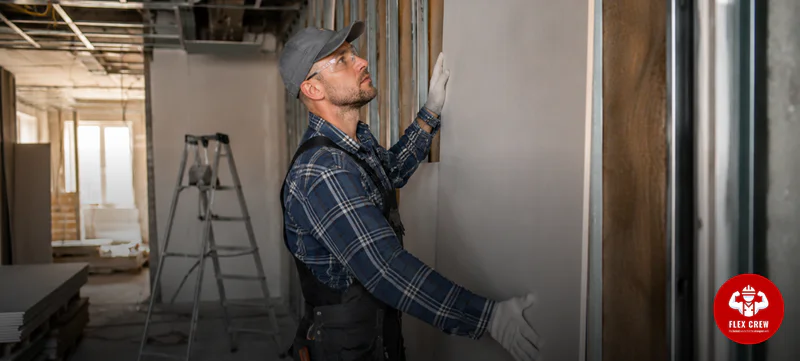
Key Takeaways
National average cost to install drywall in 2026: $2.26 – $2.69 per sq ft
Labor accounts for approximately 70% of total drywall project cost, regional wage rates are the single biggest pricing variable.
Full hang-and-finish labor runs $25 – $55 per sheet depending on finish level and market location.
Drywall repair costs nationally average $295 – $925 per repair; small holes start at $100, water-damaged ceilings can reach $2,500.
A complete drywall job on a 1,500 sq. ft. house runs $6,750 – $15,750 combining materials and labor in 2026.
Ceiling drywall consistently costs 25–50% more than wall work at the same finish level.
Skilled labor costs in Texas and Florida have risen 22% over recent years and continue climbing at 2.5–6% annually in 2026.
In high-demand markets, Dallas, Houston, Miami, Atlanta, crew availability often matters more than the per-sheet rate itself.
How Much Do Drywallers Charge Per Square Foot in 2026?
The per-square-foot model is the most common way drywall work gets priced on residential and light commercial jobs. Here's how the numbers break down by scope of work in 2026.
According to BLS-sourced construction wage data via Homewyse, the national midpoint for a complete hang-and-finish job lands around $2.26 to $2.69 per square foot for standard residential work. Level 5 finishes, the smooth, skim-coated walls common in modern builds and high-end renovations, add another $0.50 to $1.00 per square foot beyond that baseline.
One practical number to keep in mind: ceiling drywall consistently runs 20 to 40% more than wall work at the same finish level. Overhead installation is slower, compound sags against gravity, and most crews need lifts or scaffolding for anything above nine feet.
Labor Cost to Hang Drywall Per Sheet
For smaller jobs and single-trade bids, contractors often quote by the sheet rather than by the square foot. A standard 4×8 sheet covers 32 square feet. A 4×12 sheet, common for nine-foot ceilings to eliminate horizontal seams, covers 48 square feet.
A real-world example from a documented new construction project on a 3,000 sq. ft. house: 256 total sheets were hung and finished at $25 per sheet in a rural market, putting total labor at $6,400. Materials, including mud, tape, corner bead, screws, and specialty boards for bathrooms and the garage, came to $7,150. That near-even split between material and labor is a well-recognized pattern in full-house drywall work.
In metro markets, that same $25-per-sheet labor rate climbs quickly. Reddit threads from contractors in California and the Seattle area describe small patch jobs alone running $800 to $1,500, before materials, simply because of minimum service call fees and higher hourly rates in those regions.
Regional Pricing: Texas, Florida, and Georgia
Geography is the single biggest variable in how much do drywallers charge. Here's where the active construction markets FlexCrew serves stand in 2026.
According to FlexCrew's own drywall installation cost guide, which draws on regional labor data for Texas, Florida, and Georgia, skilled labor costs in construction-heavy states have risen 22% over the past several years, with annual wage growth of 2.5–6% projected to continue through 2026.
Florida's labor costs are climbing faster than Texas, with some coastal markets approaching California-tier pricing on specialized jobs. Georgia's Atlanta metro has seen sustained commercial and multi-family construction growth, keeping demand for experienced finishers consistently ahead of available supply.
For contractors managing multiple active projects in any of these markets, workforce availability is often the real cost driver, not the per-sheet rate itself. A job that sits idle for two days waiting for a crew to show up costs far more than a slightly higher labor rate on a crew that actually delivers.
How Much Does Drywall Repair Cost?
Repair pricing operates by its own logic, and it confuses a lot of homeowners. The reason small jobs feel expensive is real: a drywaller has to travel, set up, apply multiple coats with full drying time between each one, and return to sand. All of that time gets priced in regardless of how small the patch is.
According to Homewyse's May 2026 data, sourced from BLS wage statistics and current materials pricing, the national average cost to repair drywall starts at $295 to $925 per repair. Prices climbed 8–14% between 2023 and 2026 as both gypsum sheet costs and specialty finisher wages tracked construction-wide inflation.
How much does drywall repair cost by damage size:
Small hole (under 4 inches; doorknob, anchor, nail): $100 to $250 professionally. Minimum service call fees in most metros now run $125 to $200 just for the truck roll, which is why a single nail hole repair rarely drops below $150.
Medium patch (4 to 12 inches; fist-size, switch box cutout): $200 to $500. These require a cut patch piece, mesh tape, and two to three full mud coats, more than a simple fill.
Large section repair (over 12 inches; water damage, full panel): $400 to $1,000 flat, or $50 to $75 per square foot where a full drywall section must be removed and replaced.
Water-damaged ceiling: Homewyse data puts water-damaged ceiling repair at $311 to $472 per patch. A full water-damage job, patching, checking for mold, and inspecting insulation, runs $500 to $2,500 depending on scope.
How much does it cost to fix drywall on a ceiling? Expect to add a 30 to 50% premium over comparable wall repair rates. Overhead work is slower, compound fights gravity, and ceiling repairs frequently uncover secondary damage that has to be addressed before the patch holds.
What Drives the Price Higher (And What You Can Control)
Understanding the cost factors that contractors are actually pricing for puts you in a stronger position whether you're submitting a bid or evaluating one.
Finish level is the most underestimated driver. The difference between a Level 3 finish (appropriate for textured walls) and a Level 5 finish (required for glossy paint and critical lighting) can add $0.50 to $1.00 per square foot to the labor cost alone. A full house at Level 5 adds up fast.
Ceiling height changes everything above nine feet. Standard eight-foot ceilings set the baseline. For nine-foot work, contractors typically shift to 54-inch wide sheets to reduce horizontal seams, and those take longer to handle and hang. Anything above nine feet introduces lifts or scaffolding, adding both time and equipment cost.
Specialty drywall types carry a direct materials premium. Moisture-resistant green board costs 25 to 30% more per sheet than standard half-inch. Mold-resistant purple boards run 35 to 45% more. Type X fire-rated 5/8-inch drywall, required on garage ceilings and shared walls in multi-family builds per updated 2026 code in many states, typically runs $13 to $17 per sheet.
Site prep and disposal is where a lot of job budgets silently hemorrhage. Professional drywall contractors point out that entering a finished space means protecting floors, moving furniture, controlling dust, and disposing of waste material, none of which shows up in a square-footage quote unless it's explicitly included. Drywall disposal adds two to three hours and $20 to $50 to any repair job that involves removing old boards.
How Much to Drywall a 1,500 Sq. Ft. House
For a full new-build or gut renovation, the per-room numbers stop making sense and the whole-house calculation takes over. A 1,500 sq. ft. home with standard nine-foot ceilings typically requires 125 to 160 sheets of drywall across walls and ceilings, accounting for 10 to 15% cutting waste.
Working from current 2026 data, a complete hang-and-finish job on a house this size realistically looks like this:
Materials (sheets, mud, tape, corner bead, screws, specialty boards for bathrooms and garage): $3,500 to $5,500
Labor (hanging, taping, three-coat finish, sanding, ready for paint): $3,000 to $7,500 depending on region and finish level
Total combined cost: $7,000 to $13,000 for a standard residential project
In Texas and rural Georgia, the lower half of that range is achievable with competitive local crews. In Florida coastal markets or Atlanta metro, budget toward the upper half. This also assumes standard 8- to 9-foot ceilings, square rooms, and no specialty work like cathedral ceilings or curved walls, each of which adds 25 to 100% to the labor time for the affected areas.
How Much Do Drywallers Charge Per Hour?
Some contractors price by the hour for repair work and small jobs where the scope is hard to pin down before showing up. Handymen and general laborers doing basic drywall patching charge $60 to $85 per hour in 2026. Specialty drywall contractors with finishing expertise charge $60 to $100 per hour, with some high-cost markets pushing above that range.
The honest takeaway from contractors and trade professionals who discuss pricing openly: hourly rates favor the contractor when the job turns out to be harder than expected, and they favor the homeowner when it goes smoothly. For anything larger than a single-room repair, most experienced drywallers prefer per-sheet or per-square-foot pricing because it rewards efficient crews and makes budgeting predictable for everyone involved.
Finding Skilled Drywall Workers in 2026
Knowing the numbers is only half the challenge. The other half is finding workers who actually show up, do finish-quality work, and don't leave the job two-thirds done. That problem is acute across every major construction market right now. BLS data shows construction wages increased over 4.5% year-over-year, and skilled labor shortages continue to tighten the workforce in states like Texas, Florida, and Georgia, exactly the markets where construction volume is highest.
FlexCrew operates directly in these markets, connecting contractors and construction businesses with vetted skilled tradespeople including drywall hangers and finishers. The staffing model is built for the way construction projects actually work, short-term crew needs, fast turnaround, and workers who show up ready for the job at hand. For workers on the other side of that equation, FlexCrew's AI resume builder helps tradespeople present their drywall experience clearly, making it easier to get in front of contractors who are actively hiring.
How Much Do Drywallers Charge: Final Summary
The honest answer is that the number you get depends on where your job is, what the finish level requires, and whether you're pricing a full installation or a repair. Here's the practical summary of where 2026 pricing lands.
For most residential installations, $2.26 to $2.69 per square foot is the nationally benchmarked midpoint per current Homewyse/BLS data. Full-house projects in active construction states run $7,000 to $13,000 for a 1,500 sq. ft. home. Repairs range from $100 for a small patch to $2,500+ for water-damaged sections. And in high-demand markets like Houston, Miami, and Atlanta, labor availability matters just as much as labor rates.
Get at least three quotes. Make sure each one specifies the finish level, whether materials are included, and how disposal and site prep are handled. And if you're a contractor who needs reliable drywall crews without the hiring delays, visit flexcrewusa.com to see how FlexCrew staffs skilled trades across your market.