
Every construction project, renovation, and seasonal yard job ends the same way: with a mess that needs a professional crew to clear it. That final step cleanup is one of the most mispriced services in the trades. Property owners underestimate it. First-time contractors overpay for it. And workers who do it daily often don't charge enough to make it sustainable.
How much do cleanup crews charge is one of the most searched questions among homeowners, general contractors, and property managers across Texas, Florida, Georgia, and the rest of the South. The short answer: it depends on the type of cleanup. The detailed answer, with real numbers, real context, and zero filler, is what this guide is for.
Key Takeaways
The U.S. cleaning industry employs over 2.4 million janitors and building cleaners with a median wage of $17.27/hour.
Post-construction cleanup costs between $0.15 and $0.80 per square foot nationally, with most residential projects landing between $500 and $2,500.
Routine residential cleaning runs $40–$55 per hour, with a typical visit costing $174–$256 nationally.
Fall yard cleanup starts around $250–$300 base, plus $60 per cubic yard of debris removed.
Flat-rate pricing beats hourly for post-construction work, every experienced cleaner in the industry will tell you that.
Labor accounts for 55–80% of every cleanup job's total cost. That's why location, team size, and crew experience shift prices more than any other factor.
How Much Do Cleanup Crews Charge for Routine Residential Cleaning?
Standard house cleaning, vacuuming, mopping, bathroom scrubbing, kitchen surfaces is where most people first encounter professional cleanup pricing. According to aggregated 2026 data from leading home service platforms and U.S. Bureau of Labor Statistics wage reports, professional cleaning crews charge $40 to $55 per hour on average nationally.
Most homeowners pay $174 to $256 for a typical visit, though the range runs from $131 on the low end to $339 on the high end for larger homes or more intensive cleans. A first-time or one-time clean typically costs 20–30% more than recurring visits. This is standard across the industry crews are starting fresh, and there's no baseline maintenance to fall back on.
Square-foot pricing is also common, particularly for larger properties. A 2,000-square-foot home typically runs:
Routine Residential Cleanup: What Crews Charge by Service Type
Costs vary by state. In markets like Houston, Dallas, Atlanta, and Tampa, rates track close to national averages, but high-density metros on the coasts run 30–50% higher due to wage floors, insurance premiums, and fuel costs.
Monthly recurring cleanup costs, two standard visits per month, typically land between $350 and $500 depending on home size and service scope.
How Much Do Cleanup Crews Charge for Post-Construction Jobs?
Post-construction cleanup is a different category entirely. After a renovation, new build, or commercial fit-out, crews deal with layers of drywall dust settled into every surface, paint residue on windows, adhesive on floors, caulk smears, sticker removal, sawdust in HVAC returns, and debris throughout. It requires specialized products, physical endurance, and often multiple phases.
The industry-standard pricing model for post-construction cleanup is per square foot, not hourly, and for good reason. Experienced operators on Reddit's r/housekeeping community and professional cleaning forums consistently make the same point: if you price this work hourly, you either underbid or watch your margin evaporate when a job runs longer than expected.
Per-square-foot rate: $0.15 to $0.80 nationally, with most residential projects averaging $0.25 to $0.50 per square foot for final clean. Commercial work, office suites, retail buildouts, industrial facilities typically run higher at $0.30 to $0.75 per square foot due to finish standards and ceiling heights.
What does that look like in real numbers?
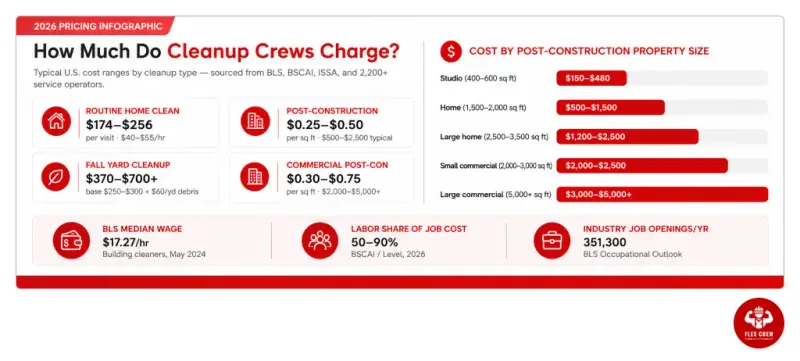
Hourly rates for post-construction work, when charged that way, run $50 to $80 per hour per worker. When you're quoted $25 per hour for post-construction cleanup, it's worth asking whether the crew has the right tools, enough workers, and experience with paint removal, adhesive scraping, and HVAC vent clearing. That's not skepticism, it's math.
The U.S. Bureau of Labor Statistics reports a median wage of $17.27 per hour for building cleaners (May 2024), and professional cleanup crews carry overhead far above that base wage: insurance, equipment, disposal fees, and transportation.
Window cleaning after construction is typically a separate line item: $5 to $15 per window, including sticker removal, track cleaning, sill and frame work, not just wiping glass.
How Much Do Cleanup Crews Charge for Fall and Seasonal Yard Work?
Seasonal outdoor cleanup, particularly fall leaf removal, follows a layered pricing structure that surprises a lot of property owners who are only expecting one number.
The base charge for a professional fall cleanup in most U.S. markets starts around $250 to $300. That base covers the crew showing up, blowing out garden beds, clearing debris from turf, and tidying the yard. What it doesn't include is debris removal, and that's where pricing climbs.
Most professional landscaping crews add $60 per cubic yard of leaves and organic material hauled off the property. Two yards adds $120 to the total. Three yards adds $180. Factor in the base price:
2 yards removed → $250 + $120 = $370 total
3 yards removed → $250 + $180 = $430 total
4 yards removed → $250 + $240 = $490 total
Established crews in active markets like Houston, Tampa, and Atlanta increasingly operate with job minimums of $500 to $700. These minimums exist because any professional cleanup job carries a baseline cost: truck, fuel, equipment, labor, and disposal.
Crews at that minimum often fill the gap with legitimate add-ons, gutter cleaning ($99 to $299 depending on the house), ornamental tree trimming ($85 to $150 per small tree), final shrub trimming, and perennial cutback. These are real services that add real value, and doing them during the same visit is more efficient and less expensive than scheduling separate trips.
The most efficient professional fall cleanup team runs four workers: two on backpack blowers, two on riding mowers with bagging systems. A team that size can clear a mid-size residential property in a fraction of the time a two-person crew would take, and efficiency is what separates profitable cleanup operations from ones that stay broke.
What Actually Drives Cleanup Crew Pricing
Understanding the line items behind a cleanup quote protects you from surprises. The same job can cost $300 or $800 depending on factors most property owners don't think to ask about.
Labor is the dominant cost: According to BSCAI and Level's 2026 benchmarks from 2,200+ service businesses, labor accounts for 50 to 90% of every cleanup job's total cost. That's why wages, team size, and local market rates shift your quote more than anything else. The cleaning industry also runs approximately 200% annual turnover (BSCAI / CleanLink), which means training and workforce stability cost operators real money, and reliable crews price accordingly.
Location moves pricing significantly: A crew operating in Dallas or Atlanta bids differently than one in a rural county two hours outside either city. Urban markets carry higher wage floors, fuel costs, insurance premiums, and disposal fees. BLS data shows metropolitan wages for building cleaners run 20–35% higher than national medians in high-cost cities. For Texas, Florida, and Georgia specifically, expect market-rate pricing that tracks close to national averages but climbs in metros like Houston, Miami, and Atlanta.
Scope of mess is everything: A crew that walks a job site before quoting is doing it right. Light leaf cleanup is not the same as post-renovation debris. Drywall dust is not the same as sawdust. Paint overspray on windows is not the same as smudged glass. Experienced operators look before they quote, and if someone gives you a number over the phone without asking a single question about the job, that's worth noticing.
Flat-rate vs. hourly matters: For recurring residential cleaning, hourly works fine, the scope is predictable. For post-construction work, flat-rate per square foot protects both the client and the crew. Experienced operators in the field are consistent on this point, and the logic holds: an unknown scope deserves a negotiated flat number, not an open-ended hourly meter.
Add-ons and job minimums are standard, not a trick: Every professional cleanup crew has a minimum cost to show up, equipment, fuel, insurance, travel. Minimums of $99 to $300 are standard for even small jobs. Crews that hit those minimums with legitimate services, gutter cleaning while the ladder is already out, shrub trimming while the truck is parked, aren't padding invoices. They're running an efficient operation.
Why Contractors and Property Managers in Texas, Florida, and Georgia Should Think About Cleanup Differently
For general contractors finishing a new build in Houston, property managers turning renovated units in Atlanta, or construction companies wrapping commercial fit-outs in Tampa, cleanup is rarely a fixed-team function. Project volume varies. Timelines shift. The labor needed for a 3,000-square-foot post-construction clean is not the same crew you need two weeks later for a 600-square-foot apartment turnover.
This is exactly the kind of staffing challenge FlexCrew was built for. FlexCrew connects contractors and construction companies across Texas, Florida, Georgia, and beyond with skilled workers, general cleanup labor, light industrial workers, and skilled trades including carpentry, HVAC, electrical, and plumbing, deployed on a project basis. You get the right number of workers for the right job, without carrying full-time headcount through slow periods.
For workers entering the cleanup and construction staffing space, FlexCrew's AI-driven resume builder helps translate hands-on experience into a resume that actually gets calls back, even without formal credentials or a long employment history.
The U.S. Bureau of Labor Statistics projects approximately 351,300 job openings per year for janitors and building cleaners through 2034. Most of those openings come from turnover, the industry's 200% annual rate means crews are constantly being rebuilt. That's both a challenge for operators and an opportunity for workers who show up reliably and do the work right.
How Much Do Cleanup Crews Charge: The Full Picture at a Glance
Here's where every pricing range covered in this guide lands, organized by job type:
The Bottom Line on What Cleanup Crews Charge
The real answer to how much do cleanup crews charge is not a single number, it's a framework. The type of job determines the pricing model. The scope of mess determines the labor hours. The location determines the wage floor. And the professionalism of the crew determines whether you get one honest quote or three callbacks trying to explain unexpected costs.
What the numbers in this guide have in common: they reflect what it actually costs to do the work right. Cleanup is physically demanding, time-sensitive, and detail-heavy. Whether it's a post-construction scrub of a newly built home in Dallas, a fall leaf cleanup in suburban Atlanta, or a routine turnover clean for a rental property in Tampa, getting it done correctly takes the right crew, the right equipment, and pricing that reflects real labor costs.
If you're a contractor or property manager who needs that crew placed fast and reliably, or a skilled worker ready to get on more job sites across Texas, Florida, or Georgia, visit FlexCrew.