
Skilled carpenters are in higher demand than ever and yet most people getting quotes have no idea whether the number they're looking at is fair, inflated, or a red flag. That gap in information costs homeowners money and costs contractors good hiring decisions every single day.
According to the U.S. Bureau of Labor Statistics (BLS), the median annual wage for carpenters reached $59,310 as of May 2024, but that's what employers pay workers on a W-2. When you're hiring a carpenter directly for a project, you're looking at a very different number. Understanding exactly how much carpenters charge per hour, and what drives that rate is what this guide is built to answer.
At FlexCrew, we place skilled carpenters with contractors and construction businesses across Texas, Florida, Georgia, and other high-growth markets every day. We see the real numbers, not the averages pulled from surveys, but the rates carpenters command based on skill, location, and the type of work on the table.
Key Takeaways
The BLS median carpenter wage is $28.51/hour as an employee, but homeowners hiring direct pay significantly more once overhead is factored in.
BLS projects 4.5% carpenter job growth from 2024 to 2034, outpacing the national average of 3.1%.
Specialty determines rate more than anything else. A master finish carpenter and a framing carpenter can differ by $60–$80/hour on the same job site.
Texas carpenters earn a median of $58,632/year; Georgia $57,977/year; Florida $56,877/year, all slightly below the national median, though Sun Belt construction demand is pushing wages up fast.
Subcontractors charge more per hour than employees, but that rate covers taxes, insurance, and overhead the employer would otherwise carry.
Hourly is not always the right pricing model. For complex projects, experienced carpenters often quote by the day or by the job.
What the Data Actually Says About Carpenter Hourly Rates
Here is where most guides get it wrong. They blend two very different numbers, what a carpenter earns as an employee versus what a homeowner or contractor pays when hiring one, and the result is confusion on both sides.
The BLS reports a median annual carpenter wage of $59,310 ($28.51/hour) based on May 2024 data. That figure is what an employer pays a W-2 carpenter before the employer adds payroll taxes, workers' compensation insurance, benefits, and overhead, which typically adds 35–40% on top of base wages. So a $28/hour carpenter actually costs closer to $38–$40/hour in total employer burden.
When you hire a carpenter for a project, whether that's a homeowner booking a trim job or a contractor bringing on a subcontractor, you're paying a market rate that includes all of that loaded cost. That's why real-world project rates for journeyman-level carpenters run $50–$80/hour, and finish or master carpenters can exceed $100/hour.
Construction Coverage's analysis of BLS data puts it clearly: carpenters earn roughly 20% more than the U.S. median for all full-time workers, which currently sits at $49,500. That premium reflects both the physical demand and the technical skill ceiling of the trade.
Carpenter Hourly Rates by Skill Level (2026)
The single biggest driver of how much carpenters charge per hour is the type of work they do and how much experience they carry into it. Here is how rates break down across the skill spectrum.
Sources: U.S. Bureau of Labor Statistics OEWS May 2024; Salary.com national benchmark data June 2026
The gap between the employed rate and the project rate is not markup, it's overhead. When a carpenter works as a subcontractor or independent tradesperson, their hourly rate covers their own taxes, tool maintenance, business insurance, and downtime between jobs. A subcontractor at $65/hour and a W-2 carpenter at $38/hour represent very similar true costs when the full employer burden is applied to the employee side.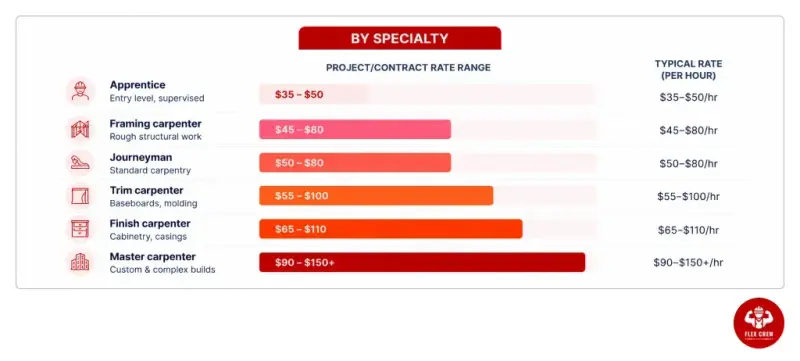
How Much Do Carpenters Charge Per Hour by State? (FlexCrew Markets)
Location is the second most powerful variable after skill level. Salary.com's June 2026 benchmark data shows clear variation across FlexCrew's primary markets.
Source: Salary.com state benchmark data, June 2026; BLS OEWS May 2024
Texas, Florida, and Georgia all sit just under the national median in base wages, but wage data alone doesn't capture the full picture. Both Texas and Florida have no state income tax, which meaningfully increases take-home pay even when gross wages appear lower than coastal markets.
And with the Sun Belt construction boom continuing to outpace housing supply, competitive pressure on carpenter wages in cities like Houston, Atlanta, and Tampa has been driving rates upward faster than the national average over the past 24 months.
Finish Carpenters vs. Framing Carpenters: Who Charges More and Why
This is one of the most practical questions contractors and homeowners ask, and the answer directly shapes your project budget.
Framing carpenters handle structural work. They move fast, work with large materials like dimensional lumber, and their work gets covered by drywall. Speed and output volume matter more than surface precision. In markets like central Texas or South Florida, framing rates typically land between $45 and $80/hour for direct hire, with experienced subcontractors working production residential builds sometimes pricing by the square foot instead.
Finish carpenters arrive after the walls are closed in. Every cut is visible. Every joint gets examined. A poorly cut piece of crown molding or an out-of-square cabinet door doesn't hide, it's there every time someone walks into that room. That precision premium is real, and it's built into finish carpenter rates, which typically range from $65 to $110/hour for project work, with master-level craftspeople doing true custom work exceeding $150/hour in high-cost metros.
The key question isn't which type of carpenter costs more, it's matching the right skill level to the task. Hiring a finish carpenter to do rough framing is wasteful. Asking a framing crew to handle cabinetry installation is a risk. Getting this right from the start is one of the practical advantages of working with a construction staffing firm that understands the difference.
What Side-Work Carpenters Should Actually Charge Per Hour
Reddit's carpentry forums and Quora threads are full of tradespeople asking the same question: I make $27–$35/hour at my day job, what should I charge for weekend work?
The answer from experienced tradespeople is consistent: charge significantly more than your employment rate. When you do side work, you are covering your own liability exposure, using your personal tools, burning your own time, and handling your own taxes. The math generally works out to a minimum of 1.5x to 2x your employment rate.
A carpenter earning $35/hour employed should be pricing side work at $50 to $70/hour minimum. Many experienced tradespeople also set a call-out minimum, commonly $100 to $150, to cover travel time and set up for small jobs. That is not overpricing. It is basic business math.
One thread from Reddit's r/Carpentry put it directly: charging too little on side work doesn't just hurt your bank account, it trains clients to undervalue the trade, and it creates a race to the bottom that pulls rates down for everyone.
Subcontractor vs. Employee: The True Cost Comparison
This is a critical question for any contractor or construction business managing labor costs across a project.
On paper, a subcontractor at $65/hour looks expensive compared to a W-2 employee at $38/hour. In practice, the gap closes fast. When you account for the employer's full labor burden, FICA taxes, federal and state unemployment, workers' comp, general liability insurance, benefits, and HR overhead, a $38/hour employee typically costs $52–$56/hour in total.
The subcontractor at $65/hour is higher, but they arrive with their own tools, carry their own insurance, and don't appear on your payroll. For project-based work, seasonal surges, or specialty tasks that don't justify a full-time hire, the subcontractor model is often the more cost-effective choice, and it keeps your crew flexible.
For businesses in Texas, Georgia, and Florida that work across project types and need to scale carpenter labor up or down with demand, this flexibility is not a minor convenience. It directly affects project margin. FlexCrew's construction staffing model is built around exactly this reality, giving contractors access to pre-vetted, trade-ready carpenters without the overhead of traditional hiring, on timelines that match actual job schedules.
Factors That Push Carpenter Rates Higher (or Lower)
Beyond skill level and location, several variables consistently shift how much carpenters charge per hour in either direction.
Project complexity is often underestimated. A straightforward deck build or fence repair prices very differently from a custom built-in entertainment center or a stair railing with turned balusters. Complex work commands higher rates because it demands more precise skills, slower execution, and greater accountability for the finished product.
Union vs. non-union status creates a predictable gap. According to BLS data, union carpenters tend to earn 10–20% more than non-union workers in comparable markets. In addition to base wages, union carpenters often receive health insurance, pension contributions, and vacation pay, benefits that push total compensation well above the hourly rate alone.
Demand cycles matter more than most people plan for. In active construction markets like Houston or Atlanta, high demand for skilled carpenters has pushed project rates well above what the BLS wage data shows. When good carpenters are scarce, rates rise and qualified finish carpenters are scarce in virtually every major Sun Belt metro right now.
Specialization pays. Carpenters who have mastered a niche, custom cabinetry, timber framing, historic restoration, or commercial millwork, consistently command rates at the top end of their category. That specialization also makes them harder to find and replace, which gives them legitimate pricing leverage.
How to Hire the Right Carpenter Without Overpaying
Getting the rate right starts well before you ask for a quote. These are the steps that actually make a difference.
Define the project scope in writing before reaching out to anyone. Vague project descriptions produce vague (and often inflated) quotes. Know your square footage, material preferences, timeline, and whether you need rough work, finish work, or both.
Get at least three quotes. Rates for identical work in the same city can vary by 30–40%. Comparing quotes tells you where the market is and flags anyone pricing unreasonably in either direction.
Match the carpenter type to the task. A skilled framing carpenter is not the right hire for detailed trim work, and vice versa. Mismatched skill-to-task pairings cost money on both sides.
Verify insurance and licensing. For structural work on residential projects, most states require permits and licensed contractors. Unlicensed work creates liability and can create problems at resale. Ask to see a certificate of insurance before work begins.
Ask what the hourly rate includes. Does it cover cleanup? Material procurement? Travel time? Getting clear on what's in the rate prevents billing disputes at the end of a job.
For contractors managing multiple projects or needing to scale crews quickly, FlexCrew handles the sourcing, vetting, and placement, so the right carpenter shows up on day one rather than three weeks into a delay. For carpenters looking to land roles that reflect their actual experience level, FlexCrew's AI-powered resume builder helps tradespeople present their skills clearly, which directly affects the rates they're able to negotiate.
Final Word
So how much do carpenters charge per hour in 2026? The honest answer is a range, not a number. Employee wages run $20–$40/hour based on BLS data, with the national median at $28.51/hour. Project and contract rates run $45–$150/hour, depending on skill level, specialty, and where the work is happening.
In FlexCrew's core markets, Texas, Florida, and Georgia, competitive Sun Belt demand is pushing rates steadily upward, even as base wage data still trails coastal markets on paper. The carpenters earning top rates are the ones who've built real skill, maintained clean work histories, and put themselves in front of the right opportunities.
Whether you're a contractor trying to staff a job correctly or a carpenter ready to find work that pays what your skills are worth, FlexCrew is built for that match. Visit FlexCrew to get started.