
A project lands on Tuesday. The start date is two weeks out. You need six workers; two carpenters, a welder, three laborers. By Friday, you have one confirmed. That's the daily reality of hiring workers for short term construction in 2025, and the market conditions driving it are not improving on their own.
FlexCrew works specifically with contractors across Texas, Florida, Georgia, and the Southeast to close these gaps fast, with vetted trade workers who show up ready.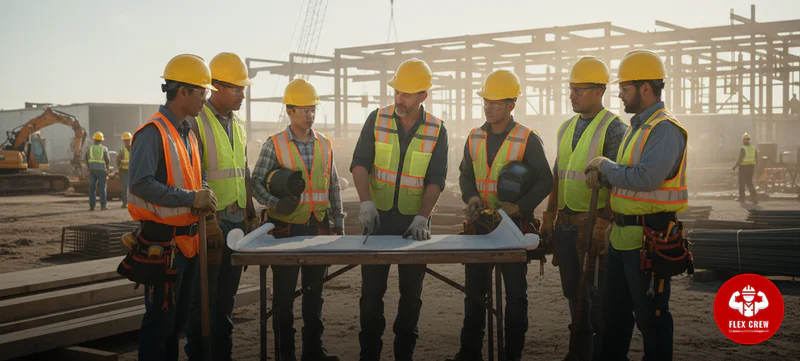
Why Hiring Workers for Short Term Construction Has Become a Business Risk
The Associated Builders and Contractors projects the construction industry needs to attract roughly 439,000 net new workers in 2025 and nearly 500,000 in 2026. The AGC's 2025 Workforce Survey found 45% of firms reported project delays directly caused by worker shortages. These are not distant industry problems, they show up on job sites in Houston, Tampa, Atlanta, and Jacksonville every week.
The workforce is aging. The average construction worker is 42 years old. One in five is over 55. Fewer young workers are entering the trades to replace them. In Texas alone, 18,500 construction jobs were added in a single 12-month stretch, the largest gain of any state, but the available labor pool did not grow to match it.
Data centers, semiconductor plants, and infrastructure megaprojects across the Sun Belt are locking up electricians, welders, and HVAC technicians on long-term contracts. A contractor in Dallas or Atlanta trying to staff a six-week project is competing directly with those employers for the same workers.
Hiring workers for short term construction in this environment is an operational risk that delays schedules and erodes margin if it is not managed as a deliberate process.
What Short Term Construction Hiring Actually Covers
Short term is not a single scenario. Duration, urgency, and required skills vary significantly across situations.
Across all of these, the requirement is the same: workers who already know the trade, meet site safety standards, and are productive from day one. A short-term role filled with the wrong person costs as much as an unfilled role, and often more, because the time spent on a bad placement is time that cannot be recovered.
The Real Cost of Getting Short Term Construction Hiring Wrong
A project manager running submittals, coordinating subcontractors, and managing schedules cannot simultaneously screen hundreds of resumes, run skills assessments, and conduct reference checks. When those steps get skipped under pressure, the result is predictable: a worker accepts verbally and does not appear on Monday morning.
The Bureau of Labor Statistics puts average hourly earnings for construction non-supervisory workers at $39.70 per hour in mid-2025. A crew standing idle for half a day waiting on a missing worker is a measurable dollar loss, before counting the downstream delay to every trade dependent on that role being filled.
Here is how self-managed hiring compares to working with a construction-specialized staffing agency:
Beginning the hiring process three weeks out with a staffing partner produces a confirmed start. Beginning three weeks out independently typically means screening is still underway when the project kicks off.
How to Hire Workers for Short Term Construction Without Losing Quality
Speed and screening quality are not mutually exclusive in short term construction hiring, but both require intention. Contractors who staff short-term projects reliably share one consistent practice: they screen for the specific role, not for construction in general.
A general laborer and a licensed electrician require entirely different evaluation criteria. This distinction gets skipped when time pressure is high, and it is the source of most placement failures.
Reliability history is the strongest predictor of a successful short-term placement. A pattern of completing projects, not just starting them, matters more than an impressive list of employers. Short stints with no explanation on a resume are worth questioning when there is no time to recover from an early departure.
Safety compliance is a baseline, not a bonus. Any worker on a job site in Texas, Florida, or Georgia is a liability exposure from the moment they arrive. OSHA awareness, PPE requirements, and site protocol need to be verified explicitly during screening, not assumed. Staffing processes that build this into assessment reduce liability on every single placement.
The window between a verbal acceptance and the start date is where hiring workers for short term construction fails most often. Agencies that contact candidates within minutes of application and stay in active communication through to day one see significantly lower no-show rates than those relying on passive job postings.
Realistic Timelines for Hiring Workers for Short Term Construction
Starting the hiring process late is the most expensive mistake in short-term construction staffing. Here is what each stage realistically takes, and where a staffing partner reduces that timeline.
A project starting in two weeks cannot wait three to five weeks for a confirmed hire. A contractor working alone almost always reaches that start date still screening candidates or forced to accept someone who has not been properly vetted.
How FlexCrew Approaches Short Term Construction Hiring for Texas, Florida, and Georgia Contractors
Most staffing platforms are not built for construction. They serve warehouses, retail operations, and healthcare facilities alongside job sites, and apply the same process to all of them. FlexCrew works exclusively in construction and skilled trades. The candidate pipeline reflects that: workers who understand job site expectations, hold relevant trade certifications, and have been screened for the specific demands of construction work in Texas, Florida, and Georgia.
Evaluating a licensed plumber is not the same as evaluating a framing carpenter. Evaluating a certified welder is not the same as evaluating a site laborer. FlexCrew applies behavioral and competency screening to each specific role, not keyword-matched resumes, which is the difference between a placement that works and one that creates more problems than it solves.
For contractors operating in Houston, Dallas, Tampa, Atlanta, and Jacksonville, an established pipeline of pre-vetted, trade-ready workers means hiring workers for short term construction does not become a crisis every time a project staffing gap opens.
FlexCrew's AI-powered resume builder also helps trade workers entering or re-entering the market present their experience accurately, so contractors receive better-matched candidates rather than higher applicant volume.
Why Short Term Construction Hiring Is Harder in Active Sun Belt Markets
National labor statistics understate how difficult short term construction hiring is in Texas, Florida, and Georgia specifically. Active markets concentrate the labor shortage. A mid-size contractor in Atlanta running a 60-day commercial interior buildout is competing for the same electricians and HVAC technicians as a billion-dollar manufacturing facility offering long-term contracts and premium compensation.
General job boards reflect that competition. A contractor posting there is not competing on a level surface. Building a standing relationship with a construction-specialized staffing partner, before a gap opens, is what separates contractors who fill short-term crews in five business days from those spending five weeks replacing workers who accepted other offers.
The build pipeline across the Southeast is not slowing. Certain booming sectors are absorbing a significant share of the construction labor force in their regions, making it hard for other projects nearby to staff up. Contractors who treat short term construction hiring as a systematic process, not a reactive scramble, will consistently outperform those who do not.
Build Your Short Term Construction Hiring Process Before You Need It
The crew gap that damages a client relationship rarely arrives with advance warning. It surfaces Tuesday and needs resolving by Monday. That is the actual rhythm of hiring workers for short term construction in Texas, Florida, and Georgia, and it requires a process that is already in place, not one assembled under pressure.
FlexCrew connects contractors in these markets directly to vetted, trade-ready workers without starting from scratch on every placement. A project gap opening in the next 30 days is the right time to establish that connection, not the day before the start date.
Contact FlexCrew at flexcrewusa.com to get your short-term construction crew in place.