
Texas is building at full speed. From the Dallas–Fort Worth commercial corridor to the residential surge sweeping Austin, Houston, and San Antonio, the demand for skilled carpenters has quietly become one of the most competitive hiring challenges in the trades. Whether you're running a six-month commercial buildout in Arlington or finishing out a luxury residential project in the Hill Country, the pressure to hire carpenter Texas talent, fast, reliably, and at the right skill level.
Getting it wrong costs you more than money. It costs you schedule, subcontractor trust, and the kind of rework headaches that follow a job long after the crew has moved on.
This blog covers what carpenters actually cost across Texas right now, how to tell the right hire from the wrong one before you're two weeks in, what the market data says about where this is all heading, and how to build a hiring process that doesn't leave you scrambling every time a phase starts.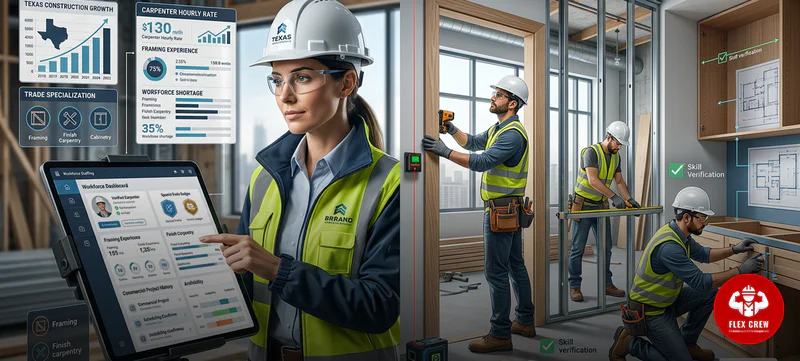
Key Takeaways
What Kind of Carpenter Do You Actually Need?
This is the question most people skip. And it's usually the reason a hire goes sideways.
Carpentry isn't one trade, it's several. A rough framing carpenter who builds structural walls and floor systems is a completely different profession from a finish carpenter installing crown molding or custom casework in a Dallas high-rise lobby. Hiring the wrong specialist doesn't mean you hired a bad carpenter. It means you hired the wrong carpenter for what you needed.
Here's a straightforward breakdown before you post a single listing:
Rough / Framing Carpenters build the structural skeleton, walls, floors, roofs. They're the first carpenters on a commercial site and the last ones you want to vet loosely, because their work is literally what everything else sits on.
Finish Carpenters handle the visible layer: trim, baseboards, door and window installations, interior millwork. This is where client-facing quality lives, and where craftsmanship actually shows up in photos.
Cabinet Makers and Casework Specialists focus on built-ins, kitchen cabinetry, custom shelving, and commercial fixtures. High-end residential builds in Austin and specialty commercial projects in Houston depend heavily on these folks.
Timber Framers are a niche skill. They're needed on exposed-structure luxury builds or specialty commercial projects where the wood is both structural and aesthetic. Don't hire a standard framer and assume they can do this.
Knowing which type you need before the first call will cut your vetting time in half and stop the mismatch hires before they start.
What the Numbers Actually Say About the Texas Market
This isn't a market where you can take a relaxed approach to hiring and expect things to work out. The data makes that pretty clear.
According to the Home Builders Institute's Fall 2025 Construction Labor Market Report, Texas added 195,600 jobs over the past year, more than any other state in the country. That's not just a good headline. It's a signal that the labor pool is being pulled in multiple directions simultaneously, and contractors who wait to hire tend to find themselves behind projects that started while they were still vetting.
The Texas Workforce Commission's 2024–2025 Workforce Report puts carpenters specifically in focus: Texas projects carpenter employment to grow from 26,400 to 28,308 by 2032, a 7.2% increase, with a 2024 median annual wage of $48,524, which exceeds the Texas all-industry median of $47,499.
And from the NAHB's Housing Market Index Survey, 65% of builders reported a shortage of labor in finished carpentry, the highest shortage rate of any of the 16 trades surveyed. That figure didn't come out of nowhere. Finish carpenters are retiring faster than new ones are entering the trade, and the gap shows up on job sites every day.
Nationally, the U.S. Bureau of Labor Statistics projects carpenter employment to grow by 4.5% between 2024 and 2034, outpacing the 3.1% average growth rate for all U.S. occupations.
The short version: Texas is growing faster than it can hire, and carpenters, especially finish carpenters, are the hardest trade to fill right now.
What Does It Cost to Hire a Carpenter in Texas?
The range is wider than most people budget for, and where you fall on that range depends on what you're actually asking someone to do.
Texas Carpenter Hourly Rate Guide

Nationally, it costs between $40 and $200 per hour to hire a carpenter, with most projects settling between $75 and $125 per hour depending on complexity and the carpenter's level of expertise. Texas market rates generally track this range, though city-specific demand moves the needle.
In Houston specifically, carpenters charge between $40 and $80 per hour for standard work, with complex custom installs or kitchen builds pushing well above $80, and built-in wardrobe and cabinetry work coming in around $204 per hour in some cases.
Texas, alongside Florida and Arizona, is experiencing some of the fastest wage growth in the construction sector. The influx of new residents is creating work order backlogs, and small contractors are paying meaningfully more for talent than they were two years ago.
The BLS confirms that average hourly earnings in construction hit $39.1 per hour nationally in July 2025, up 3.7% year-over-year, with Texas among the states reporting faster-than-average wage growth.
One more thing worth knowing: while Texas has strong carpenter employment numbers, the cost-of-living-adjusted pay for carpenters in the state sits around $49,550 which actually ranks toward the lower end nationally, reflecting weaker union presence and lower prevailing wages compared to states like California or Massachusetts. That means Texas can be cost-competitive for contractors hiring at scale, but only if you move before the backlog catches you.
How to Actually Vet a Carpenter Before You Hire
The Reddit r/Carpentry threads and DFW construction forums tell the same story over and over. Contractors describe finding candidates who look great on paper, then vanish after a week. Or workers with real skills but zero follow-through on timelines. The mismatch isn't always about ability, it's often about fit, accountability, and scope clarity.
Here's what separates contractors who consistently hire well from those who get burned:
Match the portfolio to the project type. A carpenter who spent five years framing residential in Houston is not automatically equipped for intricate commercial casework in a DFW office lobby. Ask for photos from recent projects that are actually similar to what you're hiring for.
Verify credentials and insurance before the conversation goes too far. Texas doesn't mandate a single statewide carpentry license, but the best tradespeople carry documentation of training, certifications, or union history. Hiring a licensed or certified carpenter significantly improves the odds of code-compliant work and appropriate insurance coverage. If someone pushes back on this, that's information.
Call the references, and ask the right questions. Did they show up consistently? How did they handle a problem mid-project? Was the scope respected or did it drift? References who can answer those questions specifically are worth their weight.
Define scope before you agree on a rate. A rate without a defined scope is a blank check. Get the project broken down, what's included, what's not, what constitutes a change order, before anyone picks up a tool.
Build in a timeline checkpoint. For longer projects, week two or three is where most problems surface. Build in a formal check-in so you're not finding out about schedule drift in month four.
Carpenter Austin, Dallas, Houston: How Texas Markets Differ
Not all Texas markets behave the same, and knowing the difference will change how you approach your search.
Texas Carpentry Market Comparison by City
Austin is one of the fastest-moving markets right now. The mix of luxury residential, tech campus work, and hospitality renovation keeps demand for finish carpenters and casework specialists consistently high. The catch is that experienced carpenters in Austin often have multiple offers on the table, which means a slow hiring process will cost you your first choice, and probably your second.
Dallas–Fort Worth is the largest commercial carpentry market in the state. Projects in this corridor tend to run long, the Reddit job post at the top of this guide was a six-month commercial engagement covering exterior and interior trims, siding, timber framing, doors, windows, casework, and fixtures. That kind of scope requires a carpenter who can commit to the full timeline. Contractors here frequently need to pull from outside the immediate metro to fill specialized roles.
Houston's market is driven by industrial and commercial work, the port, energy sector projects, and large-scale commercial construction keep demand steady year-round. In the Houston metro, first-line supervisors of construction trades averaged $37.69/hr in the BLS's May 2024 data, while construction laborers averaged $20.13/hr, a wide spread that reflects the premium for skilled trade supervision.
San Antonio and the I-35 corridor are growing steadily, tied to manufacturing facility buildouts and residential expansion. Supply is more balanced here than in Austin or Dallas, but that balance is shifting.
Where FlexCrew Fits Into This
If you've been managing your carpenter, hiring project-by-project, posting jobs, reviewing unqualified applications, scheduling interviews that go nowhere, you already know how much calendar time that eats. That's where FlexCrew changes the equation.
FlexCrew is a construction and skilled trades staffing partner operating across Texas, Florida, Georgia, and other active markets. When contractors need to hire carpenter Texas talent at commercial scale and on real timelines, FlexCrew handles the sourcing, vetting, and placement, so you're not spending your week reviewing candidates who don't match the work.
The process is direct: FlexCrew pre-screens candidates against the specific skills your project requires, whether that's framing crews for a commercial shell in Dallas or finish carpenters for a high-end Austin interior. You get a shortlist of workers who've already been evaluated, not a stack of resumes that require their own vetting process.
For contractors managing multi-phase projects across Texas markets, the short lead times matter. Construction phases don't wait on hiring cycles. When a project phase starts Monday, you need carpenters who are ready Monday, not two weeks from now after a second round of interviews.
FlexCrew also works directly with tradespeople. Carpenters looking for their next commercial project in Texas, Florida, or Georgia can use FlexCrew's job placement support to get matched to real jobs that fit their actual experience.
For workers who've spent years on job sites and haven't touched their resume since their last project, FlexCrew's AI-powered resume builder is a practical tool that helps tradespeople present their skills in a way that actually gets them noticed by commercial contractors.
The model works for both sides: contractors get verified workers without the overhead. Workers get connected to real commercial jobs with support to compete effectively.
What to Do Right Now
If you have an active project or a phase starting soon, a few concrete steps will move things forward faster than anything else.
Write down exactly what skills you need, what the timeline looks like, and what you're willing to pay at market rate for your Texas city. Vague job postings attract vague applicants. Specificity filters the mismatches before they consume your time.
If you're staffing at scale or on a short timeline, reach out to a staffing partner who understands the difference between a framing carpenter and a finish carpenter, because that distinction will determine whether your hire is an asset or a schedule problem. FlexCrew operates in your market and knows what commercial carpentry projects in Dallas, Houston, and Austin actually require.
If you're a carpenter looking for your next job, update your resume now to reflect your actual trade experience in concrete terms: project types, materials, tools, and timelines. FlexCrew's AI resume builder can help you present that clearly, which is the difference between being matched to a job that fits and being overlooked.
Texas is not slowing down. Texas housing permits increased 3.6% year-over-year as of June 2025, reaching 18,712 monthly, signaling continued strong growth in construction activity statewide. Contractors who build reliable hiring pipelines now, rather than scrambling project by project, will have a real operational edge in 2026.
Visit flexcrewusa.com to connect with Texas carpenters or find your next commercial carpentry job.