
A framing crew finishes two weeks ahead of schedule. The finish carpenters aren't available for another three weeks. That gap alone can cost a mid-size residential project $15,000–$30,000 in idle overhead. It happens because contractors treat carpentry as one role when it's actually two completely different jobs with different timelines, skill sets, and hiring windows. This mismatch drives up costs and impacts quality.
That is where understanding framing vs finish carpenter jobs becomes critical. FlexCrew helps contractors solve this exact problem by connecting them with specialized carpenters across Texas, Florida, Georgia, and other high-growth markets. When each phase demands different expertise, aligning talent with timing becomes a competitive advantage.
Carpentry is not a single role. It is a structured workflow where Rough Carpentry builds the foundation and Finish Carpentry defines the final result. Knowing how these roles differ helps businesses hire smarter and workers build stronger careers.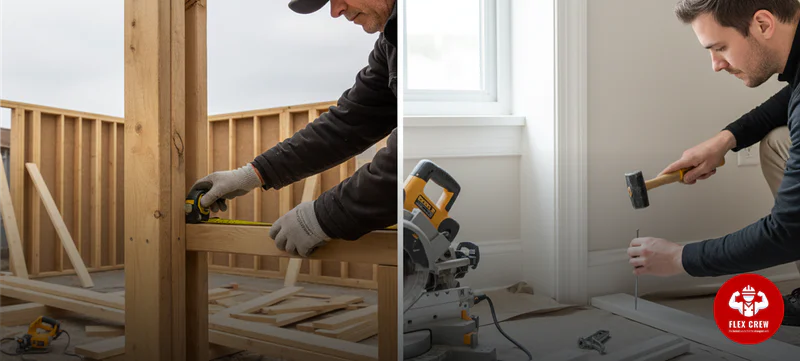
Framing vs Finish Carpenter Jobs: Understanding the Core Difference
The difference between framing and finish carpentry starts with what the customer sees and what they do not. One builds the structure. The other perfects the appearance.
Framing carpenters handle the structural framework of a building. They construct walls, floors, and roof systems that support everything else. This work happens early in the project and often involves outdoor conditions, heavy materials, and fast-paced execution.
Finish carpenters work later in the process. They install trim, doors, cabinets, and molding. Their work is highly visible, which means precision is critical. Even small gaps or uneven edges can affect the final result.
Across the U.S., there are about 959,000 carpenters, with over 74,000 job openings each year. This demand is not general; it is split across specialties like Rough Carpentry and Finish Carpentry.
For contractors, this means hiring “any carpenter” is no longer enough. You need the right carpenter at the right phase.
Framing vs Finish Carpenter Jobs in Real Construction Workflow
Every construction project follows a structured sequence, and carpentry roles align directly with that workflow. Framing and finish carpentry are not interchangeable. Each must happen at the right time for the project to move forward smoothly.
Framing begins immediately after the foundation is complete. Crews work quickly to build the skeleton of the structure. Their focus is on alignment, stability, and speed to keep the project on schedule.
Finish carpentry starts after systems like electrical, plumbing, and HVAC are installed. At this stage, the focus shifts to visual detail and craftsmanship. The goal is a clean, polished finish that meets design expectations.
When framing is even slightly off, finish carpenters must correct those issues. That leads to delays, added costs, and frustration on-site. This is why many contractors rely on FlexCrew to align skilled workers with each phase, reducing rework and keeping timelines intact.
Framing vs Finish Carpenter Jobs: Skills That Separate the Roles
The difference in skills between these roles is significant, and it directly affects hiring decisions. Each role requires a different mindset, toolset, and level of precision.
Framing carpenters rely on strength, speed, and spatial awareness. They read blueprints, measure quickly, and assemble large structural components. Their work allows small tolerances because it will be covered later.
Finish carpenters operate at a much higher level of precision. They cut, shape, and install visible elements that must fit perfectly. Their work requires patience, attention to detail, and advanced craftsmanship.
Many workers start in Rough Carpentry and later transition into Finish Carpentry. This progression increases earning potential and job stability. FlexCrew supports this growth by placing workers in roles that match their current skills while helping them gain experience across both areas.
Framing vs Finish carpenter Jobs: Salary Comparison and Earning Potential
Pay is one of the biggest deciding factors when choosing between these roles. The difference reflects skill level, precision, and demand. The median annual wage for carpenters in the U.S. is about $59,310. However, specialization impacts earnings significantly depending on the role and experience level.
According to the U.S. Bureau of Labor Statistics, the median annual wage for carpenters sits around $59,310. Finish carpenters typically land at the higher end of that range, often between $58,000 and $65,000 depending on market and experience, while framing carpenters generally start lower but benefit from consistent volume work, particularly in high-construction states.
Framing vs Finish Carpenter Salary Comparison
In markets like Texas and Florida, framing carpenters benefit from consistent demand due to new construction. Finish carpenters often command higher pay because fewer workers meet the required precision standards.
For contractors, this creates a hiring challenge. Skilled finish carpenters are harder to find, which is where FlexCrew adds value by providing pre-vetted professionals ready for immediate deployment.
Framing vs Finish Carpenter Jobs Across Texas, Florida, and Georgia
Regional construction trends directly impact hiring patterns for carpenters. High-growth states across the U.S. are driving demand for both framing and finishing roles.
In Texas, rapid residential development creates strong demand for framing carpenters. Builders need crews who can move quickly and handle large-scale housing projects.
In Florida, both framing and finish carpentry are in demand due to continuous construction and renovation work. Coastal projects often require high-quality finishes, increasing the need for skilled finish carpenters.
In Georgia, especially around Atlanta, mixed-use developments require both roles working back-to-back. Contractors must transition quickly from structure to finishing without delays.
This is where timing becomes critical. Even a short delay between phases can increase project costs significantly. FlexCrew helps contractors scale their workforce based on project stage, ensuring smooth transitions and better project control.
Framing vs Finish Carpenter Jobs: Types of Carpentry Explained
Understanding Types of Carpentry helps clarify why these roles are so different. Each type serves a specific purpose within construction.
Rough carpentry is the category framing falls under. It prioritizes load-bearing accuracy over appearance, walls must be plumb, floors must be level, and roof systems must meet structural load requirements. Mistakes here compound through every phase that follows.
Finish carpentry is its own discipline. Trim work, door hanging, cabinet installation, and molding all require tolerances measured in fractions of an inch. A finish carpenter working behind a sloppy framing job spends half their time compensating for errors that were never their responsibility.
This specialization is what drives hiring decisions today. Contractors need specific skills at each stage, not general labor. FlexCrew focuses on matching these specialized roles to project needs, improving both speed and quality.
Framing vs Finish Carpenter Jobs: Career Path and Growth Opportunities
Most carpenters enter through a 3–4 year apprenticeship, often through the United Brotherhood of Carpenters (UBC) or the NCCER certification program. Early years are spent in framing, it's physically demanding but teaches blueprint reading, layout, and tool fundamentals faster than any classroom.
The transition to finish carpentry typically happens between 3-6 years, once a worker has enough structural intuition to understand what they're finishing over. From there, specializations like cabinetry, architectural millwork, or historic restoration open up, each with meaningfully higher hourly rates and more stable, year-round project cycles.
Workers who hold both rough and finish experience consistently report better job security and negotiating power, particularly in markets where project phases turn over quickly.
FlexCrew supports this journey by connecting workers with projects that match their skills and helping them present their experience using tools like its AI Resume Builder.
Framing vs Finish Carpenter Jobs: Hiring Challenges and Solutions
Hiring mistakes in carpentry can create costly delays. Even small errors at the framing stage can affect every step that follows.
If framing is inaccurate, finish carpenters must spend extra time fixing issues. This increases labor costs and pushes deadlines further out. On the other hand, poor finish work directly impacts customer satisfaction and project quality.
Many contractors struggle because they hire general carpenters instead of specialists. This leads to inefficiencies and rework that could have been avoided.
FlexCrew solves this by focusing on role-specific staffing. Contractors get access to framing or finish carpenters based on project needs, not just availability. This targeted approach improves efficiency and reduces risk across all stages of construction.
Framing vs Finish Carpenter Jobs: Which One Is Right for You?
Choosing between these roles depends on your strengths and career goals. Each path offers strong opportunities, but the work environment and expectations are very different.
Framing carpentry is ideal for those who enjoy physical work and fast-paced environments. It offers steady demand and faster entry into the workforce. Finish carpentry suits individuals who prefer detail-oriented work and craftsmanship. It requires more time to master but offers higher earning potential and specialization.
Many professionals recommend learning both. This flexibility increases job opportunities and allows workers to adapt to changing market demand.
FlexCrew helps workers explore both paths by connecting them with projects that align with their skills, making career growth more accessible and consistent.
The Real Cost of Confusing Framing vs Finish Carpenter Jobs
Framing vs finish carpenter jobs are not two versions of the same role. They are two distinct disciplines that operate at different project stages, demand different skill sets, and carry different consequences when the wrong person is placed in the wrong phase.
Contractors who blur this line pay for it, in rework costs, blown timelines, and finish quality that doesn't match what was promised to the client. Workers who understand this distinction position themselves for better pay, more consistent work, and a career path with a clear ceiling to grow toward.
The difference between a project that finishes on time and one that doesn't often comes down to whether the right carpenter was hired for the right phase, not just whether a carpenter was hired.
That's exactly the gap FlexCrew is built to close. Whether you need a framing crew ready for structural work or a finish carpenter who can deliver precision results on the final phase, FlexCrew connects contractors across Texas, Florida, and Georgia with pre-vetted specialists matched to your project stage, not just your timeline.
Stop staffing by availability. Start staffing by specialty.