
Every week, shops and contractors across Texas, Florida, and Georgia post a "welder/fabricator" opening, hire the first certified candidate who applies, and watch the placement fall apart within 30 days. The problem is rarely the worker. It is a job posting.
When employers treat welding and fabrication as interchangeable terms, they attract the wrong candidates, set unrealistic expectations, and absorb turnover costs that compound fast. Understanding the fabrication vs welding difference is not a trade technicality, it is a hiring decision with direct bottom-line consequences.
At FlexCrew, we connect employers in construction, light industrial, and manufacturing with skilled trades workers across the South and Southeast. The single most common source of early placement failure we see is a mismatch between what the job actually requires and what the job posting said it required. This guide fixes that.
Key Takeaways: Fabrication vs Welding Difference at a Glance
Welding is one specific joining process. Fabrication is the complete workflow of building a finished metal product, cutting, forming, fitting, welding, and finishing.
Posting "welder/fabricator" when you only need one of the two leads to mismatched hires, faster turnover, and wasted onboarding time.
According to the U.S. Bureau of Labor Statistics (BLS), welders earned a median annual wage of $51,000 in May 2024, meaning overpaying a full fabricator for a bench-welding seat, or underpaying a welder placed in a fab role, both create immediate retention problems.
The American Welding Society (AWS) projects 330,000 additional welding and fabrication professionals will be needed by 2028, roughly 82,500 per year. Competition for qualified candidates is intensifying across all of FlexCrew's active markets.
35% of all welding-related job postings analyzed from 2022–2024 were listed as "welder/fabricator", the single largest category. Most were filled slowly or with high turnover because the role wasn't defined clearly enough.
FlexCrew pre-screens candidates against the specific skill requirements of each role, welder, fabricator, or hybrid, before presenting them to employers.
Why the Fabrication vs Welding Difference Gets Misread in Most Job Postings
The confusion starts at the job description. Most employers write "welder/fabricator" because they've seen other shops use it, or because they genuinely aren't sure which one they need. Both are understandable, but both cost money.
In practice, a welder and a fabricator have meaningfully different skill sets, different daily workflows, and different market pay rates. Conflating them in a job posting sends a mixed signal that attracts candidates whose expectations don't match the role. The welder who expects to run beads all day gets frustrated when asked to read blueprints and lay out parts. The fabricator who expects variety and problem-solving disengages on a repetitive production line.
According to the Society for Human Resource Management (SHRM), the average cost of a bad hire is estimated at 50–60% of the employee's annual salary. For a skilled trades role paying $50,000, that is a $25,000–$30,000 mistake, before accounting for the productivity gap, overtime coverage, and re-hiring timeline. Getting the job definition right upfront is not a paperwork exercise. It is cost control.
Understanding the Fabrication vs Welding Difference: Scope and Skill Set
The clearest way to define it for hiring purposes: a welder executes one specific process. A fabricator manages an entire build workflow, and welding is one step inside it.
A welder's job is to fuse metal joints using MIG, TIG, stick (SMAW), or flux-core (FCAW) processes. On a high-volume bench welding job, a qualified welder will have their hood down for four to six hours out of eight. Their value is in speed, consistency, and process-specific certification. They are optimized for one thing and they do it at volume.
A fabricator takes a blueprint, or sometimes a customer concept, and builds a finished metal product from raw stock. They cut material to spec, form and bend it using press brakes or rolls, fit and tack assemblies, weld joints, grind seams, inspect tolerances, and sometimes handle surface finishing. On many fabrication projects, actual arc time is only one to three hours out of eight. The rest is layout, measurement, and judgment.
Fabrication vs Welding Difference: Skills and Role Comparison
Fabrication vs Welding Difference: What It Costs When You Get the Hire Wrong
Misclassifying a role has predictable, measurable outcomes. Here is what employers in FlexCrew's markets, Texas, Florida, Georgia, and surrounding states, tell us happens most often.
When you hire a welder for a fabrication role: The worker can run the welds but struggles with blueprint interpretation, layout, and fitting. Supervisors spend time compensating. Output quality is inconsistent. The worker feels set up to fail. Turnover follows within 60–90 days.
When you hire a fabricator for a bench-welding role: The worker is overqualified for the daily task and underutilized within weeks. They may accept the role during a slow period but exit as soon as a fabrication opportunity opens elsewhere. You lose a skilled worker you've already onboarded.
When you post "welder/fabricator" without defining which you actually need: You attract both types, interview candidates across a wide skill spectrum, and often default to whoever seems most available, not whoever actually fits the job.
The fix is simpler than most employers expect. Clarifying the fabrication vs welding difference before writing the job posting means answering three questions: How many hours per shift will this person spend actually welding? Will they be reading blueprints and laying out parts independently? Do they need to manage a build from raw material to finished product, or just execute the joins? The answers tell you whether you need a welder, a fabricator, or a genuine hybrid.
Fabrication vs Welding Difference in Pay: What You Need to Budget Correctly
Pay accuracy matters for two reasons: it determines who applies, and it determines how long they stay. Posting a fabricator-level role at welder wages, or vice versa, immediately narrows your candidate pool to workers who either don't know their market value or have limited options.
Employer Pay Benchmarks by Role and Market
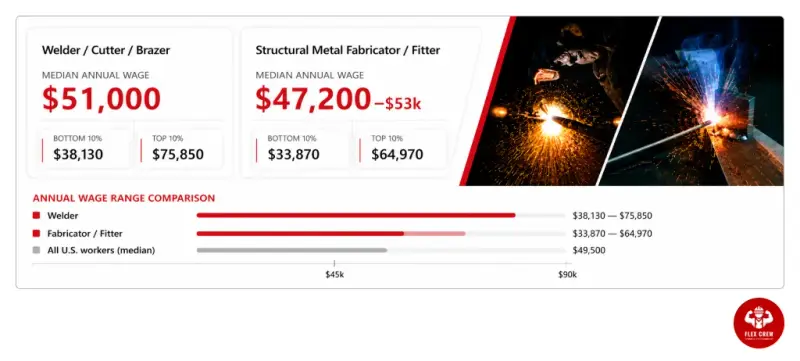
According to BLS May 2024 data, welders earned a median annual wage of $51,000, with the top 10% earning above $75,850. Structural metal fabricators and fitters earned a median in the $47,200–$53,000 range, with the top 10% reaching roughly $64,970. The welder/fabricator hybrid, when the role genuinely requires both, commands a premium above both individual medians because it eliminates the employer's need to hire two people.
In markets like Houston, where petrochemical plant work drives welder pay upward, or in Florida's Gulf Coast marine industry, where aluminum TIG fabrication is premium work, the national medians are typically floor numbers. Employers posting below regional market rates for these roles are not saving money, they are extending their time-to-fill and competing for a smaller candidate pool.
Fabrication vs Welding Difference in the U.S. Job Market Right Now
The labor supply context matters for every employer currently hiring in these trades. The numbers are not favorable for waiting.
According to the AWS, there were approximately 771,000 welding professionals in the U.S. in 2024. By 2028, an estimated 330,000 additional welding and fabrication professionals will be needed, roughly 82,500 positions per year, driven by infrastructure investment, manufacturing expansion, and an aging incumbent workforce.
More than 157,000 current welders are approaching retirement age. The BLS projects approximately 45,600 annual job openings through 2034 for welders, cutters, solderers, and brazers alone.
21% of the current welding workforce is over 55. That is a structural supply problem, not a cyclical one.
For employers in Texas, Florida, and Georgia, this translates directly into competition for the same qualified candidates. Construction activity in Dallas and Houston remains high. Florida's commercial buildout continues along the Gulf Coast and I-4 corridor.
Georgia's manufacturing base, particularly around the Savannah port and greater Atlanta is expanding. The employers who move fastest, post the clearest job descriptions, and offer competitive pay at or above regional benchmarks are the ones filling roles. The ones who wait, or who post vague "welder/fabricator" listings at median wages, are still waiting.
FlexCrew's active pipeline of pre-screened welding and fabrication candidates across these markets gives employers a direct advantage in that competition, but only when we know exactly what role we're filling.
How the Fabrication vs Welding Difference Shapes Your Interview and Screening Process
Knowing the distinction also changes how you evaluate candidates. A job posting that clearly defines the role attracts better-fit applicants, but you still need to verify in the interview that the candidate can actually do what they say.
For welder roles, the most reliable screening is a weld test on the process and position you actually use. AWS certification is a strong signal, but it does not replace testing on your specific material, thickness, and joint configuration. Ask about their experience with your exact process, MIG on structural steel is not the same as TIG on thin-gauge aluminum.
For fabrication roles, ask candidates to walk you through how they would approach a build from a blueprint. Can they describe the sequence, material selection, layout, cutting, fit-up, tacking, welding, inspection? Do they understand tolerances? Have they ordered material from a cut list? These questions separate fabricators from welders who can tack parts together.
For hybrid welder/fabricator roles, test both. A candidate who welds well but cannot read a shop drawing is a welder. A candidate who can layout and fit but cannot pass a weld test is a fitter. The actual hybrid is rarer and worth paying for.
FlexCrew conducts this screening before candidates reach your door. We verify process certifications, assess blueprint reading ability, and match candidates to the specific role profile, not just the job title, so your interview time is spent evaluating fit, not discovering mismatches.
Steel vs Aluminum: How Material Type Affects the Fabrication vs Welding Difference
This distinction also shows up differently depending on the material your shop works with, and this affects both candidate screening and pay benchmarking.
Steel fabrication is the most common context across FlexCrew's markets. Structural steel, plate, tubing, and bar stock are forgiving to work with and weldable across multiple processes. Most welders and fabricators in Texas and Georgia are working in steel, and the candidate pool is correspondingly larger.
Aluminum fabrication is a distinct discipline. It requires different filler materials, tighter heat management, and typically TIG over MIG for welded joints. Marine fabrication shops along Florida's Gulf Coast, aerospace suppliers, and food processing equipment manufacturers all work heavily in aluminum.
The candidate pool for qualified aluminum TIG fabricators is significantly smaller, the pay premium is real, and the screening criteria are tighter. A steel welder cannot walk into an aluminum TIG fabrication role without meaningful additional experience.
Knowing your material type is therefore part of defining the role accurately, and it directly affects which candidates FlexCrew targets in our placement process.
Know the Fabrication vs Welding Difference Before You Post the Job
Knowing which role you actually need is not something to figure out after the hire. It is the first question to answer before writing the job description. What does this person do for most of their shift? What equipment will they operate independently? What level of blueprint reading does the role require? Is the output a repetitive production weld or a custom-built assembly?
Getting clear on those answers takes 20 minutes. Getting it wrong costs months of turnover, onboarding, and productivity loss.
FlexCrew works with employers across Texas, Florida, Georgia, and the broader South and Southeast to fill welding and fabrication roles with candidates who actually fit, not just candidates who are available. We pre-screen for process certifications, blueprint reading ability, and role-specific experience before a single resume reaches your desk.
If you are ready to hire smarter in the skilled trades, contact FlexCrew today.