
Planning a concrete project? Understanding concrete labor cost is the difference between a profitable job and one that bleeds money. Whether you're pouring a driveway, building a foundation, or tackling commercial flatwork, labor typically eats up 40-50% of your total budget.
This breaks down exactly what you'll pay for concrete labor across the U.S., the factors that'll jack up your costs, and smart strategies to keep your projects in the black.
What Does Concrete Labor Cost Per Square Foot?
Let's cut to the chase. Here's what you're looking at for concrete labor costs in 2025:
Work Type | Labor Cost Per Sq Ft |
|---|---|
Basic slab pour | $2 - $3 |
Standard flatwork | $3 - $5 |
Commercial projects | $2 - $4 |
Complex/decorative work | $8 - $18 |
For a typical residential job, expect labor to run you between $2 and $5 per square foot. That covers forming, pouring, finishing, and basic cleanup. Commercial concrete work averages $2 to $4 per square foot, though complex projects push that number way higher.
Here's the math in action: a 1,000 square foot driveway at $3 per square foot means $3,000 just for labor. The concrete, reinforcement, and prep work? That's all extra.
Small jobs carry minimum charges that catch a lot of folks off guard. Most contractors won't roll a truck for less than $1,500-$2,000, regardless of square footage. The mobilization, setup, and cleanup take the same time whether you're pouring 50 or 150 square feet. Keep this in mind when bidding smaller residential work.
Concrete Worker Hourly Wages by Experience Level
Your crew's experience directly impacts what you'll pay. Here's the 2025 breakdown:
Experience Level | Hourly Wage | Annual Salary |
|---|---|---|
Entry-level laborers | $15 - $20 | $31,000 - $42,000 |
Mid-level workers | $20 - $30 | $42,000 - $62,000 |
Experienced finishers | $30 - $45 | $62,000 - $75,000 |
Concrete foremen | $35 - $50+ | $73,000 - $80,000+ |
The national average for concrete workers sits at about $22.49 per hour, with concrete finishers averaging $23.78. Top earners in high-demand markets pull over $30 an hour. Specialized roles like concrete estimators command significantly more, often exceeding $100,000 annually.
Beyond base wages, factor in your burden costs. Workers' comp, liability insurance, payroll taxes, and benefits add 25-35% on top of hourly rates. That $25/hour finisher actually costs you $31-34 per hour when you account for everything. Miss this calculation and you'll underbid every job.
Pro tip: Investing in skilled workers pays off. An experienced crew can pour 300-350 square feet per day without callbacks, while cheaper labor often means redos and delays that kill your margins.
Regional Concrete Labor Cost Differences Across America
Location matters more than most contractors realize. A slab that costs $5.35 per square foot in Kansas might run $8.50 in coastal California.
Region | Cost vs. National Average | Key Factors |
|---|---|---|
California | 20-30% higher | High living costs, strict regulations |
New York | 20-30% higher | Union presence, urban density |
Texas | 5-10% lower | Lower cost of living, high competition |
Florida | 5-10% lower | Year-round work, labor availability |
Midwest (Kansas, Kentucky) | At or below average | Lower overhead, less regulation |
Pacific Northwest | 10-15% higher | Growing demand, skilled labor shortage |
Urban centers like San Francisco, Los Angeles, and New York City push labor costs to the extreme. A crew charging $8 per square foot in Detroit might charge $14 in Manhattan for identical work. The difference comes down to rent, insurance, permits, and what workers need to earn to survive in those markets.
State-by-State Wage Comparison
California leads the pack with concrete workers averaging $62,139 annually. Wyoming and Oregon follow close behind, driven by infrastructure spending and skilled labor shortages. On the flip side, Southern states like Tennessee, South Carolina, and New Mexico sit at the bottom of the pay scale.
If you're bidding jobs across state lines, adjust your estimates accordingly. What works in rural Texas won't fly in downtown Seattle. Smart contractors build regional multipliers into their estimating software to account for these differences automatically.
Hidden Factors That Drive Up Concrete Labor Costs
The square footage price is just the starting point. These factors can blow up your labor budget if you don't plan for them upfront.
Site Accessibility and Conditions
Tight spaces, steep slopes, or remote locations mean hand-carrying concrete instead of using mixer trucks. A job that should take one day can stretch to three when your crew is wheelbarrowing mud 200 feet from the street. Budget an extra $500-$1,500 for difficult access situations.
Soil conditions matter too. Rocky ground or unstable soil requires additional excavation and compacting before you pour. That's labor hours you won't recover if you didn't bid them.
Weather and Seasonal Adjustments
Concrete doesn't care about your schedule. Cold weather requires heated blankets, accelerators, and extended curing protection. Hot weather means retarders, earlier start times, and faster finishing windows. Either scenario adds $50-$200 to your labor costs.
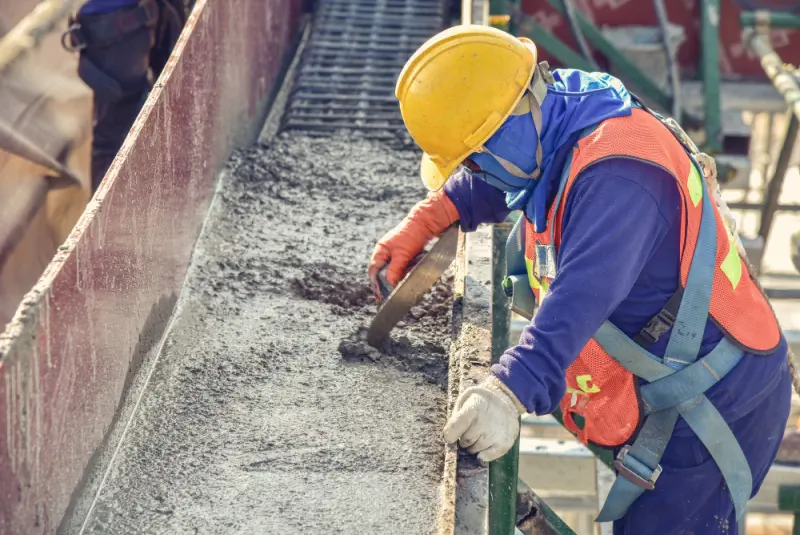
Winter pours in northern states can cost 15-20% more than summer work. Some contractors avoid cold-weather concrete entirely. Others charge premium rates to cover the headaches. Know your market and price accordingly.
Decorative and Specialty Finishes
Finish Type | Additional Labor Cost Per Sq Ft |
|---|---|
Broom finish | Included in base price |
Smooth trowel | Included in base price |
Exposed aggregate | $7 - $15 |
Stamped patterns | $8 - $20 |
Colored/stained | $2 - $8 |
Polished concrete | $3 - $12 |
Decorative concrete transforms labor costs completely. Stamped patios require specialized tools, experienced finishers, and precise timing. A basic $3/sq ft pour becomes a $15/sq ft project when you add custom patterns and integral color. Make sure your client understands this before you start.
Reinforcement and Structural Requirements
Rebar installation adds $0.30-$0.50 per linear foot in labor. Wire mesh runs $0.15-$0.30 per square foot. Thicker slabs for driveways or foundations require more material handling and finishing time. A 4-inch patio slab takes significantly less labor than an 8-inch foundation with continuous footings.
Concrete Labor Cost by Project Type
Different jobs have different labor demands. Here's what typical projects actually cost:
Project Type | Typical Size | Labor Cost Range | Total Project Cost |
|---|---|---|---|
Shed foundation | 80 - 100 sq ft | $200 - $400 | $480 - $800 |
Sidewalk | 100 - 200 sq ft | $300 - $800 | $600 - $1,600 |
Patio | 200 - 500 sq ft | $600 - $2,500 | $1,200 - $5,000 |
Single-car driveway | 200 - 300 sq ft | $600 - $1,500 | $1,200 - $3,000 |
Two-car driveway | 400 - 600 sq ft | $1,200 - $3,000 | $2,400 - $6,000 |
Garage floor | 400 - 600 sq ft | $1,200 - $3,000 | $2,400 - $6,000 |
RV pad | 500 - 800 sq ft | $1,500 - $4,000 | $3,000 - $8,000 |
Home foundation | 1,500 - 2,500 sq ft | $4,500 - $12,500 | $15,000 - $37,000 |
Foundation work commands premium labor rates because the stakes are higher. Mistakes in a patio mean cosmetic issues. Mistakes in a foundation mean structural failures and lawsuits. Experienced foundation crews charge accordingly.
How to Calculate Your Concrete Labor Needs
Here's a straightforward system for estimating labor hours on any project:
Step 1: Calculate Concrete Volume
Length (ft) × Width (ft) × Thickness (in) ÷ 12 ÷ 27 = Cubic yards
For a 24' × 24' × 4" slab: 24 × 24 × 4 ÷ 12 ÷ 27 = 7.1 cubic yards. Always add 10% for waste and spillage, so order 8 yards.
Step 2: Estimate Labor Productivity
Industry standards for crew productivity:
- One mason + one helper = 12 cubic meters of casting per day
- Standard crew pours 300-350 sq ft of 4" slab daily
- Forming and prep typically equals pour time
- Add 10-15% buffer for site conditions and unexpected delays
Step 3: Build Your Crew Cost
(Workers × Hours × Hourly Rate) × 1.30 burden rate = Total labor cost
For that 24' × 24' slab (576 sq ft), figure 2 days of work for a 4-person crew. At $30/hour loaded rate across 8-hour days:
4 workers × 16 hours × $30 = $1,920 base $1,920 × 1.30 burden = $2,496 total labor cost
That works out to about $4.33 per square foot for labor alone.
Step 4: Add Your Markup
Most successful concrete contractors mark up labor 35-50% to cover overhead and profit. The $2,496 job becomes a $3,369 - $3,744 labor bid. Don't shortchange yourself here. Overhead is real, and profit is why you're in business.
Smart Strategies to Control Concrete Labor Costs
Right-Size Your Crew
Too many workers standing around kills profitability. A typical residential pour needs:
- 1 finisher per 200-300 sq ft of surface
- 1-2 laborers for material handling and prep
- 1 foreman for oversight on jobs over $10,000
Commercial pours scale differently. You might need 6-8 finishers for a large warehouse floor, but the per-square-foot efficiency improves dramatically.
Invest in Productivity Equipment
Modern tools pay for themselves fast. Power trowels, laser screeds, and concrete vibrators boost productivity 20-40% compared to hand methods. A $500/day equipment rental that saves 4 labor hours at $30/hour nets you $120 plus the quality improvement.
Build Reliable Crews
High turnover murders productivity. Every new worker needs training, makes mistakes, and slows down experienced team members. Pay fair wages, treat people right, and your best workers stick around. The consistency alone saves 10-15% on labor costs over time.
Plan Around Weather
Scheduling pours during optimal conditions (50-75°F, low humidity, no rain forecast) prevents costly delays and rework. A rained-out pour costs you the concrete, the crew's time, and potentially the client relationship. Check forecasts obsessively.

Finding Skilled Concrete Workers in a Tight Labor Market
Here's the reality: the construction industry faces a massive skilled labor shortage. Experienced concrete finishers are retiring faster than new workers enter the trade. That's pushing wages up and making reliable crews harder to find.
FlexCrew USA connects contractors with vetted construction professionals who show up ready to work. Whether you need finishers for a weekend pour or a full crew for a commercial project, we match you with workers who have the skills and experience your jobs demand.
For concrete workers looking to advance their careers, our AI-powered resume builder helps you stand out to top contractors. Highlight your certifications, equipment experience, and project history with a professional resume that gets noticed.
Find Skilled Workers or Build Your Resume at FlexCrew USA →
FAQs About Concrete Labor Cost
What is the average concrete labor cost per square foot in 2025?
Standard residential concrete labor runs $2-$5 per square foot. Commercial work falls between $2-$4 per square foot. Decorative finishes like stamping or staining push costs to $8-$18 per square foot.
How much do concrete workers earn hourly?
The national average is $22.49 per hour. Entry-level workers start at $15-$20, while experienced finishers earn $30-$45 per hour. California, Wyoming, and Oregon pay the highest wages.
What percentage of a concrete project is labor?
Labor typically accounts for 40-50% of total project costs. Complex decorative work can push labor to 50-60% of the budget.
How can I find qualified concrete workers fast?
Partner with construction staffing specialists like FlexCrew USA. Professional staffing services pre-screen workers for skills and reliability, cutting your hiring time and reducing risk on critical projects.