
One in five worker deaths in the United States happens on a construction site. Not in a factory. Not on a highway. On a job site, one just like yours. In 2023, the construction industry recorded, accounting for 20% of all workplace deaths that year, according to OSHA. The Fatal Four, falls, struck-by incidents, electrocutions, and caught-in or between accidents, were behind more than half of those deaths. Every single one of them was preventable.
That number doesn't exist because employers don't care. It exists because compliance and safety obligations for construction employers are often misunderstood, inconsistently applied, or treated as a back-office burden rather than a front-line priority. The rules are dense. The liability is shared. And the cost of getting it wrong, financially, legally, and in human lives, is enormous.
This blog breaks down what federal law actually requires, where most contractors fall short, and what a genuinely compliant safety program looks like in practice.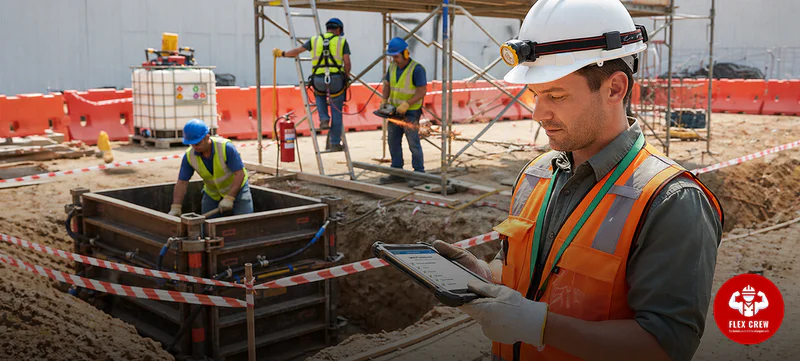
The Legal Framework Behind Compliance and Safety Obligations for Construction Employers
The governing federal standard is 29 CFR Part 1926, OSHA's construction safety rulebook. It covers everything from fall protection and excavation safety to hazardous chemical exposure and underground construction. It's not a suggestion document. It carries the full force of federal law.
One aspect that catches many contractors off guard is incorporation by reference. OSHA doesn't write rules for everything. Instead, 1926 legally pulls in standards from outside bodies, ANSI, NFPA, the Nuclear Regulatory Commission, and once incorporated, those external standards carry the same legal weight as OSHA's own regulations.
Compliance doesn't just mean knowing Part 1926. It means understanding every standard it points to as well.
For a site manager running a commercial build in Houston or overseeing a mid-size project in Atlanta, that's a significant, often underestimated, compliance obligation.

These numbers matter. In FY2024, fall protection violations alone generated over $48 million in OSHA penalties, more than five times the penalties of any other single violation category, according to Procore's analysis of OSHA data.
Who Bears Responsibility on a Multi-Employer Site
Construction is a subcontractor industry. Electricians, plumbers, welders, HVAC technicians, specialists brought in for their scope of work. But legal responsibility doesn't divide cleanly by trade. That's where a lot of general contractors in Texas, Florida, and Georgia run into trouble.
Under OSHA's multi-employer citation policy, the prime contractor assumes all obligations from the start, regardless of who actually performs the work. If a hazard exists on the site, and the prime created it, controlled it, or should have known about it through reasonable supervision, they can be cited. Subcontractors carry legal responsibility for their own scope, but joint liability is real and frequently enforced.
The practical implication: safety coordination has to happen at the site level, not just within individual trades. A GC who hands off safety responsibility to each sub and considers the job done is carrying far more risk than they realize.
Multi-Employer Liability, Who Gets Cited?
Core Compliance and Safety Obligations for Construction Employers: By Hazard Category
The Fatal Four don't happen randomly. They happen in predictable places, during predictable tasks, when specific protections are absent. Here's what the law requires, and where citations most commonly occur.
Fall Protection
The most common OSHA violation in construction in 2024 was the failure to provide appropriate fall protection. It accounts for more than twice as many citations and over five times the financial penalties of any other violation. Fall protection has topped OSHA's most-cited list for 14 consecutive years.
The rules are specific. Personal fall arrest anchor points must be independent of the work platform and capable of supporting at least 5,000 pounds per attached employee. Scaffold platform planks over 10 feet long cannot extend more than 18 inches past their support point. Workers must be trained not only on how to use fall protection equipment, but on the specific hazards of their work environment.
Aerial lifts and boom lifts carry their own requirements: controls must be tested daily, only authorized operators can use them, and workers cannot tie off to anything outside the lift itself, including nearby poles or beams, because an unexpected lift movement could pull them out or create a crush hazard.
Excavation and Trenching
Worker deaths in trench collapses declined nearly 70 percent since calendar year 2022, from 39 deaths in 2022 to 15 in 2023 and 12 in calendar year 2024, following intensive outreach and aggressive enforcement under a "zero tolerance" policy for unprotected trenches.
That progress didn't happen by accident. It happened because OSHA enforced the rules. Any trench over 5 feet deep requires a protective system, shoring to actively prevent collapse, or a trench box (shield) to protect workers if collapse occurs.
Before anyone enters an excavation, the atmosphere must be tested for oxygen deficiency, toxic gases, and flammable conditions. This applies on every site, in every state.
Noise and Chemical Exposure
OSHA's permissible exposure limit for noise is 90 dB(A) averaged over 8 hours. At or near that threshold, a hearing conservation program becomes legally required. As of 2023, around 52% of all construction workers were exposed to hazardous noise.
For lead, common in demolition of older buildings, steel cutting, and bridge renovation, the permissible exposure limit is 50 micrograms per cubic meter of air over 8 hours. An action level kicks in at just 30 micrograms, triggering air monitoring, worker notification, and mandatory training before exposure reaches the legal limit.
Asbestos carries stricter requirements still. A competent person must conduct an exposure assessment before work begins. High-speed abrasive saws without point-of-cut ventilation are prohibited. Compressed air cannot be used to clean up asbestos dust. Decontamination areas, separate lockers, and shower facilities are legally required, not to protect the company, but to prevent workers from carrying fibers home to their families.
Fire Prevention
Every job site requires a documented fire protection program. Flammable liquids are capped at 60 gallons per approved storage cabinet; combustible liquids at 120 gallons. No more than three such cabinets can be stored in a single area. A 10-B rated extinguisher must be within 50 feet of any location where more than 5 gallons of flammable liquid are in use.
Top 5 Most Cited OSHA Construction Violations, FY2024
What Separates Compliant Contractors from Cited Ones
OSHA sets a floor. The contractors with the lowest incident rates don't just clear that floor, they treat it as a starting point. The difference between them and contractors who end up in OSHA's Severe Violator Enforcement Program is rarely ignorance of the rules. It's consistent.
Toolbox talks are a useful example. On paper, they're brief daily meetings. In practice, the most effective ones are worker-led, specific to that day's tasks, and documented. That combination, active participation plus written record, turns a procedural checkbox into an actual safety control.
According to OSHA, construction companies save roughly $4 to $6 for every $1 invested in safety programs. That's not a soft return. That's direct savings from avoided workers' comp claims, reduced OSHA penalties, fewer schedule disruptions, and lower insurance premiums.
Technology is accelerating this further. Digital inspection tools, real-time hazard reporting systems, and mobile safety platforms help lean safety teams manage complex sites with fewer staff. Contractors running projects across multiple states say, a Dallas GC managing crews in Florida and Georgia simultaneously, can't supervise everything in person. Digital systems close that gap.
The Staffing Side of Construction Safety Compliance
Hiring for a construction project is a safety decision. A worker placed in a role they aren't properly trained for isn't just a productivity problem, it's a liability. Over 60% of construction accidents occur within an employee's first year of work. That statistic tells a clear story: onboarding and qualification vetting aren't administrative steps. They're risk management.
This is where staffing becomes a compliance lever, not just an operational one. When general contractors or subcontractors bring on workers, especially in skilled trades like electrical, HVAC, welding, or plumbing, verifying that those workers have the training their role demands is part of meeting compliance and safety obligations for construction employers.
FlexCrew works with contractors across Texas, Florida, Georgia, and other active markets to place trade-qualified workers who match both the skill and safety requirements of the job. Every placement goes through a screening process built around the specific demands of the role, not just availability.
For workers looking to demonstrate their qualifications clearly, FlexCrew's AI-powered resume builder helps highlight certifications, safety training credentials, and trade-specific experience so employers can make fast, informed hiring decisions.
Subcontractor selection follows the same logic. Requesting OSHA 300 logs, verifying active safety programs, reviewing EMR ratings, and asking for competent person designations before work begins is not excessive due diligence. It's the kind of proactive contractor management that protects a project from liability before the first shovel hits the ground.
Building a Compliance-Ready Safety Program: Where to Start
If you're building or strengthening a safety program, these are the areas that move the needle most.
Embed requirements directly into contracts. Specify toolbox talk frequency, required training, PPE standards, subcontractor safety documentation, and the consequences for non-compliance. If it isn't in writing, enforcement becomes nearly impossible.
Train competent persons for every high-risk task category on site. OSHA uses this designation throughout 29 CFR 1926 for a reason. A competent person is someone specifically trained to identify hazards in their area and authorized to take corrective action. For excavation, asbestos, scaffolding, and confined space entry, the designation is a legal requirement, not a title of convenience.
Conduct inspections and document what you find. Both the violations and the corrections. A documented record of active hazard management is one of the most important tools available if OSHA shows up or an incident occurs.
Finally, build the culture from the top. Safety programs written by compliance officers but ignored by superintendents and foremen don't protect anyone. When project leadership treats safety as part of the job, not a parallel obligation, workers follow that standard.
Compliance and Safety Obligations for Construction Employers Demand Consistency
Knowing the rules is not the same as following them. The contractors who end up facing willful violation fines, the ones that top $160,000 per citation, often knew what OSHA required. The gap was in application, documentation, or leadership.
The compliance and safety obligations for construction employers operating in Texas, Florida, Georgia, and across the country aren't getting simpler. OSHA enforcement is active, penalties rise annually, and multi-employer liability means the risk on a complex job site is distributed widely. But contractors who invest in training, qualified workers, and a genuine safety culture don't just avoid fines, they build better, faster, and with fewer costly disruptions.
If you're a contractor looking to build a trade-qualified, compliance-ready workforce, FlexCrew is ready to help. Visit flexcrewusa.com to connect with skilled workers or to find your next opportunity with an employer that takes safety seriously.