
Getting a commercial painting cost estimate wrong is one of the most expensive mistakes a business owner or contractor can make. Go too low and you're bleeding margin before the second coat dries. Go too high without being able to justify it, and you hand the job to someone else.
At FlexCrew, we support contractors and construction businesses across Texas, Florida, Georgia, and the Southeast every day, and the conversation around paint job pricing comes up more than most people expect.
This blog gives you the real numbers, the right framework, and the industry context to make a commercial painting cost estimate you can stand behind.
Key Takeaways
Commercial painting costs typically range from $2 to $6 per square foot, but the real number depends on surface type, building height, coat count, and regional labor rates
Labor accounts for 70–80% of most commercial painting bids, getting hours right is the single biggest factor in estimate accuracy
The U.S. paints and coating market size was valued at $45.8 billion in 2025 and is estimated to reach $66.7 billion by 2034, exhibiting a CAGR of 4.15% from 2026-2034.
45% of construction firms report project delays due to worker shortages, making reliable labor access a critical part of any painting project plan
Interior and exterior painting carry distinct cost structures knowing the difference prevents budget surprises
A proper commercial painting cost estimate breaks down labor and materials separately, never as a single lump sum
Why Commercial Painting Costs More Than Residential Work
Most people's first instinct is to compare commercial painting to what they've paid to paint a home. That comparison doesn't hold up. Commercial projects involve larger surfaces, stricter coating requirements, access challenges, and business continuity constraints that simply don't exist in residential settings.
In 2025, the U.S. painting industry generated $44 billion in revenue, with commercial painting growing at a notably faster pace than residential posting 9.4% annual growth driven by government-funded projects and rising demand for functional coatings like antimicrobial and fire-resistant finishes. That growth reflects real demand from offices, warehouses, retail spaces, healthcare facilities, and industrial plants across markets like Dallas, Tampa, Atlanta, and Charlotte.
Commercial projects in these markets carry added complexity. Off-hours scheduling, multi-story access equipment, VOC-compliant coatings, and surface prep on concrete block or steel all add cost. A warehouse in Houston with a 24-foot ceiling is a fundamentally different job than a two-bedroom house, even if the square footage is similar. Any accurate estimate has to reflect that reality.
The Core Estimating Formula (And Why It Works)
Professional painting contractors, whether they're running a two-person crew or managing a $30 million portfolio, use the same foundational formula. It's not complicated, but it requires discipline to execute consistently.
Labor Cost = Estimated Hours × Hourly Bid Rate
Material Cost = Number of Gallons × Cost Per Gallon
Total Price = (Labor Cost + Material Cost) × 2
That multiplier, doubling the combined cost, targets a 50% gross margin. It's not arbitrary. It's what a growing painting business needs to cover overhead, insurance, equipment, administrative costs, and profit. Contractors who discount below this threshold consistently find themselves unable to scale.
Here's how that plays out on a real project. Say you're estimating an interior office repaint of 3,000 square feet in San Antonio. You estimate 60 labor hours at a $22/hour bid rate, $1,320 in labor cost. You estimate 40 gallons at $45/gallon, $1,800 in materials. Total cost: $3,120. Apply the 2x markup: $6,240, or about $2.08 per square foot. That's squarely in the normal range for interior commercial work.
The bid rate per hour is not what painters are actually paid. A skilled painter who can complete a door and trim in 20 minutes might be bid at a full hour. The difference between bid hours and actual time is part of what funds a healthy margin. Contractors who confuse bid rate with pay rate end up underpricing every job.
Commercial Painting Cost by Project Type
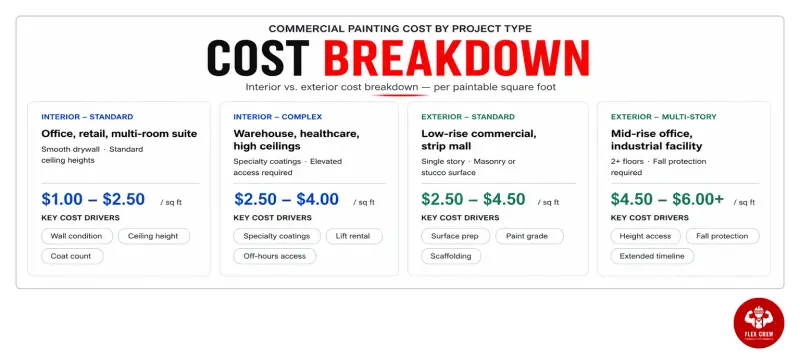
Interior work in standard office or retail spaces, smooth drywall, 9-foot ceilings, two coats, sits at the lower end. Healthcare or food-service environments requiring antimicrobial or washable coatings push the number higher.
Exterior jobs carry the weight of weather-resistant formulations, masonry prep, and safety equipment. The use of robotic systems for painting high-rise facades surged by 25% in 2025, reducing labor hours by up to 40%, but for most mid-market commercial projects, traditional crews and lifts remain the standard.
Budget Reference by Project Size
These are working ranges. Site condition, coat count, and regional labor rates will shift the final figure.
These figures align with national benchmarks. A 2,500-square-foot paintable commercial surface typically runs $5,000 to $15,000 in total project cost under normal conditions. Multi-story buildings or those with significant surface damage fall toward the high end of any bracket.
What Actually Moves the Number
Knowing the formula matters. But knowing what pushes a project from $2 per square foot to $5 per square foot is what separates a contractor who prices confidently from one who guesses and hopes.
Surface Condition: This is the biggest swing factor in any estimate. A building with clean, previously painted walls needs minimal prep. A facility with peeling coatings, mold, rust, or bare concrete can double prep time before a brush touches the finish coat. In Gulf Coast markets like Houston, Pensacola, or Savannah, humidity-related surface damage is common and routinely underestimated.
Number of Coats: Two coats is standard. Cover a dark color, switch substrate type, or use a high-hide specialty product and you may need three. That third coat adds 30 to 50% to labor time and proportional material cost. Always confirm coat count before issuing a final number.
Paint Grade: Commercial-grade paints from major manufacturers cost $40 to $70 per gallon but are engineered for durability in high-traffic, high-contact environments. As of 2025, 92% of Sherwin-Williams' North American architectural products meet or exceed low-VOC standards, a meaningful consideration for healthcare, education, and food-adjacent facilities where air quality matters.
Access Equipment: Scaffolding and boom lifts aren't just a cost line, they're a scheduling factor. Setup and teardown adds hours. Equipment rental in tight markets like Austin or Miami adds cost per day. Any project above 14 feet of working height should include a specific equipment line in the estimate.
Regional Labor Rates: According to the U.S. Bureau of Labor Statistics, painters in Texas averaged around $21.25 per hour in recent reports, with similar ranges in neighboring states depending on local market conditions and project types. Tight labor markets in Florida, Georgia, and Texas can push effective rates 20 to 30% above the national baseline on commercial work.
The Labor Crisis Shaping Every Commercial Painting Estimate Right Now
Labor cost isn't just a line item, it's the most volatile input in any commercial painting cost estimate today. A persistent skilled labor shortage is driving annual labor cost inflation of 4 to 7% in the commercial painting services industry, leaving an estimated $3.5 billion in annual U.S. commercial painting demand unfulfilled as of 2026.
According to the Associated Builders and Contractors, the construction industry must attract approximately 349,000 net new workers in 2026 just to meet current demand, a figure projected to rise to 456,000 in 2027. Painters, like other skilled tradespeople, sit squarely inside this gap.
What the Labor Gap Looks Like in FlexCrew's Core Markets
The practical effect: contractors in Dallas, Tampa, Jacksonville, and Atlanta are competing for the same pool of qualified painters. Forty-five percent of construction firms report project delays due to worker shortages, and 78% experienced at least one delayed project in the past twelve months. For commercial painting specifically, those delays translate directly into cost overruns, missed deadlines, and strained client relationships.
This is where having a staffing partner changes the equation. FlexCrew connects painting contractors and construction companies across Texas, Florida, Georgia, and the broader Southeast with vetted, ready-to-work skilled trades professionals. When a project is on the line and a crew falls short, having a reliable labor source isn't a nice-to-have, it's the difference between delivering on time and explaining a delay.
How to Build a Commercial Painting Cost Estimate That Holds Up
The estimating process should be methodical, not intuitive. Here's how professional contractors approach it.
Start with measurement. Walk the site and record every paintable surface: wall height multiplied by width, door count, window count, ceiling square footage if applicable, and fascia or trim linear footage. Don't estimate by eyeballing a room, measurement-based systems produce consistent results; intuition does not.
From those measurements, determine your hour count. Every surface type has a production rate, how many square feet a painter can cover per hour with a brush, roller, or sprayer. Plug your measurements into your production rates and you get estimated labor hours. Multiply hours by your bid rate to get labor cost.
For materials, your paint supplier will tell you the coverage rate for any product, typically 300 to 400 square feet per gallon. Divide your total paintable area by that coverage rate, multiply by your cost per gallon, and you have material cost. Add primer if required.
Apply the markup, confirm coat count, add equipment and prep line items as needed, and you have a complete estimate with every number accounted for.
The bid that skips this process, the one that comes back as a single round number from a contractor who eyeballed the space, is the one most likely to come in wrong. Ask any contractor who has lost money on a painting job, and a too-fast estimate is almost always somewhere in the story.
A Solid Commercial Painting Cost Estimate Protects Everyone
Whether you're a property manager in Florida budgeting a facility refresh, a business owner in Texas planning an office upgrade, or a painting contractor in Georgia building your estimating system from the ground up, getting the commercial painting cost estimate right is the foundation everything else is built on.
The numbers in this guide give you a framework. The formula gives you a process. And the labor market context gives you a realistic picture of what you're working with in today's market. National data from the BLS, AGC, and industry market research confirms what contractors on the ground already know: material costs are rising, labor is tight, and the gap between a well-built estimate and a rushed one is getting more expensive.
FlexCrew exists to close part of that gap. We place skilled painters and construction tradespeople with contractors and businesses across Texas, Florida, Georgia, and beyond, helping projects stay on schedule and estimates stay profitable. If you're a painting professional looking to get in front of the right contractors, FlexCrew's AI Resume Builder helps you present your skills in a way that gets noticed fast.