
Most carpentry jobs don't go wrong on the tools, they go wrong on paper. A contractor bids too low, wins the job, and spends the next three weeks working for almost nothing. A carpenter quotes from gut instinct, misses the real labor hours, and hands the client a deal they didn't intend to offer. A builder in Atlanta or Houston gets a quote that looks reasonable until the materials arrive and the scope balloons. These aren't rare situations. They happen constantly, and almost always because someone put together a carpenter cost estimate without the right information.
This blog fixes that. It pulls current data directly from the Bureau of Labor Statistics, the Associated Builders and Contractors, and real 2026 market reporting, so whether you're a contractor trying to staff and budget a project in Texas or Florida, or a carpenter figuring out what your work should actually cost, you'll have numbers you can use.
FlexCrew works with carpenters and contractors across the Southeast every day, and the pricing gap is one of the most common problems we see on both sides. Here's how to close it.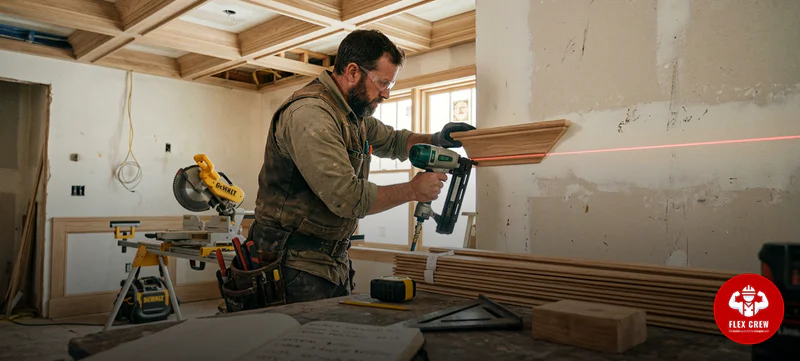
Key Takeaways
The BLS puts the median carpenter wage at $59,310/year as of May 2024, with PayScale reporting an average of $25.46/hour for hourly workers in 2026
Trim molding installation now averages $8.25–$12.37 per linear foot nationally as of May 2026
The construction industry needs an estimated 499,000 additional workers in 2026, according to ABC, a shortage that's pushing labor rates up
80% of construction firms report difficulty filling hourly craft positions
Specialty finish carpenters in Florida's urban markets (Miami, Tampa) bill between $50–$80/hour, significantly above the national hourly average
Markup on carpentry labor typically ranges from 20% to 35%, depending on project complexity and client relationship
Why Getting a Carpenter Cost Estimate Right in 2026 Matters More Than Ever
The construction labor market heading into mid-2026 is under sustained pressure. The Associated Builders and Contractors estimates the industry needs roughly 499,000 additional workers this year alone. The BLS projects about 74,100 carpenter job openings annually through 2034. Meanwhile, 82% of construction firms are having difficulty filling hourly craft positions, and 45% report project delays directly linked to labor shortages.
What this means practically: skilled carpenters have pricing leverage they didn't have five years ago. Contractors who underprice labor in their bids are the ones eating cost overruns. And carpenters who don't know their market rate are leaving money on the table every single job.
Average hourly earnings across all construction workers reached $40.92/hour in March 2026, according to BLS, a 4.3% year-over-year wage increase. Carpentry sits below that cross-industry average for most roles, but specialized finish and trim work is increasingly commanding rates well above it.
Understanding where your specific trade, skill level, and geography fall within that range is what separates a bid that wins and makes money from one that just wins.
Carpenter Cost Estimate by Specialty: 2026 Rate Benchmarks
Carpentry is not one trade with one rate. Framing, finish, trim, and master-level work all bill differently, and they should. Here's how the current market breaks down.
Carpenter Hourly Rate by Specialty (2026)
PayScale puts the baseline average at $25.46/hour in 2026 for general carpenters, while Salary.com's May 2026 benchmark shows an annual average of $60,104, roughly $29/hour. The spread between those numbers reflects experience, specialty, and region. Top earners in skilled finish roles regularly clear $35–$40/hour and above once they have five or more years of focused craft behind them.
The construction carpenters at $59,890/year, with the top 25% earning more than that benchmark by a significant margin.
What Goes Into a Carpenter Cost Estimate: Breaking It Down
A solid estimate isn't a number pulled from memory. It's built from parts, and each part has its own variables. Here's the framework most experienced carpenters and contractors use.
Materials come first. Linear footage for casing and baseboard, door units, specialty molding, pocket door hardware, each line item priced individually, with a 10–15% waste factor added for cuts and errors. Lumber prices have stabilized somewhat after the volatility of recent years, but material costs still shift quarter to quarter. Some contractors in Texas and Florida build a price adjustment clause into their contracts for jobs that don't start within 30 days of the estimate.
Labor is where specialty and experience separate the bid. Hanging a pre-hung interior door is different work than building a staircase system. Each scope should carry its own unit type, pieces, linear feet, square feet, and its own time estimate grounded in actual field experience. Not optimism.
Markup is where profit lives. As one real-world walkthrough of a trim carpentry bid illustrated: a guest house job priced at cost might show $1,100 in parts and labor. At 75% markup, accounting for complexity, custom cuts, and contractor overhead, that same job becomes a $1,900 estimate. Same work. Very different financial outcome. Most working carpenters apply 20–75% markup depending on the job and client relationship.
Contingency rounds out any honest estimate. Industry practice: budget at least one extra day per week of projected work. On a two-week renovation, that's two days of buffer. On a job involving older housing stock, common across Georgia's established neighborhoods or South Florida's older residential markets, experienced contractors budget even more aggressively.
Regional Carpenter Cost Estimate: Texas, Florida, and Georgia
Where the work happens shapes what the estimate looks like. Here's how regional pricing stacks up in FlexCrew's core markets.
Carpenter Cost Estimate by Region (2026)

The Southeast and Sunbelt markets, Atlanta, Nashville, Tampa, Dallas, have been among the most active for wage growth. One construction salary report from The Birm Group noted cities like Atlanta are seeing double-digit wage growth driven by sustained population inflows and project demand. That's directly reflected in what skilled tradespeople can and should charge there now.
Trim and Finish Carpentry Cost Per Linear Foot: What the Numbers Show
Trim work specifically deserves its own breakdown because so many bids are built around it. As of May 2026, national data shows trim molding installation starting at $8.25–$12.37 per linear foot for standard mid-range work.
Finish carpentry rates averaging $5.70–$9.00 per linear foot for standard base and casing with complex installations like coffered ceilings running $8.50–$14.00 per foot. A professional trim installation between $634 and $2,260 per opening depending on style complexity, with carpenters billing $75–$125 per hour for trim work in most markets.
Trim Carpentry Cost Per Linear Foot by Grade (2026)
What these tables won't show you is site conditions. A floor that's badly out of level, walls with irregular profiles, or a staircase that somebody framed at a non-standard angle, any of these add hours that a linear foot rate doesn't capture. That's why experienced carpenters separate their standard scope from their change order language from day one.
The Variables That Wreck an Otherwise Good Estimate
The numbers above give you a solid starting point. What they can't account for is what you find when you open the wall.
One carpenter on Reddit's r/Carpentry thread put it plainly: "Every f****ng reno... it's seemingly always something." That's not complaining, it's an accurate description of how renovation work functions. A joist that someone cut in half and patched badly. Rot that didn't show on the exterior. A floor so far out of level that every single piece of base needs scribing. These aren't edge cases. They're a regular part of renovation carpentry in older housing stock, which is common throughout Georgia, parts of Florida, and established Texas markets.
The best protection is a well-written scope with explicit change order language. Define what's included. Specify what's excluded. State your hourly rate for unforeseen work in the contract before the job starts, not after you've found the problem. Photograph everything unusual the moment you find it, then communicate with the client before proceeding.
Material price volatility remains a secondary variable. Construction average hourly earnings grew 3.7% year-over-year, but lumber and millwork materials can shift faster than wages do. Estimating materials 60 days before purchase on a large job without a price adjustment clause is a calculated risk. Build one in, or buy your materials earlier.
What This Means If You're Staffing a Carpentry Crew
For contractors running multiple projects, new residential builds across the Dallas–Fort Worth metro, commercial fit-outs in Atlanta, renovation work in Tampa, the labor math only works if you have qualified people on the tools. With 80% of construction firms reporting difficulty filling hourly craft positions, relying on posting a job and waiting is not a reliable strategy anymore.
This is the problem FlexCrew is built to solve. FlexCrew specializes in construction staffing and skilled trades placement, connecting verified carpenters, framers, and finish workers with contractors who need dependable labor across Texas, Florida, Georgia, and beyond. When a project scope is locked and a start date is set, FlexCrew helps contractors staff it without the delay of a slow hiring cycle.
For carpenters looking to land steady work and present themselves professionally to contractors, FlexCrew's AI-driven resume builder helps tradespeople translate real field skills into a profile that actually gets noticed. A carpenter with 10 years of finish work experience shouldn't be losing bids to someone who just looks better on paper.
Building Estimates That Hold Up Over Time
Every experienced carpenter will tell you the same thing: the first few years of estimating you'll underprice work. You'll win jobs you should have passed on. You'll get caught by things you didn't budget for. That's the learning curve, and it's real across every trade, not just carpentry.
What separates carpenters who get consistently profitable after year three or four from those who stay stuck is tracking. Actual hours versus estimated hours, per job. Actual material cost versus estimated cost, per line item. Over time, that data builds into reliable unit pricing that reflects how you work on the types of jobs you actually take, not what a national average table says someone else charges.
The Reddit community's long-running thread on pricing said it well: "It's better to stay home and not make any money than go to work and do the same." That's the real cost of a bad estimate. It's not just the lost margin. It's the time, the stress, and the opportunity cost of being locked into a money-losing job when a profitable one was available.
Know your costs. Know your market. Build a number you can stand behind.
Final Word: Your Carpenter Cost Estimate Needs to Reflect 2026 Reality
The labor market is tight. Wages are up. Demand across Texas, Florida, and Georgia remains strong. Contractors who build their carpenter cost estimate on outdated benchmarks or gut instinct are the ones absorbing the losses when jobs run over. And carpenters who price below market, because they're not sure what the market actually is, are subsidizing someone else's profit margin.
Use current data. Break your estimate into real line items. Protect your scope with clear change order language. And if you're a contractor who needs reliable carpentry labor, or a carpenter looking for consistent work in active construction markets, visitFlexCrew at flexcrewusa.com.