
Average Carpenter Cost: Hourly Rates and Project Pricing
Planning a renovation, staffing a build, or just trying to understand what skilled carpentry actually costs in today's market? The average carpenter cost isn't a single number, it's a range shaped by specialty, experience, geography, and project scope.
This blog breaks all of it down using verified data from the U.S. Bureau of Labor Statistics, real-world project pricing, and insights from the trades labor market that FlexCrew operates in every day across Texas, Florida, Georgia, and beyond.
Whether you're a homeowner vetting quotes or a contractor trying to staff a project on budget, this is the pricing context you need before anyone picks up a hammer.

Key Takeaways
Before diving in, here's what the data shows at a glance:
The BLS-reported median carpenter wage is $59,310 per year ($28.51/hour) as of May 2024, that's what carpenters earn as employees.
Homeowners hiring a carpenter pay a different number: typically $75 to $125 per hour for a journeyman, with the national average around $90/hour.
Specialty matters more than most people realize. A rough framing carpenter and a master finish carpenter can differ by $140/hour on the same job site.
Location shifts rates significantly. High-demand Sun Belt markets like Houston, Dallas, Atlanta, and Miami consistently run above national averages.
The BLS projects 74,100 carpenter job openings per year through 2034, demand is real and sustained.
Self-employed carpenters typically charge $55 to $100/hour, accounting for their own overhead, insurance, and taxes.
What the Data Actually Says About Average Carpenter Cost Per Hour
Here's where the confusion starts. When people search "average carpenter cost," they often land on two very different numbers, and both are correct. They're just measuring different things.
The U.S. Bureau of Labor Statistics reports the median annual wage for carpenters at $59,310 (or about $28.51 per hour). That's the wage a carpenter earns as an employee, before the employer adds in payroll taxes, workers' comp, insurance, and overhead.
When a homeowner hires a carpenter, they pay the market rate for labor services, which covers all of that overhead, plus profit margin. That's why HomeAdvisor's current data puts the typical range at $75 to $125 per hour, with most general carpentry work averaging around $90 per hour.
Neither number is wrong. They're measuring different things: one is a wage, the other is a service rate. Understanding the difference helps you read any quote you receive more clearly.
Average Carpenter Cost by Specialty
Not all carpentry is the same work, and the pricing reflects that directly. The level of skill, the time required, and the precision demanded all vary by specialty.
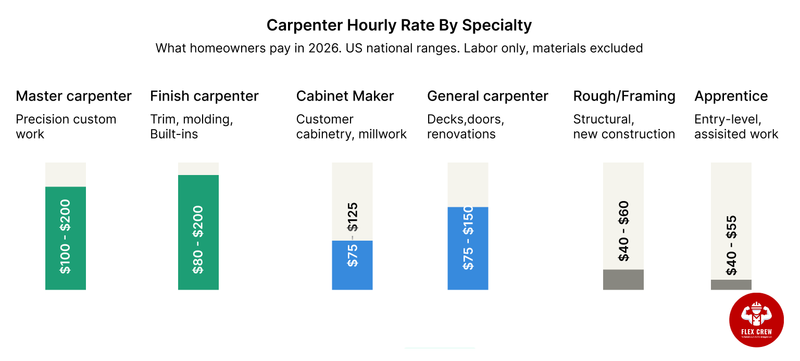
Rough carpenters handle the structural foundation, framing walls, laying floor systems, and building roof structures. The work moves fast, and it's often priced by the square foot ($4 to $10 per sq. ft.) on larger new construction jobs rather than hourly. In high-volume residential markets across Texas and Florida, rough framing crews are among the most in-demand and hardest-to-fill positions.
Finish carpenters sit at the other end of the spectrum. Every cut is visible. Every joint is inspected. Finish carpenter hourly rates are higher because the margin for error is essentially zero. Custom trim, wainscoting, built-in shelving, crown molding, and hardwood flooring all fall into this category.
General carpenters are the most practical hire for typical homeowner projects, decks, door installations, fence repairs, basic framing. Their rates reflect a broad skill set rather than a narrow specialty.
Average Carpenter Cost by Project Type
Hourly rates only tell part of the story. Most homeowners want to know what a specific project will cost in total. Here's how carpentry project pricing breaks down in 2026, based on current national data.
Average Carpenter Cost by Common Project (2026)
These are total project costs including labor. Materials are typically priced separately on larger jobs, so always ask for a line-item breakdown before signing a contract. In markets like Houston and Atlanta, project costs can run 10 to 20 percent above these national averages due to labor demand and material supply chains.
What Drives the Average Carpenter Cost Up or Down
Understanding the pricing range matters more than the midpoint number. Several factors consistently push rates in one direction or the other, and knowing them helps you anticipate costs before you request a quote.
Experience and certification create the widest gaps. The BLS data shows that the top 10% of carpenter earners make over $80,000 annually, and those are wage earners. As service providers, master carpenters with specialized reputations charge rates that reflect years of perfecting a craft that most people only interact with through finished walls and trim lines.
Geography is the single biggest variable after specialty. The Sun Belt is currently experiencing a massive backlog of both residential and commercial projects, with contractors in these rapidly expanding markets searching for skilled tradespeople who can handle heavy-gauge steel framing, complex concrete formwork, and strict coastal wind-load building codes. In markets like Miami, Austin, and Atlanta, all active areas for FlexCrew's construction staffing work, carpenter labor rates consistently run above national averages.
Union vs. non-union status is a significant factor in certain markets. Union carpenters earn approximately 40% more than non-union counterparts on average. In dense union markets like Chicago or Philadelphia, journeyman rates can exceed $50/hour as wages. In the South and Southeast, non-union contractors dominate residential and light commercial work, and rates are priced accordingly.
Project complexity and timeline also matter. A carpenter who needs to work around existing structure, match aging trim profiles, or execute custom joinery charges more than one executing a straightforward framing job. Urgency adds cost, too, a crew needed by Monday will price differently than one booked two weeks out.
Average Carpenter Day Rate: When Projects Are Quoted Differently
Not every carpenter quotes hourly. Subcontractors on multi-day projects frequently use a day rate, and understanding what that number should look like helps prevent overpaying or underpaying.
In the current U.S. market, the average carpenter day rate runs $400 to $800 per day for most specialties. Self-employed finish carpenters and specialized tradespeople in high-cost metros can run higher, sometimes $900 to $1,100 per day for complex work.
The math is straightforward: a self-employed carpenter quoting $65/hour for an 8-hour day is pricing at $520/day. That day rate already accounts for their taxes, tools, insurance, and operational overhead. It's not equivalent to a $65/hour employee wage, it's a loaded rate that covers the full cost of running an independent business.
For contractors staffing projects in Texas, Georgia, or Florida, this distinction matters when comparing bids. A subcontractor at $65/hour and a W-2 employee at $40/hour may represent very similar true labor costs once employer taxes and benefits are factored into the employee side.
Carpenter Pay by Experience Level: What Workers Actually Earn
For anyone currently in or entering the trades, the pay trajectory matters just as much as the top-line numbers.
Carpenter Pay by Experience Level (Employee Wages, 2026)
The BLS median of $28.51/hour sits right in the journeyman range, which makes sense, since journeymen represent the largest share of the working carpenter population. Carpenters earn a median $59,310 per year, which is 20% more than the typical U.S. worker.
The trajectory from apprentice to skilled carpenter is where the real financial story happens. Most tradespeople who stick with carpentry for five to seven years and develop a specialty, finish work, cabinetry, high-end residential, see meaningful wage gains that outpace many college-educated career paths during the same window.
The BLS projects about 74,100 carpenter job openings per year, on average, over the coming decade, many resulting from the need to replace workers who transfer or retire. The pipeline is there. The question is whether workers can find employers who pay fairly and offer paths forward.
That's where staffing plays a real role. FlexCrew works with carpenters across Texas, Florida, Georgia, and other active markets to connect them with contractors who need their skills, whether they're a newly qualified journeyman looking for their first full-time position or a seasoned carpenter open to contract work on commercial builds.
For workers looking to position themselves clearly, FlexCrew's AI-powered resume builder is built specifically for trades professionals, it helps carpenters present their specialties and experience in the format contractors actually respond to, not generic job application templates.
How to Budget for Carpenter Work: A Practical Framework
Getting close to the real average carpenter cost before you solicit quotes comes down to a few practical steps.
Define the specialty you need first: A finish carpenter and a rough framer are priced differently and often aren't interchangeable. Calling the wrong type of carpenter wastes time and leads to mismatched quotes.
Request at least three itemized bids: Break each bid into labor, materials, and timeline. Bids that bundle everything together make it impossible to identify where pricing differences come from.
Ask about licensing and insurance explicitly: In most U.S. states, residential contractor work above a certain value requires a license. Unlicensed carpenters may offer lower rates, but they create liability exposure for the homeowner or general contractor if something goes wrong.
Factor in material costs separately: Carpenter labor quotes rarely include materials. For a deck project averaging $9,137, materials can represent 40 to 60 percent of that total. Know what you're comparing before choosing a bid.
Plan for scope changes: The most common reason projects go over budget isn't the original bid; it's changes made after work begins. Locking in your design before the first cut keeps costs closer to what was quoted.
What Contractors and Builders Should Know About Carpenter Staffing Costs
For businesses running construction projects, residential builders, commercial contractors, remodeling firms, carpenter labor cost isn't just about the hourly rate. It's about consistency, availability, and the true cost of an unfilled position on a job site.
In FlexCrew's service areas across Texas, Florida, and Georgia, carpenter demand has run consistently above supply for the past several years. The BLS projects total carpenter employment to grow 4.5% between 2024 and 2034, surpassing the 3.1% growth rate forecasted for all U.S. workers. That sounds modest, but it's happening while large numbers of experienced carpenters are aging out of the workforce, creating a replacement demand that compounds the growth numbers.
What this means practically: finding a qualified carpenter on short notice, especially a finish carpenter or specialty woodworker, is harder and more expensive than the hourly rate suggests. Overtime, last-minute subcontractor premiums, and project delays all carry real cost.
FlexCrew helps contractors in high-demand markets cut that friction. Instead of advertising, screening, and onboarding from scratch for every project, contractors in Texas, Florida, Georgia, and neighboring states use FlexCrew's construction staffing network to access pre-vetted carpenters and skilled tradespeople on timelines that match actual project schedules. The result is a more predictable labor cost, and fewer jobs waiting on a crew that hasn't shown up yet.
The Bottom Line on Average Carpenter Cost
The numbers in this guide are grounded in real government data and current market conditions, not averages pulled from outdated sources.
Homeowners hiring a carpenter in 2026 should budget $75 to $125 per hour for most general and finish work, with the national average around $90/hour. Rough framing runs lower, at $40 to $60/hour or $4 to $10 per square foot. Master carpenters doing precision custom work can reach $200/hour.
The average carpenter cost for specific projects ranges from around $1,200 for a basic door installation to $9,000+ for a full deck build, and those numbers climb in high-demand markets like Houston, Miami, and Atlanta.
For carpenters, the median wage of $28.51/hour ($59,310/year) is a solid baseline, and specialization, location, and union status can push that meaningfully higher.
Whether you're budgeting a project, staffing a build, or navigating your career in the trades, the most expensive thing you can do is work with incomplete numbers. Use what's here as a foundation, get itemized quotes, and build time into your planning process.
If you're looking to hire skilled carpenters or connect with employers who value your craft, visit flexcrewusa.com to see how FlexCrew supports both sides of the trades labor market.