
Contractors across Texas, Florida, and Georgia are losing bids, missing deadlines, and burning out their core crews, not because of bad project management, but because of one stubborn problem: finding the right skilled workers, fast. That's exactly the gap a construction staffing platform is built to close.
FlexCrew was designed with this reality in mind, connecting contractors with vetted, trade-ready workers and giving job seekers the tools to land quality, long-term positions.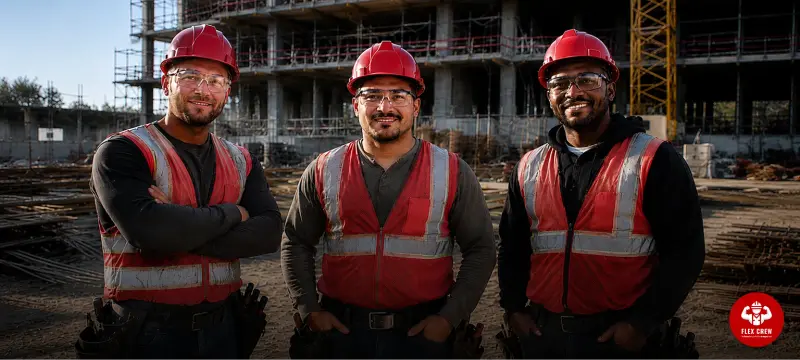
Key Takeaways
A construction staffing platform connects contractors with pre-screened skilled trade workers faster than traditional hiring methods.
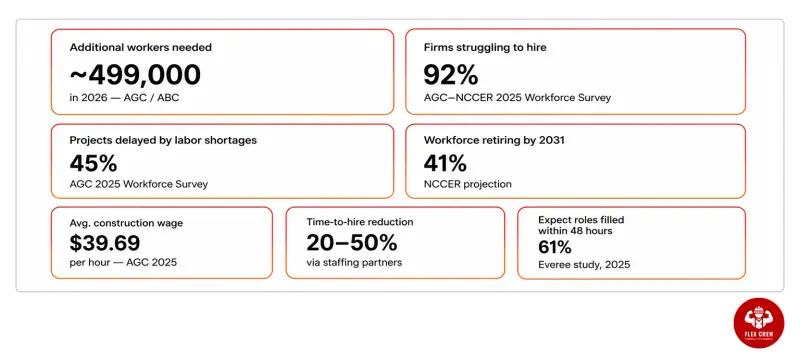
The U.S. construction industry needs to attract 439,000 new workers in 2025 alone to keep pace with demand.
94% of construction firms report difficulty filling open positions, particularly in the craft workforce.
Staffing platforms cut average hiring timelines from 34 days (manual process) to 21 days using advanced staffing technology.
Workers benefit from faster placement, better trade-fit roles, and tools like AI resume builders that help them compete with a stronger professional profile.
FlexCrew serves high-demand markets including Texas, Florida, and Georgia, covering trades like electrical, plumbing, HVAC, welding, and carpentry.
The Real Cost of a Bad Hire, or No Hire at All
Construction doesn't wait. When a crew is short one licensed electrician or a welder doesn't show up on day one, entire workflows stall. Downstream tasks, inspections, finishing, handoffs, pile up. Penalties kick in. Overtime skyrockets.
The U.S. Department of Labor estimates that a bad hire costs at least 30% of that worker's first-year salary. For a skilled tradesperson earning $30 per hour, roughly $62,400 annually, that's nearly $19,000 in replacement costs alone, before you account for delayed project timelines or rework from underqualified hires. The Society for Human Resource Management (SHRM) puts the total cost of replacing an employee even higher, between 50% and 200% of annual salary depending on role complexity.
In construction, those numbers hit differently. According to a survey, 54% of contractors reported project delays caused directly by workforce shortages, more than delays from supply chain issues or shipping disruptions combined. And unlike supply chain bottlenecks, a workforce gap doesn't resolve itself. You have to actively go find the right person.
That's the problem a construction staffing platform solves.
So, What Is a Construction Staffing Platform?
A construction staffing platform is a specialized digital system that connects construction companies with skilled, pre-screened workers faster and more reliably than traditional staffing agencies or general job boards.
Unlike a generic hiring platform built for white-collar roles, a construction staffing platform understands the trades. It's built around trade-specific workflows, certifications, and the day-to-day realities of the jobsite. It doesn't ask a welder to upload a resume formatted for a marketing role. It captures what actually matters: experience, trade specialty, certifications, availability, and location.
Think of it as a smart intermediary. On one side: contractors and project managers who need reliable workers, electricians in Dallas, HVAC techs in Orlando, carpenters in Atlanta. On the other: skilled tradespeople who want steady, well-paying work that fits their expertise. A construction staffing platform brings both sides together quickly, with verified information on each end.
FlexCrew does exactly this. Contractors can search pre-screened workers by trade and geography. Workers get matched to real opportunities, not listings that vanish into a void. And both sides work within a process that respects how construction actually operates.
One distinction worth making clearly: a construction staffing platform is not the same as construction staffing software. Tools like Arcoro, Bullhorn, or TeamEngine are internal HR platforms, software a company installs to manage its own recruiting pipeline, track applicants, and handle onboarding paperwork.
A construction staffing platform like FlexCrew is a two-sided marketplace that actively sources, vets, and places workers. You're not buying a tool to run your own hiring process, you're accessing a pre-built workforce pipeline. That difference matters when you're evaluating options, because they solve different problems.
The Scale of the Shortage: Why Platforms Matter Now
To understand why a construction staffing platform has become essential in 2026, you need to understand the scale of the workforce problem it's responding to.
According to the Bureau of Labor Statistics (BLS), there were 292,000 open construction jobs in December 2024, with a job openings rate of 3.4%, up from 3.2% the previous year. ABC's chief economist noted that the industry must attract 439,000 additional workers in 2025 beyond normal hiring just to balance supply and demand. If it fails, labor cost escalation will accelerate, making projects less financially viable across the board.
That shortage doesn't fall evenly. It's concentrated in the skilled trades, electricians, plumbers, HVAC technicians, where longer training requirements, licensing demands, and fewer immigrant workers intersect to create acute and persistent gaps.
In FlexCrew's core markets, the pressure is even more visible. NAHB data confirms that 38–41% of the construction workforce in Texas and Florida is foreign-born, a reflection of both the size of these labor markets and their heavy reliance on immigrant tradespeople to fill critical roles.
U.S. Construction Workforce — Key 2024–2026 Statistics
How a Construction Staffing Platform Works: Step by Step
The workflow is more practical than most people expect.
For contractors and employers: A project manager posts a role, say, a journeyman plumber needed in Houston for a 6-week commercial project. The platform immediately surfaces workers whose skills, location, certifications, and availability match. Instead of waiting a week for applicants to trickle in, the contractor is reviewing qualified profiles within hours.
FlexCrew's matching logic removes the noise. Contractors see plumbers with relevant commercial experience in the Houston area, not a stack of unrelated resumes from across the country.
For workers: A skilled carpenter who recently relocated to Atlanta creates a profile, uploads certifications, and notes trade specialty and availability. Within days, they're matched with contractors actively hiring in their market. FlexCrew's AI-powered resume builder helps workers translate field experience into a clear, professional profile, especially valuable for tradespeople who are highly skilled on the job but less confident on paper.
The time savings are measurable. Staffing Industry Analysts (SIA, 2024) found that firms using advanced staffing technology averaged a 21-day time-to-hire compared to 34 days for firms relying on manual processes. For commercial staffing roles like those in light industrial and trades, median time-to-fill can drop to as few as 4–5 business days on the right platform.
Construction Staffing Platform vs. Traditional Staffing Agency
This comparison comes up constantly among contractors evaluating their options. Here's an honest side-by-side breakdown.
Platform vs. Agency: What Changes for Contractors
A traditional staffing agency operates as a manual intermediary, you call them, they search an internal database, they call you back. The process is slow, and communication happens off-platform.
A construction staffing platform puts the tools directly in your hands. Contractors search in real time. Workers apply directly. And because the credential verification happens within the platform, you're not flying blind when someone shows up on-site.
That said, FlexCrew isn't a self-service job board with no accountability. Workers are vetted. Credentials are confirmed. The platform model combines the speed of technology with the trust infrastructure a proper staffing operation requires.
The Trades a Construction Staffing Platform Covers
Not all platforms cover the full breadth of the skilled trades, and that matters in practice. Construction isn't one industry. It's dozens of highly specialized disciplines working in tight sequence. A gap in any one trade can derail a project that was otherwise tracking on time.
FlexCrew covers the core skilled trades that keep construction moving in competitive markets like Texas, Florida, and Georgia.
Electrical: Licensed electricians and apprentices for commercial, industrial, and residential projects. Over half of builders in NAHB's 2024 HMI survey reported shortages of electricians. Demand is especially acute across the Sun Belt, where new development is near-constant.
Plumbing: Journeymen and master plumbers for ground-up builds, renovations, and tenant improvements. One of the most consistently hard-to-fill trades in fast-growing metros.
HVAC: Technicians for installation and service. NAHB's 2024 survey confirmed HVAC as one of the most shortage-affected trades among builder-employed craftsmen. With intense summer heat across Florida and Texas, HVAC work isn't optional, and neither is having the right crew in place.
Welding: Structural, pipe, and MIG welders for commercial construction, light industrial, and infrastructure projects. Skilled welders rank among the most sought-after workers on any job list.
Carpentry: Framers, finish carpenters, and form carpenters. According to NAHB's February 2024 HMI survey, 65% of builders reported some or serious shortage of workers performing finished carpentry, one of the highest shortage rates across all surveyed trades.
FlexCrew also supports light industrial staffing, which intersects with construction supply chains in ways that directly affect project timelines, warehouse workers, material handlers, and equipment operators who keep crews supplied and schedules intact.
Why Workers Benefit Just as Much as Contractors
The staffing conversation in construction almost always centers on what employers need. But the worker side of a construction staffing platform matters equally, and platforms that don't serve workers well end up with shallow talent pools, which means they don't actually serve contractors well either.
For skilled tradespeople, especially those new to a region or transitioning between projects, a construction staffing platform provides visibility. A welder who relocated to Georgia from another state can get in front of active contractors without spending weeks cold-calling project managers or waiting for word-of-mouth referrals.
This matters more than many contractors realize. NAHB data shows that Hispanic workers now make up approximately 32% of the U.S. construction labor force, with the number of Hispanic construction workers growing from 2.5 million to nearly 3.8 million between 2010 and 2023. In Texas and Florida, where 39–41% of construction workers are foreign-born platforms with bilingual support and accessible onboarding can tap into this workforce in ways traditional agencies never could.
FlexCrew's AI Resume Builder is a practical example of what worker-focused design looks like in action. Many highly capable tradespeople have never written a resume, they built their careers through union halls, word of mouth, or job-site referrals. That doesn't make their skills any less real. The AI Resume Builder helps workers translate years of field experience into a professional profile that contractors can evaluate quickly and confidently. It's a small feature with an outsized impact on placement quality and speed.
Trade Shortage Severity by Category
Understanding which trades face the steepest shortages helps contractors and workers alike prioritize where a construction staffing platform delivers the highest value.
Choosing the Right Construction Staffing Platform
If you're evaluating platforms, whether you're a contractor in Dallas or a trades professional looking for work in Tampa, here's what separates platforms worth using from the ones that waste everyone's time.
Trade specialization: Generic job boards don't distinguish between a structural welder and a pipe welder. A real construction staffing platform does. The matching logic has to understand trades at a granular level.
Worker verification: Certifications, licenses, and safety credentials should be confirmed before anyone sets foot on your job site. FlexCrew's vetting process is built into the platform, not bolted on as an afterthought.
Speed and transparency: Can you see available workers in your market right now? Can a worker see real, active job opportunities? If the platform feels opaque or slow, the underlying process usually is too.
Worker-facing tools: Platforms that help workers present themselves professionally attract better candidates. That's why FlexCrew's AI Resume Builder isn't just a benefit for job seekers, it's a supply-side advantage for every contractor who hires through the platform.
Geographic reach in your markets: For contractors working across Texas, Florida, Georgia, and surrounding states, you need a platform with real density in those markets, not just national brand recognition and thin local coverage.
That said, a construction staffing platform isn't the right tool for every situation. For a single-day general labor need where one of your existing crew members can absorb the work, your own contacts will likely move faster. And if your company already has a fully staffed internal HR team running a healthy recruiting pipeline, a dedicated HR software tool may complement what you're already doing.
Where platforms like FlexCrew genuinely outperform every other option is when trade verification, speed, or multi-state geographic reach are real operational constraints which, for most active contractors in the Sun Belt, they are.
A Construction Staffing Platform Is No Longer Optional
The days of posting a job and waiting are over for contractors who want to stay competitive. A construction staffing platform is the operational infrastructure that modern construction hiring runs on: faster placements, verified credentials, and a two-sided experience that works for both the employer and the worker.
The workforce data is clear. With 292,000 open construction jobs, 94% of firms struggling to fill craft positions, and an industry that needs nearly half a million new workers in 2025 alone, the contractors who move quickly and systematically have a real competitive edge. Those who rely on word-of-mouth and manual hiring will continue to lose time, money, and contracts.
FlexCrew is built for the realities of U.S. construction in 2026, specifically for the high-demand markets of Texas, Florida, Georgia, and beyond. Whether you need a licensed electrician in Houston this week or you're a skilled HVAC tech looking for steady work in Orlando, FlexCrew connects you with the right opportunity quickly, reliably, and without the friction of old-school hiring.
Ready to staff smarter? Visit FlexCrew to find workers or find work, starting today.