
Getting a welding cost estimate wrong is one of the fastest ways to lose money in fabrication. Whether you run a shop bidding a structural steel contract or you're a welder calculating your value on a job site, the numbers have to hold.
At FlexCrew, we staff skilled welders and fabricators across Texas, Florida, Georgia, and other high-demand markets every week. One thing we hear constantly from employers and workers alike: most people underestimate what a welding job actually costs. This blog breaks that down with real numbers, industry data, and a framework you can apply immediately.
Key Takeaways
A complete welding cost estimate covers four inputs: labor rate, material cost, deposition rate, and operator factor.
Labor typically accounts for 60–70% of total welding project cost.
Process selection alone, MIG vs. flux core vs. metal core can shift cost per foot by $3 or more. That's thousands of dollars on a production run.
The American Welding Society (AWS) projects that over 330,000 new welding professionals will be needed by 2028, with roughly 82,500 jobs to fill annually. Skilled welders who understand cost estimation are in the highest demand.
Operator factor, the percentage of shift time a welder actually spends pulling the trigger is the most overlooked variable in any shop's cost model.
Why Welding Cost Estimation Gets Complicated
Welding isn't a single activity. It's a system, wire, gas, electricity, human time, and equipment, and each one carries a cost that compounds across a job. A shop in Houston or Tampa running 500 feet of fillet weld per day can't afford to guess on any of those inputs.
TheU.S. welding market was valued at $118.14 billion in 2025 and is expected to reach $205.78 billion by 2035. That growth is fueled by infrastructure investment, energy projects, and manufacturing, all of which depend on fabrication shops getting their pricing right. At the same time, over 157,000 welders are nearing retirement, while projections suggest 320,500 new welders will be needed by 2029 just to meet demand. Labor is getting harder to find and more expensive. That makes accurate cost estimation more critical than ever.
The good news is the math isn't complicated once you understand the four cost drivers.
The Four Cost Drivers Behind Every Welding Cost Estimate
1. Labor Rate
Labor is your biggest line item on any job, consistently representing 60–70% of total project cost. But "labor rate" doesn't mean just the welder's hourly wage. It means your full shop rate: wages, payroll taxes, benefits, equipment depreciation, power consumption, rent allocation, and insurance.
In most Texas and Florida metro markets, a fair average welding shop rate runs $65 to $95 per hour for in-shop fabrication. Specialized work, certified pipe welding, aerospace-grade TIG, structural work requiring AWS D1.1 qualification, commands more. Structural welding averages $80–$120 per hour, pipe welding $100–$150, and custom fabrication $80–$150.
2. Material Cost
Material cost includes filler metal (wire or rod), shielding gas, base metal, and consumables like nozzles, contact tips, and grinding discs. Wire costs vary by type. Solid MIG wire runs lower per pound, but your deposition efficiency determines actual cost per pound of weld metal deposited. Dual-shield flux core and metal core wire cost more per pound but often deliver better economics per foot of weld at higher travel speeds.
3. Deposition Rate
Deposition rate is how many pounds of weld metal you're putting down per hour of arc time. It's calculated from wire feed speed and wire diameter. Higher deposition means more feet of weld per hour, and lower cost per foot. This is where process selection has its biggest impact on your welding cost estimate.
4. Operator Factor
No welder strikes an arc for a full 60 minutes every hour. They change wire spools, grind fit-up, reposition, wait on fixtures, and handle safety checks. The operator factor is the percentage of clock time actually spent welding. In most production environments, that number sits between 20% and 50%. A job that looks like 2 hours of arc time on paper is often 4–5 hours of real shop time. Ignoring the operator factor is how bids go underwater.
Cost Per Foot: The Metric Production Shops Live By
For any shop running high weld volumes, the most useful number in a welding cost estimate is cost per foot of weld. The formula looks like this:
Cost per foot = (Hourly shop rate + Hourly material cost) ÷ (Travel speed in ft/hr × Operator factor)
Here's how that plays out across five common processes, using real process data from a senior weld process specialist at Airgas, tested on 3/8" plate T-joints with consistent wire diameter, gas flow rates, and shop rate:
Welding Cost Per Foot by Transfer Mode (3/8" Plate Fillet Weld)
The short-circuit column should concern any shop manager running a heavy plate on that process. At $7.28 per foot versus metal core's $3.95, you're spending $3,330 more per thousand feet every single day. That's not a rounding error. That's a hiring decision, a machine payment, or a margin recovery.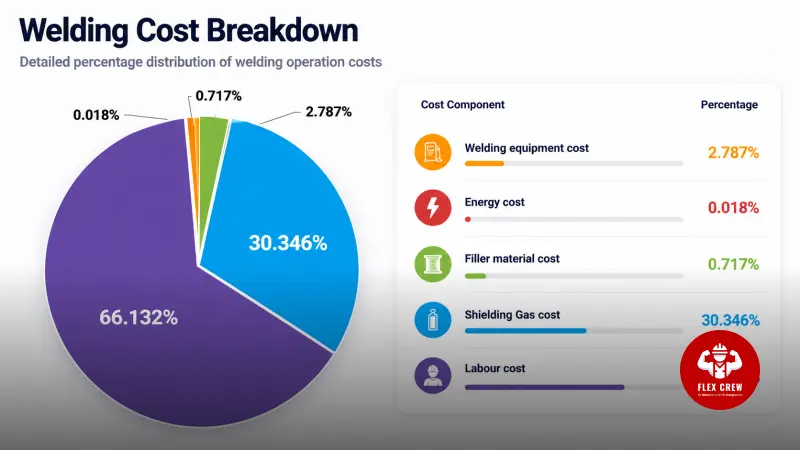
How to Build a Welding Cost Estimate Step by Step
Here's the practical framework. It applies whether you're quoting a single job or setting a production cost model.
Step 1 — Define the joint and weld size: Butt, fillet, groove, or lap joints each carry different weld metal volumes per foot. A 1/4" fillet deposits roughly 0.129 lbs per foot. A 5/16" fillet deposits roughly 0.202 lbs per foot. Start with joint geometry and leg size everything else follows from there.
Step 2 — Calculate weld metal weight: Multiply weld metal volume per foot by total weld length. Add 10–15% for spatter and stub loss on stick processes, and slightly less for wire processes with good operator technique.
Step 3 — Find your deposition rate: Wire feed speed and diameter determine melt-off rate in lbs/hour. Spray transfer and metal core typically run 40–60% higher deposition rates than short-circuit MIG at comparable wire diameters.
Step 4 — Calculate arc time: Divide total weld metal weight by deposition rate. This gives you arc-on hours.
Step 5 — Apply operator factor: Divide arc-on hours by your operator factor (as a decimal). A 30% operator factor on 2 hours of arc time means 6.7 hours of shop time. That's what you bill.
Step 6 — Add all cost components: Multiply shop hours by your blended shop rate. Add filler metal cost (lbs × cost/lb) and gas cost (CFH × arc hours × cost/CF). Sum them for your total welding cost estimate.
Sample Welding Cost Estimate: 100 Ft of 5/16" Fillet Weld (Spray Transfer MIG)
Values are illustrative. Actual costs vary by wire type, gas mix, shop rate, and operator skill.
Process Selection: Where the Real Savings Hide
The biggest lever on any welding cost estimate isn't wire price or gas cost, it's process selection. And it's the decision shops get wrong most consistently.
Short-circuit MIG has a hard ceiling around 200 amps. That limits travel speed and deposition rate. On thin sheets or root passes, it's the right call. On a 3/8" plate in a flat or horizontal position, it's an expensive habit. The data above makes this concrete, not theoretical.
Spray transfer breaks through that ceiling. Above roughly 200A and 24V, you get a smooth, high-energy arc that deposits metal fast and cleanly. The trade-off is positional limitation: spray is largely a flat and horizontal process. For shops in Georgia or Florida running structural steel, angles, and gussets in flat position, it's often the default that should be.
Pulse welding widens the envelope. You can run the pulse out of position with a more controllable puddle, useful for vertical or overhead joints where straight spray would cause excessive runout. The cost premium over spray is modest, typically $0.50–$1.00 per foot, and justified when the application demands it.
Metal core wire in spray transfer delivers the best economics for high-volume flat production. Higher deposition rates and faster achievable travel speeds produce the lowest cost per foot of any process tested on plate. The limitation is position, metal core without pulse is largely a flat/horizontal process.
Welding Process Quick Reference, When to Use What
What Welding Labor Actually Costs in 2026
Understanding process economics is half of a sound welding cost estimate. The other half is understanding what skilled labor actually costs to hire, retain, and deploy, especially in the markets where fabrication demand is highest.
The median annual wage for welders, cutters, solderers, and brazers was $51,000 in May 2024, according to the Bureau of Labor Statistics. But that median masks real variation by specialty and market. The highest 10% of earners topped $72,970, while the lowest 10% earned under $36,830. Certified pipe welders, structural welders with D1.1 or API 1104 credentials, and welders with aerospace or nuclear experience regularly command $70,000–$100,000+.
For shops doing their own hiring, the cost of a welder goes beyond wages. You're paying for job boards, interviewing time, onboarding, and the weeks or months before a new hire reaches full production speed. In tight labor markets like Houston, Tampa, or Atlanta, where fabrication demand is running strong, that search can stretch longer than expected.
The AWS reports that 21% of the U.S. welding workforce is over 55, with only 9.4% under 25. Retirements are outpacing new entrants. That math means labor costs will trend upward, and shops that can staff quickly and consistently will have a meaningful cost advantage over competitors that can't.
This is where FlexCrew directly supports fabrication shops. We specialize in placing skilled welders and light industrial workers across Texas, Florida, Georgia, and beyond, handling sourcing, screening, and placement so shops can focus on production rather than recruitment. When a project ramps up and you need certified welders on the floor fast, FlexCrew closes that gap.
For workers on the other side of the equation, understanding cost estimation makes you a more compelling hire. Welders who can speak to deposition rates, operator factor, and process economics stand out in any interview. And if you're updating your credentials for a new opportunity, FlexCrew's AI-powered resume builder helps you present your certifications, process experience, and specialties in a format that gets noticed by fabrication shops and industrial contractors.
Tools That Speed Up the Math
Several online calculators can accelerate your welding cost estimate. ESAB's Quick Weld Productivity Analyzer and Airgas's fillet cost calculator both allow you to input wire feed speed, joint type, labor rate, and material cost to generate per-foot estimates. TWI Software's Welding Estimator handles more complex job costing across multiple projects. Migal's weld cost calculator is another solid tool for simple single-joint estimates.
Use them as a starting point, not a final answer. A calculator that outputs $4.20 per foot is only as accurate as the travel speed, operator factor, and shop rate you give it. Optimistic inputs produce optimistic numbers. Accurate inputs produce estimates that hold when the job runs.
The Bottom Line on Welding Cost Estimation
A tight welding cost estimate isn't about being conservative, it's about being precise. Know your four cost drivers. Select the right process for the joint and position. Apply an honest operator factor. Track actual travel speeds on the floor and compare them to what your estimate assumed.
Shops that do this consistently bid more accurately, win better work, and protect margins. Welders who understand it command better pay and are easier for employers to evaluate and place.
Whether you're managing a fabrication operation in Dallas, running a structural shop in Tampa, or building a career in the trades across Georgia or the Southeast, the numbers behind welding cost estimation aren't just accounting, they're competitive advantage.
When you're ready to staff up or take the next step in your welding career, FlexCrew is the staffing partner built for the skilled trades.