
Water finds the weak spot in every home. It always has. If you're researching waterproofing cost per square foot right now, you're probably staring at a quote, a damp wall, or both. National data from Angi puts basement waterproofing at $3 to $10 per square foot on average, with a typical total project landing around $5,239. This blog breaks down what actually drives that number, what real homeowners have paid, and what the work looks like on site.
Key Takeaways
Waterproofing cost per square foot typically ranges from $3 to $10 for residential basements, per Angi's 2026 cost data
Interior drainage systems cost less than full exterior excavation
Basement waterproofing cost per square foot rises sharply with soil type, depth, and foundation access
Crawl space encapsulation cost per sq ft runs $2 to $4 for basic work and $3 to $10 for extensive projects
Getting three quotes with matching scope is the single best way to avoid overpaying
Why Waterproofing Cost Per Square Foot Varies So Much
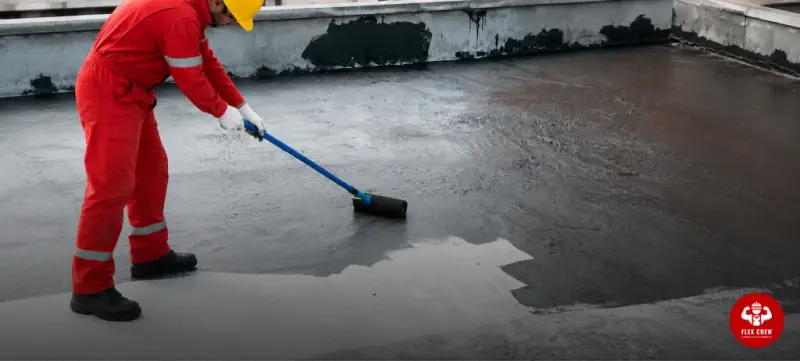
There is no single number that fits every house. Waterproofing cost per square foot depends on the water source, the foundation depth, and the method a contractor recommends. A basement with minor seepage along one wall costs far less to treat than a full-perimeter foundation with active hydrostatic pressure.
Soil matters too. Heavy clay soil, common across parts of the Midwest and much of the Southeast, holds water against a foundation longer than sandy soil does. Homes in Texas and Florida often deal with a different problem: high water tables and seasonal storms that push moisture through slabs rather than basement walls.
Labor availability shifts pricing as well. In markets where skilled trades are stretched thin, waterproofing crews charge more simply because demand outpaces supply. This is part of why staffing plays such a direct role in what homeowners eventually pay.
Waterproofing Cost Per Square Foot by Method
These figures represent national averages. Local labor rates in Texas, Florida, and Georgia can push numbers up or down depending on contractor demand and permitting requirements.
Basement Waterproofing Cost Per Square Foot
Basement waterproofing cost per square foot is the number most homeowners search for first, and for good reason. Basements sit below grade, which means they absorb pressure from groundwater year-round.
According to Angi, minor interior fixes like sealing a single crack can cost as little as $600, while a complete drainage system can run up to $15,000. This Old House puts the average even higher for larger, comprehensive jobs, estimating $13,640 for a full 1,000-square-foot basement once excavation and materials are included.
Real homeowner discussions back this range up from the ground level. One Ohio homeowner was quoted $25,000 for a 1,600-square-foot basement with dual sump pumps, a full perimeter interior gutter system, and a vapor barrier. That works out to roughly $15 per square foot, on the higher end but consistent with a comprehensive, triple-redundant system.
Another homeowner in Lorain County, dealing with water along two walls and hidden mold, received estimates ranging from $8,000 for basic interior drainage to figures as high as $190,000 for full exterior excavation on a deep foundation. The spread illustrates a simple truth: scope changes everything.
A contributor in one of those threads offered a useful shortcut. Address surface water first. Extending downspouts, regrading soil, and adding berms costs a few hundred dollars and sometimes resolves the issue entirely, without ever needing a full foundation drain replacement.
Waterproofing Cost At a Glance
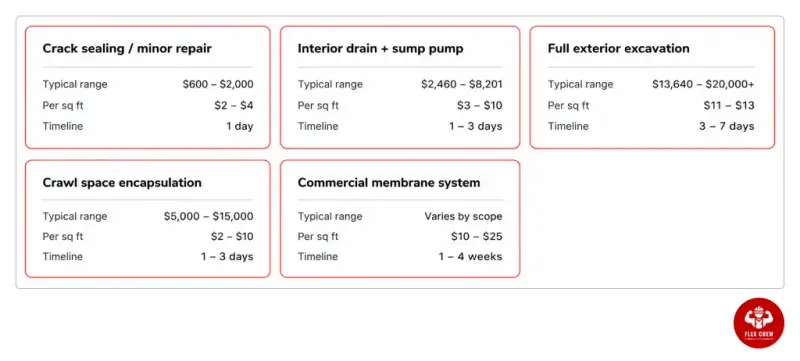
This snapshot is built from Angi, HomeAdvisor, and This Old House 2026 cost data, alongside industry commercial pricing benchmarks. Use it as a starting reference point, not a final quote.
Crawl Space Encapsulation Cost Per Sq Ft
Not every home has a basement, and crawl space encapsulation cost per sq ft is a related but distinct expense. Encapsulation involves sealing the crawl space floor and walls with a vapor barrier, then often adding a dehumidifier or sump pump.
Angi's 2026 data shows basic crawl space encapsulation running $2 to $4 per square foot, while more extensive projects involving cleaning, repairs, or mold treatment can reach $3 to $10 per square foot. A full professional job typically totals between $5,000 and $15,000, averaging around $5,500.
Encapsulation cost per sq ft climbs when a crawl space has standing water, pest damage, or existing mold, since prep work happens before waterproofing can even begin. This work is especially common in Florida and Georgia, where humidity and elevated water tables make crawl spaces vulnerable year-round.
Commercial Waterproofing Cost Per Square Foot
Commercial waterproofing cost per square foot follows different rules than residential work. Commercial projects involve larger footprints, stricter code requirements, and often multiple trades working in sequence.
Academic and industry cost data puts commercial roofing and membrane waterproofing between $10 and $18 per square foot, with below-grade foundation waterproofing in high-risk zones averaging $15 to $25 per square foot. Industrial applications with multi-layer systems can exceed $20 to $40 per square foot depending on chemical exposure and structural complexity. Waterproofing alone can represent up to 5% of a commercial project's total construction budget.
For general contractors managing these jobs, staffing becomes the real bottleneck behind that per-square-foot number. A crew shortage on a commercial waterproofing project doesn't just delay one trade. It can hold up framing, drywall, and finish work stacked behind it, and that delay shows up in the final invoice.
What a Professional Actually Does on Site
A licensed waterproofing contractor typically starts with a moisture inspection, checking readings along the wall-to-floor joint. From there, the crew identifies whether water is entering through the cold joint, hydrostatic pressure, or surface drainage failure.
For finished basements, drywall and framing usually need to come down first. This isn't optional. A professional needs to see the bare foundation to diagnose the real problem instead of guessing behind a wall.
Interior drain tile paired with wall sheeting is one of the most requested systems, according to industry professionals, because it addresses all three phases of water intrusion and typically comes with a lifetime warranty. It isn't the cheapest option, but it isn't the most expensive either. Most contractors describe it as the balanced middle choice.
DIY repairs tend to backfire. Improperly sealed cracks or mismatched drainage systems often mean a professional crew has to remove the DIY work before installing a correct system, which raises the total waterproofing cost per square foot in the end.
Getting an Accurate Estimate
Homeowners consistently report the same lesson: get more than one quote, and compare scope, not just the total. An $18,000 bid that skips trenching in one section isn't cheaper than a $28,000 bid that includes full perimeter work and a dehumidifier. It just looks that way on paper.
Ask each contractor three direct questions. Is this interior or exterior work? Why does this method fit my specific foundation? What does the warranty actually cover? These three questions surface most red flags quickly, before a contract gets signed.
It also helps to understand flood risk and soil type for your specific address. A property near a lake, wetland, or coastline, or in a region with heavy clay soil, should expect higher waterproofing cost per square foot than a home on well-drained, sandy ground.
Where FlexCrew Fits Into the Waterproofing Trade
Every number in the tables above rests on one thing: available skilled labor. Contractors need reliable plumbers, laborers, and equipment operators to keep waterproofing projects on schedule, and that's where FlexCrew comes into the picture.
FlexCrew provides construction staffing and skilled trades hiring across Texas, Florida, Georgia, and other active markets, connecting businesses with workers experienced in plumbing, HVAC, carpentry, and general light industrial support. Waterproofing crews often need this exact mix, especially during peak storm-season demand when project volume spikes fast and every open slot on a crew adds to the wait.
For contractors, that means faster access to vetted workers without carrying excess payroll during slow months, which helps keep bids competitive rather than inflated by labor scarcity. For workers, FlexCrew offers job placement support and a straightforward path into steady construction work, including an AI-driven resume builder that helps skilled tradespeople present their experience clearly to hiring contractors.
If you're a contractor bidding waterproofing jobs and struggling to staff them fast enough, that's a labor problem, not a pricing problem. And it's exactly the kind of gap FlexCrew was built to close.
Final Thoughts on Waterproofing Cost Per Square Foot
There's no way around it: waterproofing is an investment, not a quick fix. Waterproofing cost per square foot depends on your foundation, your soil, your region, and the honesty of the contractor standing in your basement.
Homeowners in Texas, Florida, Georgia, and beyond should expect real variation between interior and exterior systems, and between residential and commercial waterproofing cost per square foot figures. Getting the scope right the first time protects the investment for decades.
If you're a contractor who needs reliable crews to keep waterproofing jobs on schedule, or a skilled tradesperson looking for steady placement, FlexCrew can help you move faster on both sides of the job.