
Construction projects live and die by their connections, and that starts with welds. There are over 100 welding processes in use today, but construction sites really only rely on a handful of them. Knowing the types of welders for construction, and what each one is actually good at, is the difference between a strong hire and a costly redo.
That's where staffing gets tricky. Contractors across Texas, Florida, Georgia, and other fast-growing markets need welders on short notice, and not every welder fits every job. FlexCrew, a construction and skilled trades staffing partner, works with contractors in these regions every week to match the right process experience to the right project.
Before you post a job or call a staffing partner, it helps to understand what you're actually asking for.
Key Takeaways
There are five welding processes that show up on construction sites most often: oxyfuel, stick, flux core, MIG, and TIG.
The U.S. Bureau of Labor Statistics counted 457,300 welders, cutters, solderers, and brazers employed in 2024, with a median annual wage of $51,000.
The American Welding Society projects the industry will need roughly 320,500 new welding professionals by 2029, with about 80,000 openings a year.
MIG welding remains the most common process on general construction and fabrication jobs.
Stick welding still holds up best in rough field and pipeline conditions.
Matching the right types of welders for construction to your project scope prevents wasted labor hours and rework.
Why the Types of Welders for Construction Actually Matter
Not every weld on a job site calls for the same skill set. A pipeline repair needs something different than a thin-gauge HVAC duct or an aluminum trailer frame. Hire the wrong type of welder and you risk weak joints, wasted material, or a redo that blows your schedule.
Every welding process has to do three things well. It needs a concentrated heat source. It has to shield the molten weld pool from contamination. And it has to add filler material to build the joint. How each process handles those three tasks is what separates one type of welder from another.
The stakes are higher than they used to be. According to the Bureau of Labor Statistics, welder employment is projected to grow only 2 percent from 2024 to 2034, yet about 45,600 openings are expected each year, mostly from retirements. The American Welding Society puts the gap in sharper terms, projecting the U.S. will need around 320,500 new welding professionals by 2029, with roughly 80,000 jobs to fill annually between 2025 and 2029. That shortage means qualified welders, especially ones trained on the right process, don't stay on the market long.
The Welding Workforce, By the Numbers
The U.S. Bureau of Labor Statistics counted 457,300 welders, cutters, solderers, and brazers employed in 2024, earning a median annual wage of $51,000. Employment is projected to grow just 2 percent through 2034, but that slow growth masks a real problem: roughly 45,600 openings are projected each year, mostly from workers retiring or transferring out of the trade.
The American Welding Society frames the shortage in starker terms, projecting the country will need around 320,500 new welding professionals by 2029, with roughly 80,000 jobs to fill annually between 2025 and 2029. AWS data also shows that about 60 percent of the U.S. welding workforce is concentrated in the South, Southeast, and Great Lakes regions.
For contractors hiring in Texas, Florida, and Georgia, that regional concentration matters. These states sit inside the part of the country that already holds the largest share of the nation's welding workforce, which is one reason FlexCrew focuses its recruiting efforts there.
Oxyfuel Welding: The Old-School Foundation
Oxyfuel welding, often called gas welding, uses a flame from burning acetylene and oxygen to melt metal. It's one of the oldest processes still taught today, dating back to the early 1900s.
On modern construction sites, oxyfuel welding isn't common anymore. It's slower and less efficient than newer processes. It still shows up in light aircraft frame work, race chassis fabrication, and welding schools where trainees learn to control a weld puddle.
If you're staffing a general construction crew, you likely won't need an oxyfuel specialist. But a welder trained on oxyfuel usually has strong fundamentals in puddle control, which transfers well to other processes.
Stick Welding: Reliable and Field-Ready
Stick welding, or shielded metal arc welding, uses a coated electrode and an electrical arc to melt metal. The equipment is simple: two cables, a clamp, and an electrode holder.
The coating on the rod, called flux, burns off during welding and shields the weld pool from air. It leaves behind slag that has to be chipped or brushed away once the weld cools.
Stick welding handles thicker materials well, generally an eighth of an inch or more. It struggles on thin sheet metal because it runs too hot for delicate work. This process is still a mainstay in pipeline and repair work, since field conditions can be dirty, windy, or wet, and stick welding tolerates that better than gas-shielded processes.
Flux Core Welding: A Budget-Friendly Workhorse
Flux core welding feeds a tubular wire with powdered flux inside instead of a solid electrode. The gun automatically feeds wire when the trigger is pulled, so there's no need to stop and swap rods.
This process is popular with hobbyists because the equipment can be inexpensive. But it also earns a solid place in industrial settings, especially for outdoor structural work. Flux core still produces slag, though less than stick welding, and it's easier to remove.
For contractors building outdoors in windy conditions common across Texas and the Gulf Coast, flux core holds up well since it doesn't rely on a shielding gas that wind can blow away.
MIG Welding: The Construction Site Standard
MIG welding, or gas metal arc welding, is likely the most common process you'll see across general construction and fabrication shops. It uses a solid wire fed through a gun, along with a shielding gas, usually a mix of argon and carbon dioxide.
Because there's no flux involved, MIG welding leaves no slag behind. That means less cleanup and a faster path from weld to inspection. MIG welding handles a wide range of thicknesses and is relatively quick to learn compared to other processes, which makes it a practical entry point for newer welders joining a crew.
If you're hiring for a fabrication shop, a metal building project, or general contractor work, MIG welding experience should sit near the top of your list.
TIG Welding: Precision for Specialty Work
TIG welding, or gas tungsten arc welding, uses a non-melting tungsten electrode and a shielding gas, with filler metal added by hand when needed. Many machines include a foot pedal to control amperage in real time.
This process delivers the most control of any welding method. It's ideal for thin materials, aluminum, stainless steel, and any job where appearance matters as much as strength.
TIG welding has the steepest learning curve of the group. It's also slower than MIG or flux core, which makes it less practical for large-volume structural work, but it's the process to ask for when a project needs a visible, polished weld or specialty metal work.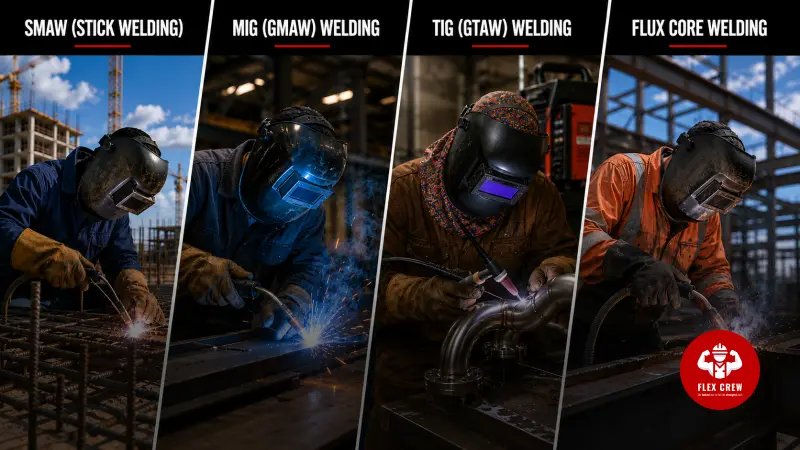
Comparing the Types of Welders for Construction
The table below lines up the five processes side by side, so you can match project needs to the right hire at a glance.
Many experienced welders are cross-trained across two or three of these processes. A welder who knows stick and MIG, for example, can flex between repair work and general fabrication as project needs shift.
Hiring the Right Type of Welder, Faster
Finding a welder with the right process experience shouldn't take weeks. FlexCrew connects contractors across Texas, Florida, Georgia, and other active markets with skilled trades workers, including welders, electricians, HVAC techs, plumbers, and carpenters, often within days rather than weeks.
For businesses, that means less time reviewing unqualified applicants and more time keeping a project on schedule. FlexCrew's staffing process is built to understand the specific process experience a job requires, whether that's MIG for a fabrication run or stick welding for a field repair, and match candidates accordingly.
For workers, FlexCrew also offers job placement support and an AI-driven resume builder. A welder can use the tool to clearly list which processes they're certified in, from flux core to TIG, which helps contractors identify the right fit faster during review.
Realistic timeframes matter here too. Straightforward MIG or stick placements can often be filled within a few business days when local candidate pools are strong. Specialty roles, like TIG welders for aerospace-grade aluminum work, may take longer since that skill set is narrower and the national shortage AWS has documented hits specialty trades hardest.
A Few Practical Steps Before You Post a Role
Start by identifying the material thickness and metal type your project involves. That alone narrows the welding process needed.
Next, consider the work environment. Outdoor, windy, or field-repair conditions often favor stick or flux core over gas-shielded MIG or TIG.
Then think about finish requirements. If the weld will be visible or needs to meet a cosmetic standard, TIG experience becomes more important.
Finally, be specific in the job posting. Listing the exact process, such as "MIG welding, structural steel, outdoor site" instead of just "welder needed," attracts candidates who are actually qualified and cuts down on mismatched applications.
Wrapping Up
The types of welders for construction each bring different strengths to a project. Oxyfuel remains mostly a training tool today. Stick welding holds up in tough field conditions and pipeline repair. Flux core offers a budget-friendly option for outdoor structural work. MIG welding covers the bulk of general fabrication and construction needs. TIG welding delivers the precision specialty projects demand.
With the Bureau of Labor Statistics and the American Welding Society both flagging a shrinking labor pool, matching the right welding process to your project scope matters more than ever. If you're hiring in Texas, Florida, Georgia, or another market FlexCrew serves, reach out to get connected with qualified welders who fit your exact job requirements.