
America's construction and manufacturing sectors are facing a skills gap that industry leaders can no longer ignore. According to the American Welding Society, the U.S. faces a projected shortage of 400,000 welders, and that's just one trade within a much larger fabrication workforce crisis. The global metal fabrication industry was valued at $693 billion in 2025 and is on track to exceed $1.1 trillion by 2034. Meanwhile, fabricated structural metal manufacturing in the U.S. alone hit $45.3 billion in 2025, up 2.2% year over year. The work is there. The workers are not.
Understanding the types of metal fabrication is fundamental to knowing where demand is concentrated, which skills are genuinely scarce, and how to position yourself, or your business, to compete in this market. This blog covers every major fabrication type in depth, backed by credible data, and grounded in what's actually happening on the shop floor and the job site.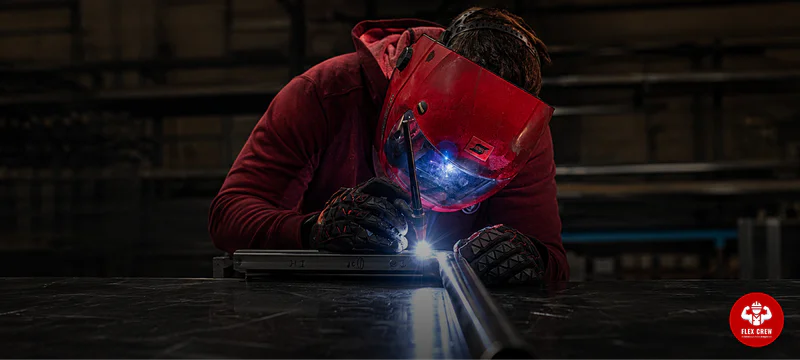
Key Takeaways
Before diving in, here's what this guide establishes:
There are 9 primary types of metal fabrication, each serving distinct functions in manufacturing and construction.
Welding holds the largest segment share in North America at 25.3% of the fabrication market.
The median annual wage for welders was $51,000 as of May 2024, with top earners exceeding $75,850.
Texas alone employs over 141,000 fabricated metal product manufacturing workers (Federal Reserve Bank of Dallas, Dec. 2025), with payroll growing 2.2% year-over-year.
45,600 welder openings are projected annually in the U.S. through 2034, mostly driven by retirements.
Construction and infrastructure account for over 34% of sheet metal market demand globally.
Workers with documented certifications in fabrication trades consistently see faster job placements and higher starting wages.
What is Metal Fabrication?
Metal fabrication is the process of transforming raw metal, sheets, bars, rods, tubes, or castings, into finished structural or functional components. It spans every industry that builds or makes things: construction, aerospace, automotive, oil and gas, HVAC, defense, and light industrial manufacturing.
What makes it a skilled trade, not just a manufacturing function, is the judgment it requires. Knowing which process to apply to which material, at what tolerance, using which equipment, that's the knowledge that separates a trained fabricator from someone who just operates a machine. Across the Sun Belt markets FlexCrew serves, that expertise is in persistent short supply.
The 9 Types of Metal Fabrication, Explained

1. Cutting: The Foundation of Every Fabrication Job
Every fabrication project begins with cutting. Raw stock, plate, sheet, bar, or tube needs to be reduced to a workable shape before anything else can happen. The quality of that cut sets the dimensional tolerance for every step that follows.
Laser cutting uses a focused light beam and is the standard for precision work on thin to medium metals. Plasma cutting uses electrically conductive gas to cut thicker materials faster, the dominant method in Texas oil and gas fabrication shops and heavy construction. Waterjet cutting uses high-pressure water with abrasive additives, ideal for heat-sensitive alloys. Sawing remains the workhorse for simple large-volume cuts in structural steel work.
Laser cutting usage across the fabrication industry rose 22% between 2020 and 2023, reflecting the broader shift toward precision and automation in shop environments.
2. Bending and Forming
Once metal is cut to size, it often needs to change shape. Bending and forming accomplish this without removing any material, they deform the metal to a new geometry.
Press brake bending is the most common method. A press brake machine applies downward force with a die to create clean, accurate angles, the kind of precision needed for brackets, enclosures, and structural frames. Roll bending passes metal sheets through rollers to create curves and cylindrical shapes. Rotary draw bending is used specifically for pipes and tubes and is standard in HVAC and plumbing fabrication.
Stamping is a broader forming method where a die presses a shape directly into a metal sheet. It's widely used in mass production. HVAC contractors across Georgia and Florida rely heavily on fabricated bent ductwork components, making press brake and roll bending skills directly relevant to FlexCrew's skilled trades hiring in those markets.
3. Welding: The Largest Segment in North American Fabrication
Welding is where the industry concentrates its most critical talent. It joins metal pieces through heat, and sometimes pressure creating bonds that are often as strong as or stronger than the base material.
Welding held 25.3% of the North American metal fabrication market in 2024, the largest single process segment. The U.S. Bureau of Labor Statistics reports that welding-related jobs account for over 400,000 positions in manufacturing alone. The median annual wage reached $51,000 in May 2024, with experienced and certified welders in high-demand markets earning significantly more.
The three active welding types in industrial fabrication are MIG (Metal Inert Gas) welding, preferred for speed and production volume; TIG (Tungsten Inert Gas) welding, used for precision work on thin metals and specialty alloys; and Arc welding, the go-to method for heavy-duty structural applications.
For workers entering the field or looking to advance, welding certifications are direct wage multipliers. FlexCrew's AI Resume Builder is built specifically for skilled trades workers, it helps you organize certifications, materials experience, and industry context in a format that hiring contractors in Texas, Florida, and Georgia immediately recognize and act on.
4. Machining: Precision at a Microscopic Scale
Machining removes material from a workpiece to achieve exact shapes, dimensions, and surface finishes. While other types of metal fabrication reshape or join, machining subtracts, and it does so at tolerances measured in thousandths of an inch.
The primary methods are milling (rotating cutters removing material in controlled patterns), turning (the workpiece rotates on a lathe while a tool shapes it), and drilling (precise hole-making for fasteners and fittings). CNC (Computer Numerical Control) machining automates all three, and it has become the standard in light industrial manufacturing environments. As of 2023, 45% of U.S. metal fabricators had adopted Industry 4.0 technologies, including CNC automation.
Florida's aerospace and defense manufacturing corridor consistently demands machining talent. CNC machinists and operators are among the positions FlexCrew places most frequently in light industrial staffing.
5. Casting
Casting involves melting metal and pouring it into a mold where it cools and solidifies into a finished shape. It's one of the oldest fabrication processes and remains essential for complex geometries that would be expensive or impossible to achieve through cutting or bending.
Sand casting is a lower-cost method suited to large or irregular parts. Die casting forces molten metal into precision molds under high pressure, enabling high-volume production of detailed components. Casting's advantage is dimensional flexibility, you can produce intricate internal geometry in a single operation.
6. Forging
Forging applies extreme compressive force, often combined with heat to solid metal, shaping it while compressing its internal grain structure. The result is consistently stronger than a cast equivalent of the same alloy.
Automotive components, hand tools, industrial flanges, and structural hardware are commonly forged precisely because the strength is built into the metal's microstructure, not just its shape. The Reddit blacksmithing community discusses this distinction regularly including experimental techniques like forge-welding steel cables for Damascus blades, which requires controlled heat, specialized flux, and a thorough understanding of how pressure interacts with metal at the grain level. That hands-on curiosity is the same drive that makes a great fabrication worker.
7. Stamping and Punching
When production volumes scale up, stamping and punching become essential. Both use dies and presses to process types of metal sheets quickly and consistently.
Stamping presses a contour, logo, or structural detail into a sheet using high force. Punching uses the same principle to remove material cutting holes, slots, and cutouts for panels, electrical connectors, and structural hardware. These processes define light industrial manufacturing environments and are among the most common assignments for workers placed by FlexCrew in production facilities across Texas and Georgia.
8. Shearing
Shearing uses two blades to make straight, high-accuracy cuts through sheet metal, think of it as industrial scissors. It's distinct from sawing or laser cutting in that it creates very clean edges on flat sheet stock with minimal waste. Shearing is a routine step in most sheet metal shops and construction fabrication environments.
9. Finishing
Finishing is the final stage in most all type welding and fabrication workflows. It determines how a part performs and looks over its service life.
Common finishing methods include powder coating (a durable, corrosion-resistant surface widely used in construction hardware and consumer products), galvanizing (a zinc coating that protects steel from rust, essential for outdoor infrastructure in Florida's coastal environments), and polishing (for surfaces where friction or aesthetics matter). Finishing also includes extrusion, drawing, and edge-folding processes that finalize the part's geometry and structural readiness.
Types of Metal Fabrication at a Glance
Types of Metal Fabrication Materials: What Gets Fabricated Most
The process matters, but so does the material being worked. Different metals respond differently to cutting, bending, welding, and forming, and choosing the wrong combination is a common source of defects and rework.
Types of Metal Fabrication Jobs: Where the Workforce Fits In
Understanding the types of metal fabrication also means understanding the labor market they generate. Across FlexCrew's active service areas, Texas, Florida, Georgia, and surrounding states, fabrication work drives consistent demand at multiple skill levels.
Texas added more construction jobs than any other state in 2024, over 42,000 new positions, and currently employs more than 857,000 workers in construction (Texas Workforce Commission). Fabricated metal product manufacturing payroll in Texas hit 141,000 workers as of December 2025 (Federal Reserve Bank of Dallas), growing 2.2% year-over-year. Dallas-Fort Worth, Houston, San Antonio, and Austin are all actively hiring combination welders, pipefitters, and CNC operators.
Florida's aerospace and defense manufacturing corridor maintains steady demand for machinists and precision welders. Coastal construction drives demand for galvanized steel fabrication and stainless work.
Georgia's expanding manufacturing base, logistics, automotive suppliers, and industrial facilities, keeps stamping, punching, and forming operators in consistent demand.
How FlexCrew Bridges the Skills Gap
The metal fabrication industry is growing, but 90% of manufacturers reported direct production issues due to labor shortages in a 2024 industry report. Finding qualified fabricators is consistently harder than finding the work itself.
FlexCrew addresses that directly. For workers, we offer job placement support backed by tools like our AI Resume Builder, which helps skilled trades workers translate hands-on shop experience, welding certifications, machine types, material knowledge, into a resume that gets seen and acted on by the contractors and manufacturers who need those skills most.
For businesses, we provide contractor hiring for both short-term production surges and sustained workforce needs across all types of metal fabrication environments. Whether you're a sheet metal shop in Houston, a structural steel contractor in Atlanta, or a light industrial facility in central Florida, FlexCrew can staff your floor without the months-long search that's become standard in this market.
Visit FlexCrew to connect with skilled workers or find your next fabrication role today.