
Construction sites run on people, not just blueprints. Behind every finished building sits a crew of hands doing very different jobs, and no two roles look quite the same. If you've ever wondered what separates a hod carrier from a heavy equipment operator, you're asking the right question.
Understanding the types of construction laborers is the first step toward building a career, or building the right team for a project. It's also the exact problem FlexCrew was built to solve. FlexCrew is a construction and light industrial staffing platform that connects workers with real job openings and helps contractors fill crews fast across Texas, Florida, Georgia, and other growing markets.
According to the U.S. Bureau of Labor Statistics, construction laborers made up roughly 1.1 million workers nationwide as of 2025, one of the largest occupational groups in the entire construction and extraction field. That scale alone shows how many different types of construction laborers the industry actually needs, and how much variation exists between them.
This blog breaks down the major types of construction laborers you'll find on a typical job site. We'll cover what each role does, what it tends to pay, and how to get started, whether you're job hunting or hiring a crew.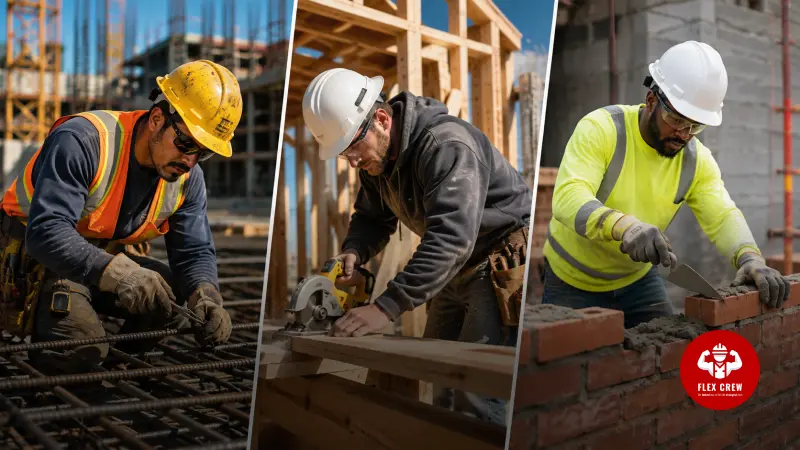
Key Takeaways
There are several distinct types of construction laborers, ranging from general laborers to specialized trade helpers.
The BLS reports a 2024 median wage of $46,050 a year, or $22.14 an hour, for construction laborers and helpers nationally.
Employment for construction laborers is projected to grow 7% between 2024 and 2034, faster than the average for all U.S. occupations.
Many types of construction laborers require little formal schooling but demand real physical skill, judgment, and safety awareness.
FlexCrew helps workers find placements and helps businesses in Texas, Florida, and Georgia hire dependable labor quickly, backed by tools like its AI Resume Builder.
Why Understanding the Types of Construction Laborers Matters
Construction is not one job. It's dozens of jobs stacked together on the same site, often working within feet of each other. A general contractor needs concrete finishers, electricians, welders, and general laborers moving in sync, on schedule, every single day.
Knowing the different types of construction laborers helps job seekers pick a lane that fits their strengths and pay goals. It also helps business owners staff projects correctly instead of guessing and overpaying for the wrong skill set.
Reddit's r/Construction community backs this up with real experience, not theory. One tradesperson described laborers as the people who "do everything possible to let the skilled guy focus on the skilled part." Another noted that a good laborer "knows the organization" and keeps an entire crew moving.
These aren't throwaway jobs. They're the backbone of every build, and the data supports that: the BLS projects about 149,400 job openings for construction laborers and helpers each year through 2034.
The Main Types of Construction Laborers, at a Glance
Before going deeper into each role, here's a quick side-by-side look at the most common types of construction laborers found on job sites across Texas, Florida, and Georgia today.
General Laborers: The Foundation of Every Crew
General laborers are often the entry point into construction. They haul materials, clean job sites, dig, and support skilled tradespeople throughout the day. One Reddit user described the role bluntly as a "human forklift," and honestly, that's not far off.
Daily tasks for general laborers include:
Loading and unloading trucks
Site cleanup and debris removal
Digging trenches and basic excavation
Prepping materials for carpenters, masons, or electricians
This role is the most common starting point among the types of construction laborers, largely because it requires no license and minimal prior experience. It also builds the foundation workers need before moving into a specialized trade.
Skilled Trade Helpers: Learning While Earning
One step up from general labor is the trade helper role. These are among the more specialized types of construction laborers, working directly under licensed tradespeople and absorbing technical knowledge on the job.
Common trade helper positions include electrician's helpers who assist with wiring and conduit runs, plumber's helpers who support pipe fitting and fixture installation, HVAC helpers who help with ductwork and equipment setup, and welder's helpers who prep materials and manage equipment for certified welders.
These roles tend to pay more than general labor because they require growing technical skill. Many helpers move into formal apprenticeships within a year or two, and FlexCrew places workers into these trade-adjacent openings across its active markets, supporting people working toward licensure in plumbing, electrical, HVAC, and welding.
Mason Tenders and Hod Carriers
Masonry work relies heavily on support labor. A hod carrier, sometimes called a mason tender, keeps bricklayers and masons supplied with mortar and block, often while working at height.
A mason who posted on r/Construction explained that hod carriers are far from unskilled. Landing "a brimmer 30ft up on a hydro mobile unit in the wind" takes real precision. Reading the wall, timing the mortar mix correctly, and knowing exactly when to restock all take genuine practice.
Many mason tenders eventually cross-train into bricklaying itself, since the two roles overlap so closely on a daily basis.
Concrete, Utility, and Road Laborers
Several other types of construction laborers focus on infrastructure work that's easy to overlook but essential to every project.
Concrete laborers pour, vibrate, and finish concrete before it sets, which leaves little room for error. Their work includes stripping structural formwork safely and coordinating pour timing with delivery trucks.
Utility and pipe laborers install water lines, sewer pipe, and gas distribution systems. One experienced union laborer described the scope as laying pipe, checking grade with a laser, shoring trenches, and tapping utility lines, work that carries real risk if trench safety is ignored.
Asphalt and road laborers rake, shovel, and place hot asphalt behind paving machines, while traffic control laborers manage lane closures nearby. As one former apprentice explained, this work "takes some thinking," especially on highway projects where a mistake can be dangerous for everyone involved.
Demolition Laborers and Equipment Operators
Before any structure goes up, something often has to come down. Demolition laborers handle manual and mechanized demolition, environmental abatement, and site clearing, sometimes including asbestos or lead paint removal.
Equipment operators represent another step up among the types of construction laborers, moving beyond hand tools into machine work. Forklift operators, roller operators, and small excavator operators fall into this category, blending general labor experience with equipment certification.
Pay Ranges Across the Types of Construction Laborers
Pay varies by role, region, certification, and union status. The table below combines national BLS figures with typical market ranges reported across Texas, Florida, and Georgia job postings.
For context, the BLS reports that the broader construction and extraction occupational group earned a median annual wage of $58,360 in May 2024, well above the median for all U.S. occupations at $49,500. That gap shows why moving from general labor into a specialized trade often pays off financially over time.
Is Construction Labor a Skilled Trade?
This question comes up constantly on forums like r/Construction, and the honest answer is: it depends on the specific role. Basic cleanup work requires less technical skill. But pipe laying, concrete finishing, and mason tending all demand real training, timing, and judgment.
As one Reddit commenter put it, "there's no unskilled labor," because even routine tasks require discipline to do safely, day after day, on a live job site. Looking at the different types of construction laborers side by side makes clear where true skilled-trade work begins and where general support work ends.
How to Start a Career in Construction Labor
Breaking into construction doesn't require a four-year degree. Most companies care more about reliability and willingness to learn than a diploma, which is part of why the industry keeps growing faster than average.
A realistic path looks like this:
Start as a general laborer to learn job site basics, usually within the first few weeks.
Build relationships with tradespeople and ask questions on-site.
Move into a trade helper role within six months to a year of steady work.
Pursue apprenticeship or certification in a specialty like electrical, HVAC, or welding.
Advance toward journeyman or foreman-level pay over roughly three to five years.
Networking matters more than people expect. Talking to companies directly, showing up on time, and demonstrating basic competence often outweighs years of formal experience, especially for entry-level types of construction laborers.
How FlexCrew Supports Workers and Contractors
FlexCrew was built around the real pace of construction hiring, where openings move fast and crews need to be staffed within days, not weeks. Workers can browse open roles across general labor, skilled trades, and light industrial positions in Texas, Florida, Georgia, and other active FlexCrew markets.
For job seekers, FlexCrew's AI Resume Builder helps turn hands-on experience into a resume that actually gets noticed. Many laborers have strong skills but weak paperwork. The tool helps translate real job site experience, hauling materials, operating equipment, assisting tradespeople, into language hiring managers respond to quickly.
For businesses, FlexCrew simplifies contractor hiring by connecting companies with pre-screened labor ready to work. Whether a general contractor needs a five-person crew for a two-week job or a longer-term hire for a specialty trade, FlexCrew shortens the search timeline considerably compared to traditional job boards.
This matters most during peak building seasons, when demand for reliable labor spikes across fast-growing Sun Belt states.
Choosing the Right Fit Among the Types of Construction Laborers
Not every laborer role suits every worker. Someone who enjoys precision work might gravitate toward concrete finishing or mason tending. Someone who prefers variety might prefer general labor, which exposes them to multiple trades quickly and helps them figure out a longer-term direction.
Contractors should think the same way. Matching the right type of construction laborer to the right task improves both safety and project speed. A skilled hold carrier on a masonry job will consistently outperform a general laborer without that specific background.
Final Thoughts
The types of construction laborers on a job site range from entry-level general labor to highly specific trade support roles, each with its own pay range, skill demands, and career trajectory. Nearly all of them offer a real path forward without student debt, and national data confirms the demand is only growing, with the BLS projecting 7% job growth for construction laborers and helpers through 2034.
Whether you're a worker exploring construction as a career, or a contractor building out a crew in Texas, Florida, or Georgia, understanding these roles makes hiring and job searching considerably easier.
FlexCrew connects both sides of that equation, pairing job seekers with real openings and helping businesses fill roles across every type of construction laborer they need. Start by browsing current openings on FlexCrew, or reach out today to build your next crew.