
Quick answer: There are three main types of construction cleaning, rough clean, final clean, and punch clean, each covering a different stage between framing and handover.
Missed handover deadlines, dust-covered fixtures, and mismatched crew sizes cost contractors real money every year. A lot of that comes down to one issue: not knowing which type of construction cleaning a project actually needs at each stage. Bidding the wrong phase, or under-staffing a final clean, turns a routine job into a loss.
FlexCrew works with contractors and cleaning companies across Texas, Florida, and Georgia. They fill these jobs with reliable, trained labor when deadlines are tight.
This blog breaks down each phase of construction cleaning, what it actually costs, and how staffing works behind the scenes. Whether you're a project manager building a scope of work or a worker looking for your next job, you'll walk away knowing exactly what to expect.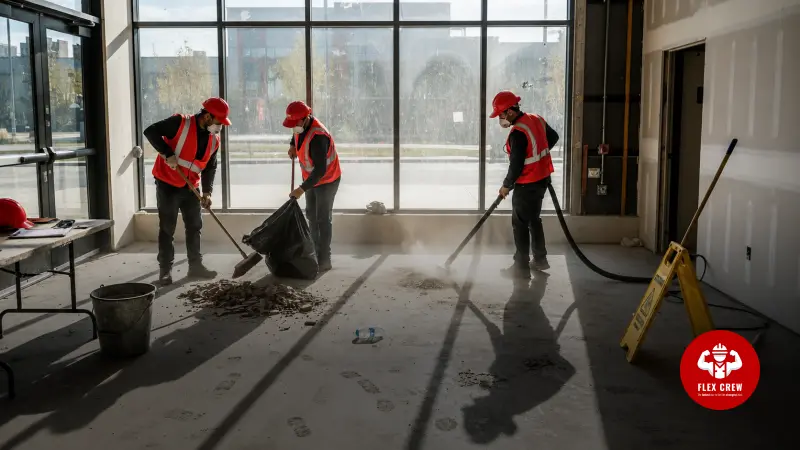
Key Takeaways
There are three core types of construction cleaning: rough clean, final clean, and punch clean.
Rates typically range from $0.10 to $0.50 per square foot, depending on the phase and region.
A backpack vacuum, easy-trap dusting system, and floor machine are non-negotiable tools.
Crews should expect to wipe most surfaces two to three times before a room is truly done.
FlexCrew helps contractors in Texas, Florida, and Georgia staff these jobs quickly, and helps workers get hired faster with a free AI resume builder.
What is Post Construction Cleaning?
Post construction cleaning is the process of removing dust, debris, and construction residue from a newly built or renovated space. It happens after trades finish their work but before the building is handed over to the owner or occupant. This isn't the same as a standard janitorial clean.
Construction sites generate drywall dust, concrete dust, adhesive residue, and paint splatter that regular cleaning products and tools weren't built for. That's why the types of construction cleaning differ so much from office or residential cleaning. Crews need heavier-duty equipment and a different pace of work altogether.
Airborne dust isn't just a cleaning inconvenience, either. OSHA's silica standard (29 CFR 1926.1153) sets a permissible exposure limit of 50 micrograms of respirable crystalline silica per cubic meter of air over an 8-hour shift, a benchmark that shapes how crews handle drywall and concrete dust on active sites.
The Types of Construction Cleaning Explained
Most construction cleaning breaks down into three distinct phases. Knowing the difference matters for bidding, scheduling, and staffing the right crew size.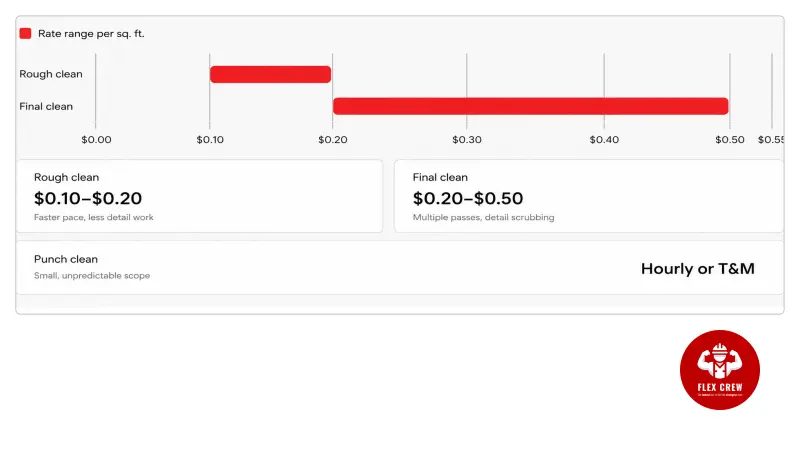
Rough clean happens first, often while trades are still on site. Crews remove large debris, sweep up boxes, pull tape and paper off floors, and clear out trash. The goal here is safety and access, not shine.
Final clean comes once fixtures, flooring, and finishes are installed. This is detail work. Crews dust every wall and ceiling, scrub bathrooms and kitchens, clean windows inside and out, and vacuum or steam-clean floors. Surfaces often need to be wiped two or three times to fully lift the dust.
Punch clean, sometimes called the touch-up or second final, happens after the punch list. Once trades come back to fix flagged items, they usually leave a new mess behind. Crews return to spot-clean those specific areas before the final walkthrough.
Some contracts bundle a fourth phase, a light construction cleanup, for smaller renovation jobs where a full three-phase process isn't needed. Reading the scope of work carefully matters here. Contracts that bury extra cleaning phases in the fine print can turn a profitable job into a costly one fast.
Types of Construction Cleaning Services You Can Hire
Beyond the three core phases, there are different types of construction cleaning services built around project size and complexity. Some companies specialize in high-rise commercial builds. Others focus on single-family homes, apartment turnovers, or retail buildouts.
Larger commercial projects in cities across Texas, Florida, and Georgia often need multiple crews working in shifts to hit tight handover deadlines. Smaller residential jobs may only need two or three workers for a day or two. This is where flexible staffing becomes valuable. A general contractor doesn't always want to keep a full cleaning crew on payroll year-round, especially between projects.
FlexCrew helps bridge that gap. Contractors can bring on trained cleaning labor for the exact window they need, without the overhead of permanent hires. That flexibility matters just as much on light industrial job sites and warehouse buildouts as it does on residential construction cleanup.
Equipment That Matches Each Cleaning Type
The tools a crew brings should match the specific type of construction cleaning on the schedule that day. A rough clean crew needs sturdy trash bins, brooms, and a wet-dry vacuum for spills and loose debris. A final clean crew needs far more: a HEPA backpack vacuum, an auto-scrubber for floors, ladders and high-dusting poles, and a full window cleaning kit.
Consumer-grade tools rarely hold up on these job sites. Household vacuums clog within an hour, and disposable dusters get expensive fast once you're covering thousands of square feet of drywall dust. Crews that invest in commercial equipment upfront usually finish faster and spend less on emergency supply runs.
Chemicals matter too. A neutral, heavy-duty degreaser handles most construction residue, but mud, paint overspray, and adhesive stickers each need a slightly different approach. Letting the cleaning solution sit on dried mud for several minutes before wiping saves time and avoids smearing it across the surface.
Post Construction Cleaning Checklist
A solid post construction cleaning checklist starts with vacuuming loose debris using a HEPA-filtered backpack vacuum. Upright household vacuums simply can't handle the dust load. From there, crews dust walls, ceilings, light fixtures, and vents before touching any wet cleaning products.
Baseboards, outlet covers, and door hardware are easy to skip but get checked during walkthroughs. Manufacturer stickers on glass, appliances, and fixtures need careful removal so they don't scratch the surface underneath.
A full checklist for the types of construction cleaning phases should also include a final inspection with the construction manager before the room is marked complete. Skipping this step is one of the most common mistakes crews make across all types of construction cleaning projects.
Post Construction Cleaning Rates
Post construction cleaning rates vary by phase, square footage, and region.
Crew productivity is a useful benchmark here. Many experienced crews complete around 200 square feet per hour on a detailed final clean. That number drops on jobs with heavy dust, custom finishes, or delicate surfaces like natural stone. Contractors bidding these types of construction cleaning jobs should factor in labor hours, not just square footage, to avoid underquoting.
The building services industry overall is large and still growing. IBISWorld has estimated the U.S. commercial cleaning services market at tens of billions of dollars in annual revenue, with construction-related cleaning as one of its faster-growing segments.
Rates in Texas, Florida, and Georgia markets can also shift based on local labor availability and project volume, and staffing shortages during peak building seasons often push rates up temporarily.
Types of Construction Cleaning Jobs and Staffing
Construction cleaning jobs range from entry-level laborers to lead crew supervisors who manage room sign-offs and quality checks. Entry-level roles usually require no prior experience, just reliability and the ability to follow a checklist. Lead roles need more experience with commercial equipment, communication with construction managers, and scheduling.
The Bureau of Labor Statistics has tracked steady demand in building cleaning occupations nationally, and construction-adjacent cleaning roles tend to track closely with regional building activity.
FlexCrew places workers into these roles across active markets in Texas, Florida, and Georgia, along with related fields like light industrial staffing and skilled trades. If a job site also needs a plumber, electrician, HVAC technician, welder, or carpenter, FlexCrew works with contractors on those placements too.
For workers entering this field, FlexCrew's AI resume builder helps highlight relevant experience, even if it's a first job in construction cleaning. It's a simple way to get a resume in front of contractors faster, without spending hours formatting a document from scratch.
Common Challenges Across Construction Cleaning Types
Every phase of construction cleaning comes with its own headaches. Rough cleans deal with trade traffic and unpredictable trash volume. Final cleans deal with stubborn residue like paint overspray and drywall mud that needs time to break down before it wipes clean.
Communication is often the bigger challenge, not the cleaning itself. Crews need a clear sign-off process with the construction manager for every room. Without it, teams end up re-cleaning spaces that were already marked complete, which eats into labor budgets fast.
Equipment failure is another common issue. Backpack vacuums clog, floor machines take a beating, and towels and chemicals run out faster than expected. Crews that show up under-equipped for these types of construction cleaning jobs often lose money on last-minute supply runs.
Turnover is a quieter challenge too. Construction cleaning is physically demanding, and crews that aren't staffed correctly for the phase in front of them tend to burn out or fall behind schedule. Matching the right worker experience level to each type of construction cleaning job helps projects stay on track without constant re-staffing.
Wrapping Up
Understanding the types of construction cleaning helps contractors bid accurately and helps workers know what a job actually involves before they show up. Rough clean, final clean, and punch clean each demand different tools, timelines, and skill levels. Getting the right crew size and experience level matters just as much as the cleaning products used.
Contractors in Texas, Florida, or Georgia staffing up for a project can turn to FlexCrew to fill construction cleaning roles quickly, alongside skilled trades and light industrial positions. Workers breaking into this field can start with FlexCrew's AI resume builder to put their experience in front of the right employers faster. Visit FlexCrew to get started today.