
Construction firms nationwide needed roughly 349,000 net new workers in 2026 just to keep pace with demand, according to Associated Builders and Contractors. Some of that gap sits in licensed trades. Some sit in general labor. Understanding skilled vs unskilled construction labor is the first step to closing it, whether you're building a crew or planning a career.
That's the exact problem FlexCrew was built to solve. As a staffing partner active across Texas, Florida, Georgia, and other fast-growing construction markets, FlexCrew places both licensed tradespeople and general labor crews for contractors who can't afford to wait on either.
This blog breaks down what actually separates skilled vs unskilled construction labor, where semi-skilled roles fit, and what the latest federal data says about pay, growth, and hiring timelines in 2026.
Key Takeaways
Skilled construction labor requires a paid-for credential, license, or apprenticeship; unskilled labor is trained on the job and paid from day one.
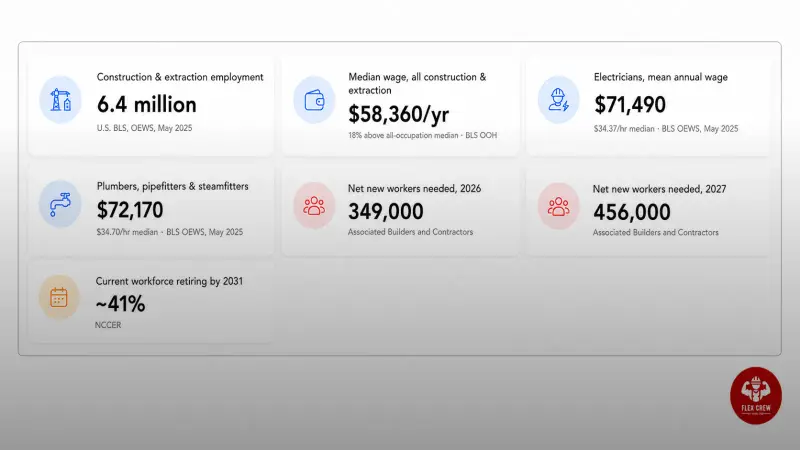
BLS data puts the median wage for construction and extraction occupations at $58,360 a year, about 18% above the median for all U.S. occupations.
ABC estimates the industry needs 349,000 net new workers in 2026, and NCCER projects 41% of the current workforce will retire by 2031.
Semi-skilled labor is the fastest-growing middle tier, bridging general labor and full trade apprenticeships.
FlexCrew fills both skilled and unskilled construction labor requests across Texas, Florida, and Georgia, often faster than firms hiring solo.
What Skilled vs Unskilled Construction Labor Actually Means
Skilled construction labor covers trades that require training beyond a high school diploma, such as electricians, plumbers, HVAC technicians, welders, and carpenters. These workers typically complete an apprenticeship, hold a license or certification, and fund much of that training themselves, through time, tuition, or years of supervised hours.
Unskilled construction labor doesn't require a credential to start. Site cleanup, material handling, demolition support, and general labor helping a skilled crew stay on schedule all fall here. Training happens on-site and pay starts immediately. That doesn't make the work easy. Moving concrete and working a full shift in Texas heat takes real stamina, but the entry bar is lower and skill is built through repetition rather than a classroom.
The table below lays out the practical distinctions at a glance.
Skilled vs Semi-Skilled vs Unskilled Construction Labor at a Glance
Wage figures reflect U.S. Bureau of Labor Statistics Occupational Employment and Wage Statistics and Employment Projections data. Actual pay varies significantly by state, licensing, and union status.
Skilled and Unskilled Labor in Construction: Real Examples
On a typical commercial build in Atlanta, Tampa, or Houston, the skilled roster includes electricians pulling wire, plumbers setting rough-in lines, HVAC installers running ductwork, and welders joining structural steel. These are the skilled labor examples contractors chase hardest, because licensed trades are the slowest positions to fill.
The unskilled and semi-skilled roster on the same site includes laborers moving materials, operators running smaller equipment, and helpers assisting the trades directly. This work demands stamina, coordination, and site awareness, even without a certificate attached to it.
Reddit's r/antiwork community has debated the labels for years, and the most upvoted explanation lines up with how staffing agencies classify roles in practice: unskilled labor means training happens on the clock and is paid for by the employer, while skilled labor means the worker brought a credential they funded themselves.
Semi-Skilled Labor: The Middle Tier Everyone Forgets
Semi-skilled labor construction roles sit between the two extremes, and this middle tier is where a lot of career growth actually happens. A semi-skilled worker might operate a pressure washer, spot for heavy equipment, assist with drywall or insulation, or run a chalk line for layout work. They've moved past pure general labor but haven't yet completed a full trade apprenticeship.
Semi-skilled labor construction positions typically pay more than entry-level unskilled roles because they carry more responsibility and some site-specific training. Many contractors build these roles intentionally, using them as a bridge toward a full apprenticeship. A worker who starts as a laborer, earns scaffolding and confined-space certification, and starts assisting with framing is walking that exact bridge, often within twelve to twenty-four months.
Why the Skilled vs Unskilled Construction Labor Gap Is Widening
The construction workforce shortage is not spread evenly across skilled vs unskilled construction labor. According to Associated Builders and Contractors, the industry needed roughly 349,000 net new workers in 2026, with that figure projected to climb to 456,000 in 2027 as spending growth resumes. The National Center for Construction Education and Research projects that about 41% of the current construction workforce will retire by 2031, taking institutional knowledge with them, largely from licensed trades.
The Associated General Contractors of America has reported that workforce shortages are now a leading cause of project delays, with a substantial share of contractors reporting at least one delayed project tied directly to staffing gaps. Unskilled and general labor positions tend to fill faster, but retention is the real challenge there, since workers move between sites and industries chasing better pay or steadier hours.
Skilled vs Unskilled Construction Labor: By the Numbers
How FlexCrew Bridges Skilled vs Unskilled Construction Labor for Contractors
FlexCrew works both sides of this equation. For contractors, that means access to licensed trades, including plumbing, electrical, HVAC, welding, and carpentry, alongside general and light industrial labor for the same project. Instead of running two separate hiring processes, a contractor in Houston, Orlando, or Atlanta can source a full crew through one point of contact.
Speed matters here. Skilled trade placements typically take longer to source than general labor, simply because licensing and verification take time. FlexCrew shortens that window by maintaining a pre-vetted bench of tradespeople across its active markets, so contractors aren't starting from zero every time a project ramps up. General labor and semi-skilled roles, by comparison, can often be filled within a few business days when volume allows.
For workers, FlexCrew's job placement support covers both ends of the skilled vs unskilled construction labor spectrum. A newly certified welder gets matched to projects that value that credential. A laborer looking to move into a semi-skilled or skilled path gets guidance on what training would open more doors.
FlexCrew's AI Resume Builder plays a direct role here too, helping workers present their actual on-the-job experience clearly, so a laborer with three years of scaffolding and demolition experience doesn't get filtered out by a resume that undersells real, hands-on skill.
Practical Steps and Timelines for Hiring Both Categories
Contractors staffing a mixed crew get better results by separating licensed-trade needs from general labor needs early in project planning. The table below reflects typical timelines FlexCrew sees across its active markets.
Typical Hiring and Career Timelines
Contractors trying to staff a licensed role with unlicensed labor to save money almost always pay more later in rework, delays, or safety violations. Budgeting realistic timelines for skilled trades, and moving quickly on general labor through an established staffing partner, keeps both sides of the crew on schedule.
Practical Steps for Workers Choosing a Path
Workers weighing skilled vs unskilled construction labor as a career decision should think about timeline and investment, not just starting pay. Entering as general labor means a paycheck immediately, with no upfront cost, and many workers use that time to learn the industry before committing to a trade.
Moving toward a skilled trade usually means an apprenticeship lasting two to five years, combined with classroom hours and supervised fieldwork. The payoff, based on current BLS wage data, is a portable, licensed credential and pay that consistently outperforms the all-occupation median. Semi-skilled roles offer a practical middle step, letting a worker build site experience and specific certifications while deciding whether to pursue a full apprenticeship.
Whichever path a worker chooses, a clear, accurate resume speeds up the process. FlexCrew's AI Resume Builder is built specifically for this, translating real job-site experience into language hiring managers and staffing coordinators recognize immediately.
The Bottom Line on Skilled vs Unskilled Construction Labor
The line between skilled vs unskilled construction labor isn't about who works harder. It's about who paid for their training and when they get paid to learn it. Federal data backs up how much both groups matter: construction and extraction occupations employ 6.4 million people nationally, and the industry still needs hundreds of thousands more workers across every skill level to meet 2026 demand.
Contractors who understand this distinction staff smarter, budgeting realistic timelines for licensed trades while moving quickly on general labor. Workers who understand it can plan a career path instead of drifting between jobs.
FlexCrew supports both sides of that equation across Texas, Florida, Georgia, and beyond, connecting contractors to reliable skilled and unskilled construction labor while helping workers find their next role and build toward the next one.
If you're hiring a crew or looking for your next job site, reach out to FlexCrew to see how fast the right match can come together.