
Underbidding is the fastest way to turn a good fabrication job into a losing one. Shop owners quote fast, win the bid, and only later realize the numbers didn't hold up. A rushed metal fabrication cost estimate is usually the root cause. Material prices moved, labor took longer than planned, or a skilled welder simply wasn't available on time.
This blog breaks down how to build a metal fabrication cost estimate that holds up from first sketch to final install, using real activity-based methods and current industry data.
Key Takeaways
A solid metal fabrication cost estimate breaks every job into design, cutting, fabrication, finishing, and install stages.
The median welder wage was $27.29 an hour nationally in May 2025, according to the U.S. Bureau of Labor Statistics.
Steel and iron producer prices rose roughly 7% year over year as of May 2026, per BLS producer price index data.
Material markups, shop rates, and machine time all need separate line items, not one blended guess.
Skilled welders and fabricators are hard to find on short notice, especially in fast-growing markets like Texas, Florida, and Georgia.
What Goes Into a Metal Fabrication Cost Estimate
Every metal fabrication cost estimate starts with the same five activities. Design, cutting, fabrication, finishing, and installation. Skip one, and your bid falls apart later.
Design covers drafting hours, customer meetings, and project management time. Cutting includes laser, plasma, or saw time plus the raw material itself. Fabrication is the actual welding, forming, and assembly work. Finishing covers sanding, deburring, powder coating, and quality checks. Installation includes field labor, equipment rental, shipping, and any subcontracted work like caulking or crane rental.
Shops that lump all of this into one "shop rate" often guess wrong. A metal fabrication cost estimate built activity by activity is far more accurate, because each stage carries its own labor, equipment, and material costs.
Metal Fabrication Cost Estimate by Job Stage (Activity-Based Model)
Metal Fabrication Cost Estimate: Labor Rates Across Texas, Florida, and Georgia
Labor is usually the largest variable in any metal fabrication cost estimate. According to the Bureau of Labor Statistics' May 2025 Occupational Employment and Wage Statistics, welders, cutters, solderers, and brazers earned a median hourly wage of $27.29, with a mean annual wage of $56,760 nationwide. That figure covers base pay only. Once a shop factors in workers' comp, payroll taxes, benefits, and overhead, billed shop labor rates typically run $70 to $120 per hour or more.
BLS also projects only about 2% employment growth for welders through 2034, even as roughly 45,600 job openings are expected each year, mostly from workers retiring or changing trades. That gap between slow growth and steady demand is exactly why skilled labor stays tight in high-construction states.
Rates and availability shift by region. Shops in Houston, Dallas, and San Antonio compete for welders against a booming construction sector. Florida shops in Tampa, Orlando, and Jacksonville face similar pressure from hurricane rebuilding and commercial growth. Georgia's Atlanta metro has seen steady demand for structural steel and light industrial fabrication work.
Metal Fabrication Cost Estimate: Labor Snapshot (BLS May 2025 Data)
When a shop is short-staffed, a metal fabrication cost estimate can look accurate on paper and still fail in practice. A job priced at $85 an hour for a certified welder means nothing if that welder isn't available in time. This is where a staffing partner starts to matter, and it's a gap FlexCrew works with fab shops to close every week.
Activity-Based Costing: A Smarter Metal Fabrication Cost Estimate Method
Many experienced fabricators rely on activity -based costing, often called ABC costing. Instead of one blended number, you assign hours and costs to each specific task on the job.
For example, design might take 60 drafting hours plus 6 hours of client takeoffs. Cutting might run 10 hours on a laser at $220 an hour. Fabrication could be 120 hours on the shop floor. Finishing might add another 40 hours of sanding and powder coating. Installation could mean 80 field hours plus equipment rental.
Add it up, and you get a metal fabrication cost estimate that's transparent and defensible. If a customer cancels mid-project, you know exactly what to bill, because each stage already stands on its own. This method also reveals where your real profit centers are. Many shop owners are surprised to learn finishing and cutting often cost as much as fabrication itself.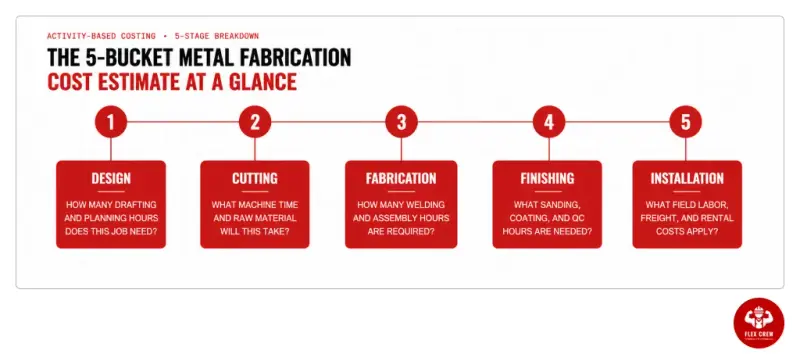
Material Costs and Markups That Shape Your Metal Fabrication Cost Estimate
Steel prices move fast, and the last two years prove it. BLS producer price index data shows iron and steel prices climbed roughly 7% year over year as of May 2026, while hot-rolled steel bars, plates, and structural shapes ran about 10% above year-earlier levels. The Associated Builders and Contractors also reported overall construction input costs up close to 9.6% year over year during the same period, driven partly by tariffs and freight costs.
That kind of swing is exactly why most experienced estimators build in a markup of 30% to 50% on raw material for a metal fabrication cost estimate. Bidding a job three to eighteen months before material purchase means predicting where steel prices will land, not where they sit today.
Hardware markups vary by item. A specialty part or small-dollar item might carry a 50% to 150% markup. A large-ticket item like a prefabricated component might only support a 20% markup, since customers can shop that price elsewhere.
Every metal fabrication cost estimate should separate material cost from labor cost. Blending them hides where your money actually goes. It also makes change orders harder to justify when a customer asks for a bigger or smaller part.
Common Mistakes That Wreck a Metal Fabrication Cost Estimate
Underestimating finishing hours is one of the most common errors. Sanding, deburring, and quality checks often take nearly as long as welding, especially on stainless steel jobs with a mirror finish.
Forgetting to separate furnish costs from install costs is another frequent mistake. A metal fabrication cost estimate needs both numbers clearly listed. This protects a shop if a customer wants materials shipped but installed by their own crew.
Skipping exclusions is a silent profit killer. If your scope doesn't include electrical, concrete, or masonry work, say so in writing. Otherwise, customers may assume it's covered and expect the shop to absorb the cost.
Finally, many shops forget to price in admin time. Bookkeeping, payroll, and HR support for a project usually run around 5% of total planning and labor hours. Leave that out, and your estimate quietly loses margin.
How Staffing Shortages Affect Your Metal Fabrication Cost Estimate
A well-built metal fabrication cost estimate still depends on having the right people to execute it. With welder job growth projected at just 2% through 2034 and tens of thousands of openings each year, shops in fast-growing regions feel the squeeze first.
When a shop can't staff a job on time, deadlines slip and costs climb. Overtime, rush freight, and idle rental equipment all eat into the margin built into the original bid.
This is where FlexCrew fits in. FlexCrew, the staffing partner, works with construction and manufacturing businesses across Texas, Florida, Georgia, and other active markets to fill skilled trades and light industrial roles quickly. Shops use FlexCrew for welders, fabricators, electricians, HVAC techs, plumbers, and carpenters when a bid depends on labor that has to show up on schedule. Contractors and business owners can request qualified workers directly, so a well-priced metal fabrication cost estimate doesn't stall over an open position.
For workers, FlexCrew also offers job placement support and an AI-driven resume builder. A welder or fabricator looking for steady shop or field work can build a stronger resume in minutes and get matched to active openings faster.
Tools and Software for a Faster Metal Fabrication Cost Estimate
Spreadsheets remain a popular tool for building a metal fabrication cost estimate. A well-built spreadsheet tracks design hours, cutting time, material costs, finishing hours, and install costs in one place.
Dedicated steel fabrication estimating software has grown popular too. These tools calculate structural steel fabrication cost per kg, track machine rates, and generate customer-ready quotes automatically. Online sheet metal fabrication cost calculators can also give a rough baseline for smaller jobs.
Whichever tool a shop chooses, the numbers are only as good as the inputs. Shop rates, machine rates, and labor availability all need real, current data. A metal fabrication cost estimate built on outdated labor costs or wishful staffing assumptions will miss the mark every time.
A Realistic Metal Fabrication Cost Estimate Workflow
Start with a site visit or drawing review, usually one to three days depending on job complexity. Build the activity-based breakdown next, covering design, cutting, fabrication, finishing, and install.
Price labor using current local rates for the market, whether that's Dallas, Miami, or Atlanta. Add material costs with a standard markup, then layer in a small buffer, often 5%, for unexpected changes.
Before sending the quote, double-check exclusions and payment terms. A typical deposit request runs 25% to 50%, with payment terms of 30 to 90 days. Confirm the labor is lined up to hit the promised timeline, whether that means an existing crew or a staffing partner to fill the gaps.
Final Thoughts on Your Metal Fabrication Cost Estimate
A strong metal fabrication cost estimate isn't about guessing a number that feels right. It's about breaking every job into real activities, pricing labor accurately for the region, and confirming the skilled hands exist to deliver on time.
Shops across Texas, Florida, Georgia, and other FlexCrew markets face the same challenge every week. Good pricing means little without reliable staffing behind it. Whether a shop needs a certified welder for a two-week job or a full crew for a commercial install, FlexCrew helps businesses fill skilled trades and light industrial roles fast. Workers looking for their next fabrication or welding role can lean on FlexCrew's job placement support and AI resume builder to get matched quicker.
Ready to staff the next job with confidence? Visit FlexCrew and turn your next metal fabrication cost estimate into a fully staffed, on-time project.