
Budgeting a metal fabrication project without accurate numbers is one of the fastest ways to blow a deadline and a bank account. Whether you're a general contractor in Houston running structural steel for a commercial build, a shop owner in Tampa pricing out a custom run, or a manufacturer in Atlanta sourcing fabricated components, the question is the same: how much does metal fabrication cost?
The range is real, a simple custom aluminum bracket can run just over $80 all in, while a structural architectural installation can hit $30,000 or more. What drives that gap isn't a mystery. It's materials, labor, design complexity, finishing, and how well a shop accounts for every activity in a job. This guide breaks all of it down with real numbers, current market data, and the kind of clarity that helps you walk into any project with your eyes open.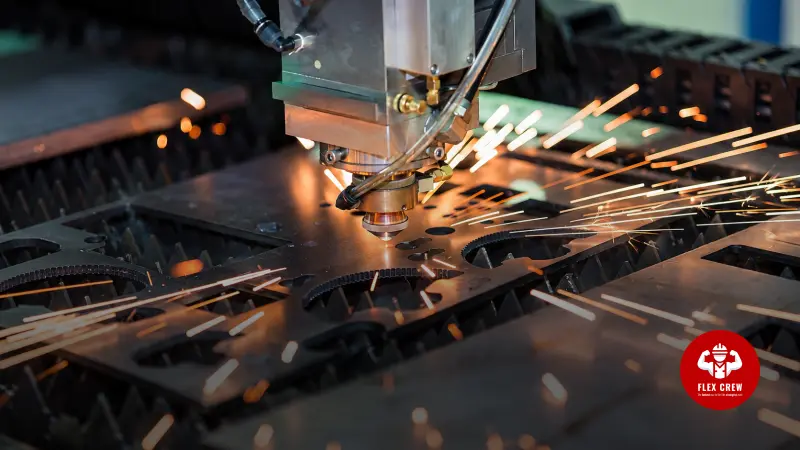
Key Takeaways
Metal fabrication projects in the U.S. typically range from $535 to $3,620, with the average custom project landing around $2,072.
Labor accounts for 40–60% of total project cost. Fabrication shop hourly rates run $75–$150/hr for general work; laser cutting machines bill at $120–$220/hr.
Material type, carbon steel vs. stainless vs. aluminum is the second biggest driver, and prices shift with tariffs and market conditions.
Finishing (powder coating, anodizing, grinding) is the most underestimated cost category. It can match or exceed weld time on complex jobs.
Structured costing methods like activity-based costing (ABC) produce far more accurate quotes than per-inch or doubling methods.
The U.S. welding workforce faces a projected shortage of 320,500 professionals by 2029, according to the American Welding Society, already pushing skilled labor costs higher in markets like Texas, Florida, and Georgia.
What Does Metal Fabrication Cost on Average?
There is no universal number, and anyone who gives you one without asking about your material, complexity, or finish is guessing. But there are reliable benchmarks.
Most custom metal fabrication projects in the United States fall within the following ranges, based on industry data and real fabricator pricing from shop-level breakdowns and community discussions:
These figures reflect real shop pricing. For context, one documented small-shop example involved a custom aluminum bracket that came out to $83.28 total, $50 in drafting (flat fee), $26 in labor for 15.5 minutes of shop time at a $100/hr rate, and $6.72 in marked-up aluminum with sales tax. The lesson: even a small part has several moving cost components, and each one has to be calculated independently.
Metal Fabrication Cost Per Hour: The Shop Rate Reality
The fabrication shop hourly rate is the single most important number in any quote. It isn't just wages, it bundles equipment depreciation, facility overhead, consumables, insurance, workers' comp, and profit margin into one billable figure. Shops that understand their true cost-per-hour make money. Shops that guess don't stay open long.
Here's how rates break down by process type in U.S. shops as of 2025:
In Texas and Florida, two of the most active fabrication markets in the country, general shop rates tend to sit slightly below the national average due to lower real estate overhead. But the story is shifting.
The median annual wage for welders, cutters, solderers, and brazers was $51,000 in May 2024, according to the U.S. Bureau of Labor Statistics, while sheet metal workers earned a median of $60,850 that same year.
Those wages translate directly into higher billable shop rates as competition for certified tradespeople intensifies, particularly in construction-heavy markets like Houston, Tampa, Atlanta, and Orlando.
How Much Does Metal Fabrication Cost Per Square Foot?
The per-square-foot question comes up most often for sheet metal work and surface finishing. The honest answer: it depends heavily on material, thickness, and what kind of finish is required.
The per-square-foot framing is most useful for finishing and material budgeting. It breaks down for total project cost because welding, bending, drafting, and setup time are measured in hours, not area. Experienced fabricators calculate these separately, which is what activity-based costing is built for.
The Five Cost Drivers That Actually Determine Your Quote
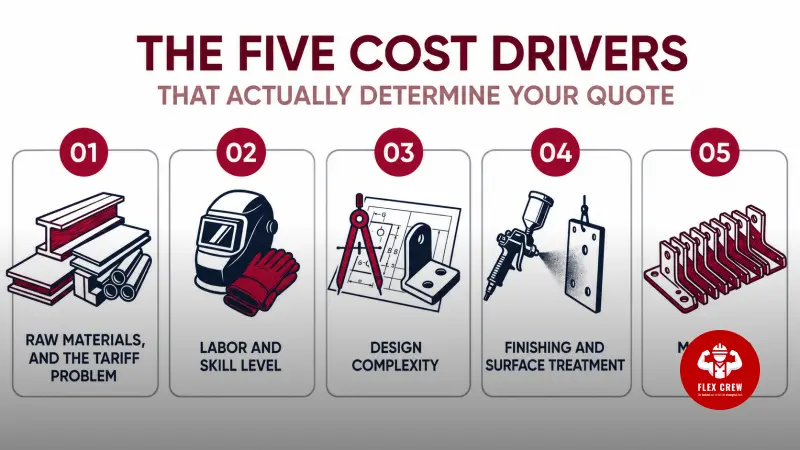
1. Raw Materials, and the Tariff Problem
Material selection is often the first and most significant cost decision. Carbon steel is the most affordable structural metal. Aluminum costs more per pound but processes quickly. Stainless steel sits higher, and titanium higher still.
What makes material cost tricky right now is market volatility.The national average price of structural steel hit $2,653.03 per ton in July 2025 before softening into early 2026, and hot-rolled coil topped $1,000 per ton in April 2026, up from $835/ton in 2024, driven largely by Section 232 tariff increases. That means a job quoted in January can look very different when material is actually purchased in June.
Experienced fabricators protect against this by building in a material markup of 35–50%. On a $230 aluminum sheet, the marked-up charge becomes roughly $310–$345 before a single cut is made. This isn't padding, it covers price swings, yield loss from nesting, storage costs, and handling. Always ask your fabricator how they handle material price changes between quote and production.
2. Labor and Skill Level
Labor is where metal fabrication cost per hour becomes the deciding factor. The time spent drafting, cutting, prepping, welding, and finishing all compounds into the final bill. A part that takes 15 minutes to cut can take 30 minutes to weld and another 10 to inspect and clean.
Skill level matters significantly. Certified TIG welders command meaningfully higher rates than general MIG operators. Precision work on stainless or aluminum, where weld quality must be structurally sound and visually clean, requires experienced hands. The American Welding Society projects that 320,500 new welders will be needed by 2029, with over 157,000 currently nearing retirement. That supply-demand gap is already being felt on labor invoices in high-activity states like Texas and Florida, where fabrication and construction intersect most heavily.
3. Design Complexity
Straight cuts and simple bends are inexpensive. Internal radii, multi-axis bends, custom-shaped cutouts, and tolerances tighter than standard practice all require more machine time, more programming setup, and higher scrap rates. A part that exceeds a brake's capacity can't simply be bent, it has to be welded out in multiple pieces, adding seams and labor time.
Complex architectural or structural projects add design cost on top: 3D CAD modeling runs $90–$200 per hour. 2D manufacturing drawings for production average $50–$60 per hour. Always spec tolerances at what the part actually needs, not the tightest number on the drawing. Unnecessary tight tolerances slow machining and raise rejection rates without adding real value.
4. Finishing and Surface Treatment
Finishing is the cost category that surprises most people, and the one that shops most often underprice when they're guessing. Sanding, deburring, powder coating, anodizing, and plating all add significant time and cost that doesn't show up in weld inches or cut lengths.
A practical industry benchmark for mild steel: three fabrication hours for every one sanding hour. For a number-four stainless finish, common in food processing, medical, and commercial architectural applications, that ratio becomes 1:1. Shops using activity-based costing track finishing hours as a separate bucket. When they do, they often find finishing rivals or exceed welding in total cost on complex jobs.
5. Quantity and Volume
Per-unit cost drops as production volume increases. Setup time, CNC programming, material nesting, and first-article inspection are fixed costs that get spread across the run. A one-off custom bracket will always cost more per unit than the same part in a run of 100. If you're evaluating a quote for a recurring part, ask specifically at what volume the per-piece price breaks.
How Professional Shops Price Metal Fabrication Jobs
The most accurate fabrication shops use activity-based costing (ABC) , a structured method that breaks every job into five distinct buckets: design, cutting, fabrication, finishing, and delivery or install. Each activity carries its own labor rate and machine rate. Materials are cost at actual purchase price with a defined markup. Nothing is bundled or estimated.
This approach reveals something counterintuitive: the cutting and finishing buckets often generate more total cost than the welding bucket, even though most people assume welding is where the money is. In a documented commercial example covering an architectural steel installation, laser cutting generated $15,000 in billable cost, finishing and assembly generated $12,000, and fabrication (welding, fit-up) generated $8,400. Design dollars nearly matched fabrication dollars.
Shops that skip structured costing and instead charge by the weld inch, double the material cost, or eyeball a quote end up either undercharging, and losing money, or overcharging, and losing customers. Neither outcome builds a business.
What Drives Quotes Up Unexpectedly
Real fabricator discussions and Reddit metalworking threads consistently surface the same list of quote inflators that catch customers off guard:
Rush lead times carry premiums of 20–30% or more. Expedited work disrupts scheduled production and often requires overtime pay.
Material price changes between quote and execution are especially volatile right now given tariff-driven steel price swings. Clarify in writing how your fabricator handles this before signing.
Over-specced tolerances slow everything down. Tighter tolerances mean slower cut speeds, higher scrap rates, and more inspection time. If the dimension isn't structurally critical, don't hold it to ±0.005".
Unplanned finishing, especially outdoor corrosion protection for parts going into a Florida or coastal Georgia environment is frequently an afterthought that adds thousands. Specify your end-use environment upfront and let the shop design the finish for it.
Post-weld cleanup on jobs where cut quality suffers adds time that wasn't in the original estimate. This happens when torch settings aren't dialed in for the material. Ask your fabricator what QC steps happen before fabrication begins.
What This Means for Fabrication Shops Managing Workforce
Running a fabrication operation, whether you're a shop owner in Dallas, a GC managing subcontractors in Tampa, or a light industrial facility in metro Atlanta, comes down to having the right skilled workers available when the work demands them.
Welders, CNC operators, press brake technicians, laser operators, and QC personnel all have distinct certifications and experience requirements. A shortage of any one of them creates a production bottleneck that ripples across every cost category above.
According to the American Welding Society, approximately 82,500 welding jobs need to be filled annually through 2028, a figure that represents both a national workforce challenge and a daily operational reality for shops across the South and Southeast.
That's where FlexCrew fits in. FlexCrew specializes in construction staffing and skilled trades hiring across Texas, Florida, Georgia, and other active U.S. markets, connecting certified welders, fabricators, and light industrial workers with shops and contractors that need to staff up quickly without sacrificing quality or compliance.
Whether a Houston shop needs a structural welder for a three-week job or a Florida manufacturing facility needs a consistent pipeline of skilled production workers, FlexCrew handles sourcing, screening, and placement with real trades knowledge behind every match.
Skilled tradespeople looking to get placed faster can also use FlexCrew's AI-powered resume builder, which helps welders and fabricators present their certifications, weld processes, and materials experience in a format that gets noticed by the right shops, especially in competitive markets where the difference between getting called and getting overlooked often comes down to how credentials are positioned.
Conclusion: Know the Numbers Before the Job Starts
Understanding how much does metal fabrication cost means looking past the number on the quote and into what's inside it, labor rates, machine costs, material markups, finishing hours, and overhead. The shops that price with discipline deliver predictable outcomes. The customers who understand these drivers get more transparent quotes and fewer change-order surprises.
Whether you're a contractor building out a project in Dallas, a manufacturer sourcing fabricated parts in Tampa, or a shop owner trying to sharpen your own pricing model, the same principle applies: accurate numbers beat gut estimates every time.
And if your operation needs certified welders or skilled fabricators to stay on schedule and on budget, FlexCrew is ready to help, across Texas, Florida, Georgia, and beyond.