
Getting a drywall quote that feels too high, too vague, or wildly different from the next contractor's bid is one of the most common frustrations in home renovation. Homeowners rarely know if $3,200 for a ceiling is fair or a rip-off. Contractors bidding jobs across busy markets face a different problem: staffing enough skilled hands to hit the price they quoted.
So, how much does drywall installation cost per square foot in 2026? According to national cost data from Angi and HomeAdvisor, most homeowners pay between $1.50 and $3.50 per square foot for a fully installed job, materials and labor combined. That number moves up or down based on ceiling height, finish level, and local labor availability.
This guide breaks down real 2026 pricing data, explains why quotes vary so much, and shows how staffing plays a bigger role in your final cost than most people realize. FlexCrew works with contractors and skilled trades crews across Texas, Florida, Georgia, and other active markets, and drywall labor shortages are one of the most common scheduling headaches we help solve.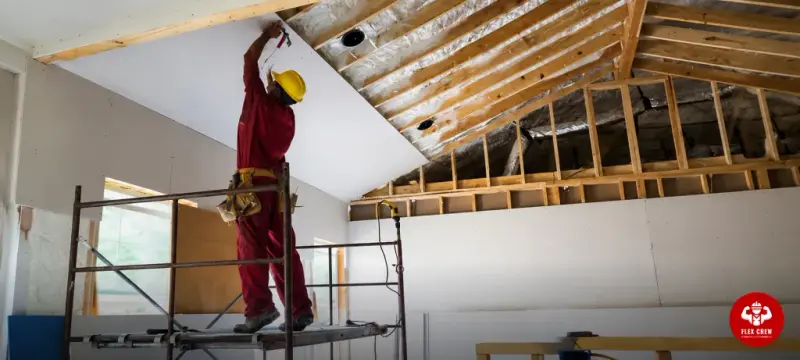
Key Takeaways
National data from Angi and HomeAdvisor puts drywall installation at $1.50 to $3.50 per square foot in 2026.
The average total drywall project costs $2,102, per Angi's analysis of completed jobs.
Labor makes up 65% to 75% of total drywall installation cost.
The U.S. Bureau of Labor Statistics reports a median annual wage of $58,140 for drywall and ceiling tile installers as of May 2024.
Ceilings, small jobs, and high-demand metro markets almost always push the price toward the top of the range.
What Drives How Much Drywall Installation Costs Per Square Foot
Three factors decide your final number: materials, labor, and finish level. Materials are the smaller pieces. According to HomeAdvisor, drywall sheets themselves cost $0.50 to $0.80 per square foot, or roughly $12 to $20 per 4x8 panel.
Labor is where the real cost lives. HomeAdvisor reports that labor accounts for 65% to 75% of total installation cost, while Angi puts that figure closer to 70%. That labor cost breaks down into three phases: hanging the sheets, taping and mudding the seams, and sanding for a smooth finish.
Finish level matters too. The Gypsum Association defines several finish levels, from a rough Level 0 used behind walls to a flawless Level 5 used in bright, open rooms. Higher finish levels mean more coats, more drying time, and more labor hours.
National Cost Data: What Homeowners Actually Pay
Real project data tells a more reliable story than online estimates. Angi's analysis of completed jobs found that total drywall installation projects average $2,102, with most homeowners spending between $1,000 and $3,252. HomeAdvisor reports a similar average, with typical spending between $987 and $3,216.
The table below shows how these national averages break down by common project size.
Notice how the whole-house project costs less per square foot than the small bathroom once you divide it out. Larger jobs benefit from crew efficiency, while small jobs carry fixed setup costs no matter the size.
Labor vs. Material: Where Your Money Actually Goes
Understanding how much drywall installation cost per square foot means understanding the labor-to-material split. Here's how national data breaks that down.
This is exactly why labor availability moves the market so much. When skilled hangers and finishers are in short supply, the labor share of your quote climbs, and so does the total price per square foot.
Why Labor Shortages Push Prices Higher
The U.S. Bureau of Labor Statistics reports that drywall and ceiling tile installers earned a median annual wage of $58,140 as of May 2024, with wide variation by region. Metro areas with strong construction demand, including many parts of Texas, Florida, and Georgia, tend to sit above that median.
The National Association of Home Builders notes that interior finishes, including drywall, represent roughly 22% to 26% of total hard construction costs on a new single-family home. That's a significant chunk of any build, and it's directly tied to whether skilled crews are available when the schedule calls for them.
This is where staffing becomes part of the pricing conversation, not just a background detail. Contractors who can't find enough hangers or finishers either push back their timeline or pay overtime rates to keep pace, and both options raise the final number a homeowner sees.
FlexCrew works with contractors across these markets to fill exactly those gaps. Through construction staffing and skilled trades hiring support, FlexCrew helps connect contractors with drywall hangers, finishers, framers, and other trades workers, so a labor shortage doesn't have to mean a blown deadline or an inflated bid.
Quick Reference: 2026 Drywall Cost Snapshot
For a fast, at-a-glance summary, here's the core data every homeowner or contractor should know before requesting a quote.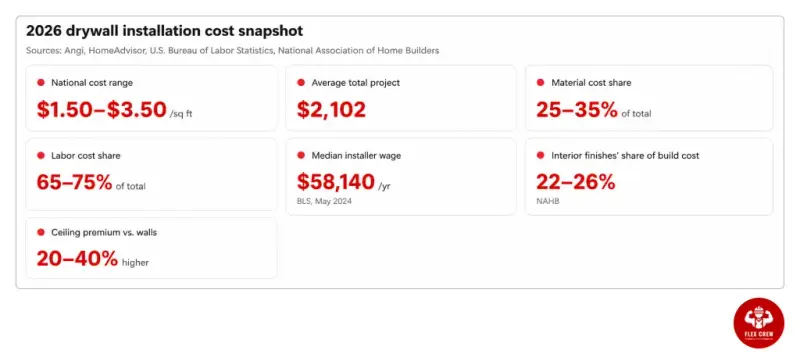
Why Ceilings Cost More Than Walls
Ceiling drywall consistently costs more than wall drywall, and the reasoning is physical, not just anecdotal. Overhead panels are heavier to maneuver, harder to hold in place while fastening, and more likely to sag or crack at the seams if rushed.
A homeowner on a popular drywall discussion forum recently posted a $3,200 quote for a 350-square-foot ceiling, materials and labor included, with demolition excluded. Several working contractors in that thread confirmed the price was reasonable, breaking it down to roughly $600 in material with the remainder covering prep, hanging, three coats of mud, and texture.
That same thread highlighted a detail worth remembering: framing issues often surface only after an old ceiling comes down, adding labor that wasn't in the original bid. It's a reminder that how much does drywall installation cost per square foot can shift mid-project once a contractor sees what's actually behind the surface.
Small Jobs vs. Whole-House Projects
Pricing per square foot rarely stays flat across project sizes. A breakdown from a real 3,000-square-foot home build showed close to 260 sheets of mixed drywall types needed, with material costs landing around $7,000 and labor priced per sheet, commonly $25 to $34 per sheet depending on the region.
Smaller jobs don't get that same efficiency. A single ceiling or one room requires the same setup, delivery, and cleanup time as a much larger project, so contractors often charge more per square foot to make the job worthwhile. This is standard practice across the industry, not a sign that a small-job quote is unfair.
Practical Steps for Getting an Accurate Quote
Start by confirming what's included. Ask whether demolition of old material is part of the price, since many quotes, like the ceiling example above, exclude it. Ask about the finish level, since Level 5 work costs meaningfully more than a basic Level 4 finish.
Get two or three quotes when possible, especially in competitive metro markets. Regional labor costs vary enough that a national average is only a starting point, not a final answer.
If you're a skilled tradesperson looking for steady drywall, framing, or finishing work, having your experience clearly presented helps you get hired faster. FlexCrew's AI Resume Builder helps workers organize their trade experience so job placement support can match them to open roles more quickly, whether that's a large residential build or a light industrial project.
Regional Notes for Texas, Florida, and Georgia
Pricing isn't uniform across FlexCrew's active markets. Metro hubs like Houston, Dallas, Miami, Orlando, and Atlanta typically run higher on labor rates due to demand and cost of living, while smaller cities and rural areas often price lower.
Humidity is a practical factor in Gulf Coast and Florida projects. Moisture-resistant board shows up more often in bathrooms, laundry rooms, and garages, which adds slightly to material costs but protects against long-term damage.
Whatever region you're in, local quotes still beat national averages. Permitting rules, material suppliers, and labor markets all shift the final number more than any single online estimate can predict.
Final Thoughts
So, how much does drywall installation cost per square foot in 2026? Based on data from Angi, HomeAdvisor, and the U.S. Bureau of Labor Statistics, most residential jobs land between $1.50 and $3.50 per square foot, with ceilings, small projects, and tight labor markets pushing costs toward the higher end.
Understanding the material-to-labor split, and the role skilled crew availability plays in that number, helps both homeowners and contractors plan realistically. When labor shortages threaten to slow down a drywall project or push a bid past budget, staffing support matters just as much as material pricing.
If crew availability is holding your next drywall project back, FlexCrew's construction and skilled trades staffing across Texas, Florida, Georgia, and other active markets can help you find qualified workers without the usual hiring delays.
Ready to staff your next drywall project or find skilled trades work? Visit FlexCrew to connect with contractors and job opportunities in your area.