
Commercial painters are in short supply across the country, and the pay gap between those who know their worth and those who don't can run $15,000 or more per year. According to the U.S. Bureau of Labor Statistics, the 2024 median annual wage for construction and maintenance painters is $48,660, or $23.40 per hour. That figure covers all painters. When you isolate commercial work, office buildings, warehouses, retail centers, industrial facilities, the numbers shift, often higher.
This blog covers what commercial painters actually earn, broken down by state, experience level, and employment type, so workers and contractors in Texas, Florida, Georgia, and beyond can make informed decisions.
Key Takeaways
The BLS 2024 median for construction and maintenance painters is $48,660/year ($23.40/hour).
The national average commercial painter salary is $46,305/year ($22.26/hour) as of September 2026, per ZipRecruiter.
Most commercial painters fall in the $39,500–$50,500/year range (25th–75th percentile).
Top 10% of commercial painters earn $58,000–$65,000+ annually.
Self-employed commercial painters can earn $60,000–$100,000+, depending on project volume and market.
Union painters average $74,411/year (Glassdoor, 2026), with top earners reaching $97,900.
The BLS projects 28,100 openings per year for painters through 2034 — steady, consistent demand.
In Texas, Florida, and Georgia, commercial painter hourly rates average $21.23–$22.93/hour.
Why Commercial Painting Pays More Than Residential
The distinction matters, and so does the dollar gap. Residential painters handle interior and exterior work on homes. Commercial painters work on shopping centers, warehouses, restaurant chains, hospitals, and large apartment complexes. The projects are bigger, the surfaces more varied, and the client expectations more demanding.
According to Buildermuse's 2026 BLS-adjusted analysis, the national median for all construction painters sits at $24.20/hour ($50,340/year) when accounting for 2025–2026 data adjustments, with the state spread running from $17.05/hour in Mississippi to $34.90/hour in Hawaii. That 105% gap between the lowest and highest states underlines something important: where you work and what you paint moves the needle far more than most workers expect.
Commercial work commands premium pay for real reasons. Projects involve larger crews, tighter production schedules, specialized surface prep, industrial-grade coatings, and OSHA safety coordination. A facility manager overseeing a warehouse repaint isn't hiring a one-person residential operation, they need a team that shows up reliably, works evenings around business operations, and documents the work properly.
That consistency is what makes commercial painting a career, not just a job. As one Oregon-based commercial painting contractor noted on the Painting Pro Podcast, a single facility manager relationship can generate five or more jobs in a single year. Residential work rarely delivers that kind of repeat pipeline.
2026 Commercial Painter Salary: How the Numbers Stack Up
ZipRecruiter's September 2026 data puts the national average commercial painter salary at $46,305/year ($22.26/hour). The BLS 2024 median for all construction and maintenance painters is slightly higher at $48,660/year, a gap that reflects how ZipRecruiter's real-time job posting data skews toward currently posted (and often lower) openings.
Here's the full wage distribution based on combined BLS and ZipRecruiter 2026 data: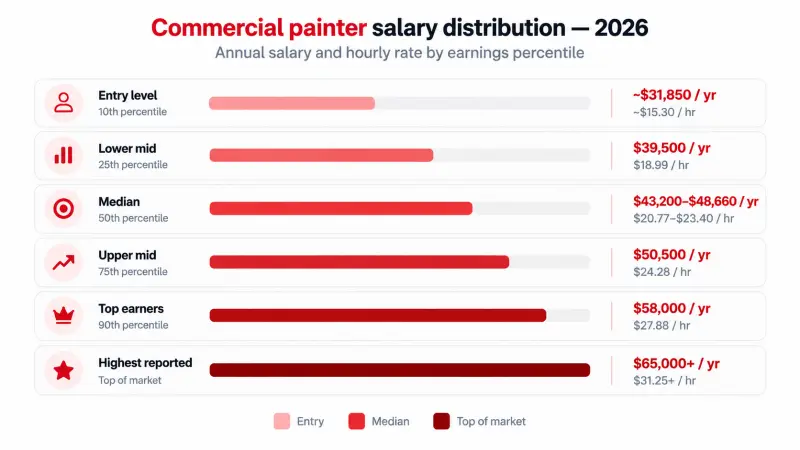
The $33,000 spread between the lowest and highest earners is the real story here. A commercial painter just starting out can reasonably expect $15–$19/hour. A lead painter or crew supervisor on large institutional projects in a strong market can command $27–$32/hour. Experience, specialization, and geography all compound each other.
Commercial Painter Salary by State: FlexCrew Markets and Beyond
Location is one of the most powerful salary levers available to working painters. States with strong commercial construction pipelines, active union presence, or prevailing wage laws consistently pay more.
FlexCrew's Primary Markets
Texas, Florida, and Georgia sit right at, or slightly above the national average. The high volume of commercial construction in metros like Houston, Dallas, Atlanta, Tampa, and Orlando keeps demand for skilled commercial painters consistent year-round. Contractors in these markets routinely need painters for retail build-outs, hospital repaints, restaurant rollouts, and industrial facility work. FlexCrew's skilled labor staffing services are specifically built for this kind of fast-moving commercial demand.
Highest-Paying States for Commercial Painters
Illinois and New York's premium wages are driven largely by IUPAT (International Union of Painters and Allied Trades) density and state prevailing wage laws. Illinois' Prevailing Wage Act and New York's Labor Law § 220 put commercial repaints on public buildings at union-equivalent rates, a significant lift for painters working those markets.
Union vs. Non-Union: The Pay Gap Is Real
The union question comes up constantly in commercial painting, and the numbers back up the argument for organized labor in high-cost markets.
According to Glassdoor's 2026 data, the average salary for a union painter is $74,411/year, with the 75th percentile reaching $97,900. That's roughly 60% more than the non-union national average of $45,394 (ZipRecruiter, May 2026).
The gap isn't just base pay. Union journeyman painters in markets like Chicago and New York earn $42–$48/hour in base wages, plus $16–$20/hour in fringe benefits (health, pension, training funds), a total compensation package that can reach $68/hour or more.
Non-union commercial painters in Texas and Florida typically earn $18–$28/hour, with fewer structured benefits. If you're working non-union in a FlexCrew market and want to understand what competitive compensation looks like for your skill level, our job placement team can help you benchmark your rate before your next job search.
Commercial Painter Pay by Experience: What to Realistically Expect
Experience compounds pay faster in commercial painting than in many trades, because the skill ceiling, industrial coatings, spray systems, complex prep work, crew leadership, keeps rising.
Entry-Level (0–2 years): $30,000–$45,000/year Most entry-level commercial painters start doing prep work: sanding, masking, priming, cleanup. BLS data puts the 10th percentile at roughly $15.30/hour for construction painters, that's the floor for new hires on commercial crews. Reddit threads from working painters in Ohio, Michigan, and Florida consistently show starting wages of $16–$22/hour depending on the company.
Experienced Painter (2–5 years): $46,000–$60,000/year At this stage, a painter handles finished surfaces, exterior work, and more demanding applications, spray rigs, specialty primers, industrial coatings. This is also where working closely with a Sherwin-Williams rep to get product spec sheets on bids starts to matter. Painters who bring technical knowledge to a job site are harder to replace.
Lead Painter or Crew Supervisor (5+ years): $55,000–$80,000/year Lead painters manage production, maintain quality control, and keep jobs on timeline. You're not just running a roller, you're responsible for crew efficiency and client satisfaction. The income jump here is real.
Self-Employed Commercial Painter: $60,000–$100,000+/year Running your own commercial painting operation is where the ceiling opens up. Contractors who build repeat relationships with facility managers, the kind that generate four to six projects per year from a single client, can build stable six-figure businesses without a large fleet. The tradeoff: you handle bidding, scheduling, invoicing, and crew management alongside the field work.
Workers ready to make that jump can start with FlexCrew's AI resume builder to build a professional profile that reflects commercial project experience, an important first step when approaching larger contractors or operating independently.
What Drives Commercial Painter Pay Up or Down
Several factors shape where a painter lands on the salary spectrum, and most of them are within a worker's control over time.
Specialization is the fastest lever: Painters who operate spray equipment, handle industrial coatings, work with lead paint remediation protocols, or specialize in floor coatings command higher rates. According to Buildermuse's 2026 analysis, the sector you paint in moves your wage more than the state you paint in. Industrial and institutional painters consistently out-earn those doing standard commercial repaint work.
Project complexity pays: Large commercial jobs, warehouses, hospital wings, school repaints, require more planning, more coordination, and more accountability than a single retail storefront. Painters who have experience on complex projects are more valuable to contractors bidding that work.
Reliability is underpriced: Contractors at every level lose clients over missed line items, unfinished surfaces, and poor communication. Painters who show up consistently, document their work, and communicate clearly tend to earn raises faster and hold steady work longer. In the podcast world of commercial painting, this reputation for reliability is the foundation of every recurring facility manager relationship.
Geography still matters: In Atlanta and Tampa, the commercial construction pipeline is active enough that skilled painters can shop offers more aggressively than in slower markets. Contractors in high-volume metros often need painters quickly, and painters who position themselves for that demand, with the right skills, resume, and connections, rarely sit idle for long.
How Much Does It Cost to Paint a Commercial Building, and What It Means for Your Pay
Understanding project economics helps workers know whether they're being compensated fairly. Commercial painting costs typically run $1.50–$3.50 per square foot for interior work and $2.00–$5.00 per square foot for exterior applications, depending on surface condition, coating type, and project scope. A 20,000-square-foot warehouse repaint can run $30,000–$70,000 in total contract value.
Labor typically accounts for 50–70% of total commercial painting project cost. On a $50,000 job, that's $25,000–$35,000 in labor. With a four-person crew over two weeks, the math should add up to a fair hourly rate, not $16/hour on a job where the contractor is billing $28/hour per head.
If that math doesn't work out for you at your current employer, it may be time to explore what other contractors are paying. FlexCrew's findworkers platform connects painters directly with commercial contractors actively hiring, without the guesswork of cold-applying to job boards.
Getting Into Commercial Painting: The Realistic Path
For workers new to the trade, the path into commercial painting is more accessible than most skilled trades. No national license is required to work as a painter, though contractors typically require a state contractor's license to operate a business.
The career progression generally looks like this:
Year 0–2: Crew helper, prep work, priming, cleanup, basic application
Year 2–5: Full journeyman capability, exterior, spray, complex surfaces
Year 5+: Crew lead, supervisor, or independent contractor
The BLS projects 28,100 openings per year for construction and maintenance painters through 2034, consistent demand driven primarily by replacement needs as the current workforce ages out. For workers entering Texas, Florida, or Georgia's commercial markets right now, the timing is good.
Before applying, a strong, clearly formatted resume matters more than most trades workers expect. Contractors running large-scale commercial work screen applicants fast, and the ones who document their project experience well get the callback.
How FlexCrew Supports Commercial Painters and the Contractors Who Hire Them
FlexCrew is a construction and skilled trades staffing company. We connect painters, carpenters, welders, HVAC technicians, and other trades workers with commercial contractors across Texas, Florida, Georgia, and beyond.
For painters looking for better-paying commercial work, we match your experience and availability with active job openings, cutting weeks out of a job search. For contractors running commercial projects, we source reliable trades workers without the delay of traditional hiring processes.
Whether you're looking for your next placement or need to find workers fast for a commercial painting project, FlexCrew is built for the pace commercial construction demands.