
Fabrication workers across Texas, Florida, and Georgia are consistently underpaid, and most of them don't know it until they quit. Pay gaps in this trade are wide, and the difference between what an average shop floor worker earns and what a skilled, specialized fabricator can pull in is not a few dollars. It's often double. Understanding where you stand, and where you could stand, starts with knowing the real numbers.
This blog breaks down how much fabricators make in 2026, backed by data from the U.S. Bureau of Labor Statistics, PayScale, and Glassdoor. Whether you're starting out, considering a specialty, or just trying to figure out whether your current rate is fair, the numbers here will give you something solid to work with.
Key Takeaways
Entry-level shop fabricators in Texas, Florida, and Georgia typically start between $15 and $20/hr. Specialized roles push significantly higher.
Specialty niches, stainless steel, pipe, structural, and aerospace, consistently pay 30–80% more than general shop fabrication.
Certifications, reliability, and willingness to change employers are the three fastest levers for higher pay in this trade.
Georgia's construction employment hit 229,200 workers in mid-2025, up 10% since pre-pandemic 2020, driving strong fabrication demand across the state.
Workers who understand their role's scope and seek specialty certifications consistently reach the upper pay tiers faster.
What Fabricators Earn in 2026
Most salary searches return an average and call it a day. That's not particularly useful here, because fabrication pay is one of the most variable in the skilled trades. The same job title can mean $17/hr at a general production shop and $55/hr at a structural steel company, both are called "fabricators."
According to the U.S. Bureau of Labor Statistics, the median annual wage for assemblers and fabricators was $45,450 in May 2025. The lowest 10 percent earned less than $34,020, and the highest 10 percent earned more than $67,440. That's a $33,000 spread within the same broad occupation category. The position of your skills, your specialty, and your geography inside that spread determines your paycheck.
PayScale data puts the median hourly rate for metal fabricators at $22.70 in 2026, with the top 10% of earners reaching $31.37/hr. Glassdoor's self-reported figures are higher. The average salary for a metal fabricator on Glassdoor sits at $57,563 per year, or $28/hr, with top earners reaching up to $80,773 at the 90th percentile.
The gap between those figures exists because different data sources pull from different pools, job postings, self-reported salaries, and employer surveys don't all measure the same thing. What matters practically is that the floor for a capable fabricator in a competitive market is meaningfully higher than what a lot of shops are currently offering.
Fabricator vs. Welder: Why the Distinction Affects Your Pay
The terms are often used interchangeably. They shouldn't be, because the distinction affects how you're classified, hired, and compensated. For a full breakdown of what separates these roles, see FlexCrew's guide onfabrication vs. welding differences and the detailed breakdown ofwelder-fabricator duties and responsibilities.
A welder's primary skill is technical arc work: maintaining the right angle, heat input, and travel speed to produce a sound joint. A fabricator does all of that, plus planning, measuring, cutting, jigging, sequencing, and problem-solving across an entire production workflow. On a typical day in a custom fabrication shop, the arc might only be lit for 10–15 minutes. The rest of the work is setup, layout, and execution, that's fabrication.
The BLS distinguishes structural metal fabricators and fitters as a separate category from general assembly workers. Their 2025 median annual wage was $51,330, roughly $5,880 per year more than miscellaneous assemblers and fabricators at $44,650. That gap is the market's recognition that fabrication skill earns a premium over basic assembly.
For comparison, welders, cutters, solderers, and brazers had a 2025 median annual pay of $53,750, higher than general fabricators but well below specialty roles. The clearest path to higher pay is combining both skills and specializing. A fabricator who can TIG weld stainless, read CAD drawings, and sequence a complex build is in a different market entirely.
How Much Do Fabricators Make Per Hour by Specialty
Not all fabrication work is equal, and pay reflects that clearly. Here's how hourly rates break down by specialty and experience level, drawn from BLS percentile data and current labor market sources:
Aircraft structure, surfaces, rigging, and systems assemblers sit at the top of the BLS fabrication pay scale, with a 2025 median of $65,380 per year. That's the clearest example of how specialization compounds your earning power in this trade.
The self-employed billing rate deserves a note here. It is not the same as take-home pay. A custom fabricator billing $150/hr in Texas or Florida is running overhead costs, shop rent, insurance, tooling, electricity, that typically run $40–$60/hr before profit.
But the ceiling on a lean, well-run small shop is real. The income potential for a business-minded fabricator is substantially higher than working for someone else in even a well-paid niche role.
How Much Do Fabricators Make by State: TX, FL & GA
Geography shapes pay significantly in fabrication. Cost of living, industrial density, and construction activity in a given region all influence what employers are willing to pay. Here's how the three primary FlexCrew markets compare, using current data from Indeed and Glassdoor:
In Georgia specifically, Indeed reports the average fabricator salary at $19.22/hr, with top-paying cities including Kennesaw at $24.93/hr and Savannah at $24.14/hr. Those aren't outliers, they reflect the industrial demand around Atlanta's manufacturing corridor and the Port of Brunswick.
Texas is the most active market in FlexCrew's footprint for fabrication hiring. ZipRecruiter data shows the average fabricator in Texas earns around $40,186 per year, or $19.32/hr, with top earners reaching $52,172 annually. That base rate understates what's available in the industrial markets around Houston, Corpus Christi, and the DFW corridor, where pipeline and structural work push rates considerably higher.
The cost-of-living factor is real and worth calculating. A $26/hr rate in Georgia or Texas generally has more purchasing power than $32/hr in a high-cost California market. Fabricators in the Sun Belt states often come out ahead in real terms even when their nominal rate looks lower.
How Much Does a Fabricator Earn Annually: A Career Stage View
Annual income for fabricators varies not just by skill level but by how aggressively a worker pursues overtime, certifications, and job mobility. The workers in Reddit's r/Welding community who reported the biggest year-over-year pay jumps had one thing in common: they moved.
A fabricator who changed shops after two years of experience consistently reported 20–30% pay increases often for the same type of work, simply at an employer with a higher new-hire budget.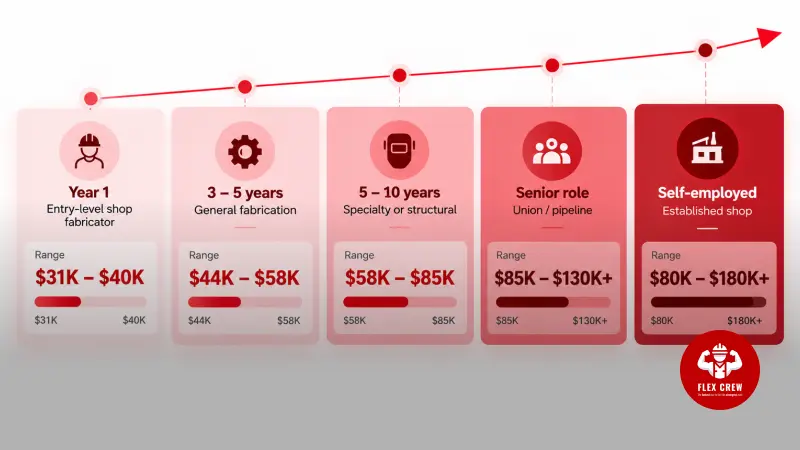
The BLS projects approximately 177,500 annual openings for assemblers and fabricators through 2035, driven largely by the need to replace workers who exit the labor force. That replacement demand is consistent and doesn't depend on rapid industry growth, it's structural, which means fabrication job availability is stable even when the broader economy softens.
Overtime is a significant income lever, particularly in industrial markets. Workers in Louisiana, Texas, and Gulf Coast industrial zones regularly report six-figure years on $40–$45/hr base rates simply because overtime is consistent and available.
What Drives Fabricator Pay Higher, And What Keeps It Flat
The Reddit threads on fabricator pay reveal an uncomfortable but useful pattern. Workers who stay at one shop for years without switching often find themselves collecting $0.50–$1.00 annual raises while new hires come in at meaningfully higher starting rates.
The market is competitive for skilled workers right now, and employers have larger budgets to attract new talent than to retain existing employees. That asymmetry works in favor of workers who are willing to move.
Several factors consistently push fabricator pay upward.
Certifications are income multipliers:AWS certifications in specific processes, TIG, MIG, SMAW, or materials like aluminum, stainless, or titanium each command premiums. Salary.com data shows that effective communication skills alone can increase a welder/fabricator's salary by up to 6%. Technical credentials move the needle further. Certifications for pressure vessel work, structural steel, or aerospace fabrication can shift a worker from the 50th percentile to the 75th percentile of earners in the same market.
Reliability is underrated, and underpriced: Shop owners and staffing professionals across Texas, Florida, and Georgia describe the same phenomenon: showing up on time and sober, ready to work at the start of the shift, immediately separates a worker from a significant portion of the available labor pool. It sounds like a low bar, it isn't. In fabrication, consistent attendance and punctuality translates directly into more responsibility, better assignments, and faster raises.
Spatial thinking and math matter: The ability to read a tape measure accurately, hold dimensions in your head, convert a drawing to real material, and ask questions when something doesn't make sense separates the $18/hr worker from the $35/hr worker in the same shop. Fabrication is not purely physical skill. It is organized thinking applied to metal.
Small business ownership changes the entire equation: A self-employed fabricator in a cost-of-living-reasonable market like Texas or Georgia, billing $100–$150/hr with $40–$50/hr in overhead, is operating a legitimate six-figure business. Getting there takes time, typically three to five years of employed work to build the skill base, tool inventory, and client trust, but the ceiling is real and the path is documented.
Finding Fabrication Work in TX, FL & GA
For workers,FlexCrew's skilled trades jobs board connects fabricators and welders with employers actively hiring across Texas, Florida, and Georgia, including light industrial, structural, and specialty roles. Workers who haven't needed to formally write down what they know how to do can use FlexCrew's AI-powered resume builder to turn real-world skills and experience into a resume that gets noticed by hiring managers.
It's a practical tool, not a gimmick, particularly useful for workers who've spent years building skill but never had to market it in writing. FlexCrew also lists temporary and short-term fabrication jobs for workers who want to test a new market or role before committing.
Georgia's construction activity alone is projected to reach $24.3 billion in 2026, with EV and advanced manufacturing facilities driving sustained demand for skilled welders and fabricators across the state.
The Bottom Line on Fabricator Pay
How much do fabricators make? Enough to build a solid living, and in the right specialty or business setup, enough to build real financial security. The BLS median sits at $45,450 annually for the broad category, with structural metal fabricators and fitters reaching $51,330 at the median. But those numbers are floors and midpoints, not ceilings.
The workers earning the most in this trade are not always the most technically gifted. They are the ones who learned their craft, kept improving, stayed reliable, pursued certifications, and eventually charged what their skills are genuinely worth. That formula works in Houston, in Tampa, in Atlanta, and in every other market where FlexCrew operates.
Know your number. Then go get it.