
Construction is one of the few industries where a worker without a college degree can realistically earn $60,000, $80,000, or even more within a few years on the job. Yet plenty of workers, especially those just starting out, are pulling far less than what their skills, hours, and physical effort actually deserve. The gap isn't random. It comes down to trade, geography, union status, and knowing how to position yourself in a market that's increasingly hungry for skilled labor.
This blog breaks down exactly how much construction workers make in 2026, from national medians to trade-specific wages to what the numbers look like in states like Texas, Florida, and Georgia, so you can get a clear, honest picture of where you stand and what's possible.
Key Takeaways
The national median wage for construction laborers is $46,730/year ($22.47/hr), per BLS May 2024 data.
Skilled trades consistently pay more: electricians median $61,590, plumbers $61,550, carpenters $56,350.
Average hourly earnings for all construction employees in Texas reached $36.94 in December 2025, per Federal Reserve Bank of St. Louis / BLS data.
The construction industry needs to attract an estimated 349,000 net new workers in 2026, according to Associated Builders and Contractors, a labor shortage that continues to push wages upward.
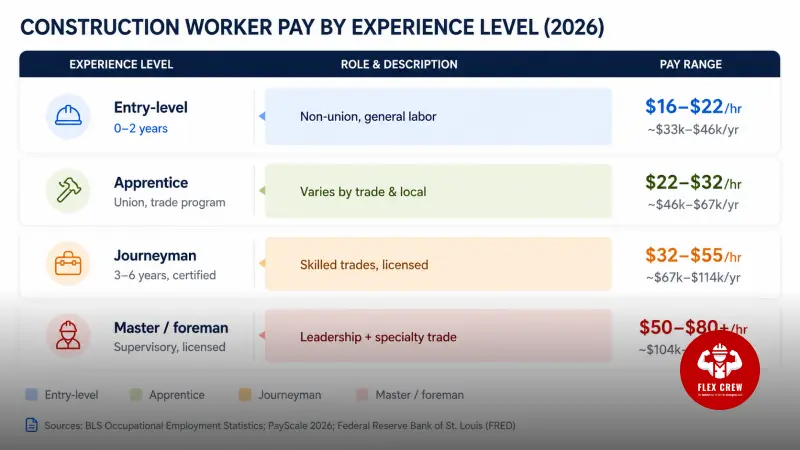
Entry-level workers typically earn $16–$22/hr; journeyman wages in skilled trades take 3–5 years to reach.
Overtime, union membership, and trade specialization are the three fastest levers for higher pay.
What the National Numbers Actually Show
The U.S. Bureau of Labor Statistics puts the 2024 median annual wage for construction laborers at $46,730, roughly $22.47 per hour. That's the midpoint. Half of all construction workers earn above it, half below. The lowest 10% brought home under $33,610 annually. The top 10% cleared more than $75,560.
Those figures cover general labor. Step into a specialized trade and the range shifts meaningfully. Electricians earned a median annual wage of $61,590, with projected job growth of 10%, among the fastest-growing in the entire construction sector. Plumbers, pipefitters, and steamfitters came in at $61,550, while carpenters reached a median of $56,350, with more than 84,000 new jobs projected through 2033.
The practical takeaway: staying a general laborer long-term puts a ceiling on what you can earn. Specializing, even at a basic level in your first year, is the single most reliable way to move up the pay scale.
How Much Do Construction Workers Make Per Hour?
Hourly pay in construction is where most workers start their calculations, and where the biggest misconceptions live. Instructors and older tradespeople sometimes quote apprentice union rates in high-cost cities as if they represent the norm. They don't.
The average hourly pay for a construction worker in 2026 is $19.98, with the range running from $14.16 at the 10th percentile to $31.21 at the 90th, according to PayScale data. That range captures the reality well: entry-level non-union labor in the South, mid-career tradespeople in mid-sized metros, and senior workers or foremen in union-heavy markets all land at very different points.
A worker on a viral YouTube segment recalled earning $120–$145 per day doing non-union construction work in the greater Los Angeles area, roughly $15–$18 per hour for a full day including commute time. That's a real data point, and it illustrates how far below the union-cited figures everyday non-union, metro-adjacent work can fall.
Construction Pay by Experience Level (2026)
How Much Do Construction Workers Make a Week and a Month?
A general laborer averaging $22/hr and working a standard 40-hour week grosses around $880 per week roughly $3,500–$3,800 per month before taxes. In active markets across Texas, Florida, and Georgia, that's a livable baseline, particularly in mid-sized metros where cost of living stays below national averages.
But the week-to-week number changes fast once overtime enters the picture. Most active job sites run 50–60 hour weeks during peak phases. At time-and-a-half, a $22/hr worker putting in just 10 extra hours weekly adds roughly $330 to their check over $17,000 annually when sustained across a full project cycle.
Workers willing to take on night shifts, weekend work, or highway projects that require off-hours scheduling frequently earn more than their base rate suggests.
Workers in trades on Reddit report union carpenter wages with significant benefit packages on top. The ceiling, when union wages, overtime, and a high-demand metro align can push annual compensation well past six figures. That's not the median experience, but it's not fiction either.
How Much Does a Construction Worker Make in a Year?
Annually, construction pay breaks into rough income tiers:
Under $40,000/year covers general laborers in low-wage markets, workers with limited hours, and those dealing with seasonal gaps or spotty work consistency. This is the reality for the bottom portion of the field.
$40,000–$60,000/year is the practical middle range for experienced laborers and early-stage trade apprentices in active markets across Texas, Florida, and Georgia. Workers who show up consistently, put in overtime, and build site-level relationships tend to land here within 2–3 years.
$60,000–$80,000/year is where journeyman carpenters, plumbers, and electricians cluster once they're licensed and working steadily with quality employers. This tier often includes benefits, health coverage, retirement contributions, that further close the gap with higher-paying white-collar work.
$80,000–$120,000+/year belongs to union journeymen and foremen in high-demand metro areas, project managers with 7–10 years of experience, and specialty tradespeople in markets like Seattle, Chicago, or New York.
The construction industry's employment level reached 8.3 million in July 2024, surpassing its previous peak of 7.7 million from 2006, even as the industry continued to face a pervasive talent shortage, with an average of 382,000 job openings per month between August 2023 and July 2024. That sustained demand is one reason why wages across the board have trended upward, not downward, over the past several years.
Pay by Trade: Where the Real Wage Differences Live
"Construction worker" covers dozens of distinct occupations. The pay difference between a general laborer and a licensed electrician at the same level of experience can be $15,000–$20,000+ per year. Trade specialization is not a minor variable, it's the primary driver of how much construction workers earn over a full career.
Median Annual Pay by Construction Trade (BLS 2024)
Source: U.S. Bureau of Labor Statistics, Occupational Outlook Handbook and Employment Projections, 2024
The pattern is consistent: trades requiring licensing, apprenticeship completion, or specialized certification pay more, often significantly more, than general labor. And within trades, the gap between entry-level and journeyman pay can be $15–$25/hr, which is why career progression matters more in construction than most workers realize early on.
According to the Associated Builders and Contractors, the industry will need 456,000 new workers in 2027, up 30.7% from 2026, driven in part by the AI infrastructure boom and returning construction spending growth. Every additional $1 billion spent on construction translates to demand for 3,450 fresh jobs. For workers in skilled trades, that demand picture means sustained upward wage pressure through the late 2020s.
How Much Do Construction Workers Make by State?
Geography moves wages more than most workers account for. A journeyman electrician in New York City and one in rural Georgia hold the same certification, but they're not earning the same paycheck. State minimum wages, union density, cost of living, and local project volume all shape what employers offer.
Average Construction Pay by State (2026)
Sources: Federal Reserve Bank of St. Louis (FRED) / BLS State and Metro Area Employment data; PayScale 2026 local market data
Texas stands out for a specific reason: the average hourly earnings figure covers all construction employees statewide, not just laborers, reflecting how many skilled tradespeople and foremen operate in the state's industrial and commercial markets. For a general laborer in Texas, $18–$22/hr is a more realistic entry point, with experienced tradespeople earning well above that.
In Florida, the median hourly pay for a construction laborer is $25.50, with the range running from $16.21 at the 25th percentile to $32.56 at the 75th, per PayScale 2026 data. The spread reflects how dramatically wages vary between Miami's commercial corridors and smaller rural markets.
For workers in Georgia, early-career construction workers in Atlanta average $17.50/hr, with the range extending up to $28.99/hr for experienced workers, according to PayScale 2026. Atlanta's metro growth has kept construction demand high, which benefits workers who are positioned to take advantage of it.
Union vs. Non-Union: What the Pay Difference Looks Like in Practice
This is the question that generates the most debate on job sites and in online forums, and for good reason. The gap is real, but it comes with trade-offs that matter.
Union construction workers earn higher base wages and receive benefits packages, health insurance, pension, annuity, that non-union workers typically have to fund themselves or go without entirely. In Pennsylvania, for example, heavy highway carpenters in union locals earn base wages of $38–$42/hr take-home, with total compensation packages valued at $60–$65/hr when pension and medical benefits are factored in. That's the union ceiling, and it takes years to reach.
The trade-offs: union apprenticeship programs run 3–5 years. Dues come out of every check. And breaking into a union locally, particularly in competitive markets, can be difficult. Workers on Reddit threads consistently note that the barrier to entry is one reason many qualified tradespeople never access union wages.
Non-union workers in fast-growth Sun Belt markets can still earn well. In Texas and Florida, where residential and commercial development is outpacing the available labor supply, skilled non-union tradespeople with the right certifications are in genuine demand. The key is being able to demonstrate your credentials clearly, and landing with employers who pay based on skill rather than tenure.
That's where having clean, well-organized documentation of your experience and certifications matters more than most workers realize. FlexCrew's AI Resume Builder is built specifically for tradespeople, pulling together certifications, equipment operated, and employment history into a format that helps skilled workers get in front of employers paying competitive rates, not just employers who happen to be hiring.
What Nobody Tells You About Construction Pay
The YouTube clips and Reddit threads about construction wages tend toward extremes. Either it's the fast track to $100K with no degree, or it's backbreaking work for $18/hr with no stability. The truth lands between those poles, and knowing the friction points matters.
Seasonal gaps are real, even in the South: Winters in Texas, Florida, and Georgia are milder than the Northeast, but projects still end, contracts still expire, and the stretch between gigs happens. Workers who stay consistently employed year-round tend to have either a strong network or a placement partner keeping their pipeline full.
Some employers don't pay reliably: Non-union residential and commercial work has a higher rate of payment disputes than most new entrants expect. Vetting employers before accepting work, checking their licensing, payment history, and reputation, is something workers often skip until they've been burned once. Connecting through a vetted staffing network helps screen that risk.
Going independent too early can backfire: Workers who leave crews to run their own operation after a few years often discover that bidding, collections, and payroll management consume what looks like higher gross pay on paper. Five years of deep trade experience is a realistic floor before going solo, not 18 months, regardless of what a quick online calculation suggests.
Pay doesn't always reflect the quality of the employer: The best-paying construction jobs aren't always the ones advertised loudest. FlexCrew works directly with contractors across Texas, Florida, and Georgia to match skilled tradespeople, electricians, plumbers, HVAC techs, welders, carpenters, with employers who offer both competitive wages and consistent work volume. That combination is what actually drives annual earnings upward.
How to Increase What You Make in Construction
The workers who move up the pay scale fastest in construction aren't necessarily the ones who work the hardest. They're the ones who make deliberate moves at the right times.
Get certified early:OSHA 10 and OSHA 30 cards cost under $200 and immediately widen your pool of eligible employers. Welding certifications, equipment operator licenses, and trade-specific credentials each add negotiating leverage.
Choose a trade specialization within your first year: Every year you spend as a general laborer is a year you're not building toward journeyman wages. Electrician's helper, plumber's apprentice, HVAC assistant, even entry-level positions within a trade move your trajectory.
Document your experience clearly: Employers can't pay you for skills they don't know you have. A well-built resume that accurately reflects your certifications, equipment you've operated, and project types you've worked isn't a luxury, it's a negotiating tool.
Apply through channels that vet employers: Not all construction jobs are created equal. FlexCrew connects workers with contractors across the Sun Belt who have both the project volume and the pay structure to support consistent earnings. Getting in front of the right employer matters as much as having the right skills.
The Bottom Line: Know Your Number, Then Go Get It
How much do construction workers make? At the median, $46,730 a year, but that number is a floor for anyone willing to specialize, get certified, and position themselves in a strong market. In active construction markets across Texas, Florida, and Georgia, skilled tradespeople with the right credentials and the right employer connections are earning substantially more.
The labor shortage isn't going anywhere. Associated Builders and Contractors projects that the industry will need 456,000 new workers in 2027, placing further upward pressure on labor costs, which means the window to negotiate better wages, access new opportunities, and move up in your trade has rarely been wider.
FlexCrew works with skilled tradespeople across the Sun Belt to make those connections faster. Whether you're stepping onto your first site or making a strategic move after five years in a trade, start by making sure your experience is documented and positioned to work for you, not just sitting in your head. Visit FlexCrew to get started.