
Most construction job postings open with a number that looks great on paper. "$25 an hour. No experience necessary." What the sign never tells you is how much of that rate survives taxes, slow weeks, misclassification, and the cost of your own tools, or how dramatically that number shifts depending on your trade, your state, and who is doing the hiring.
For workers trying to plan a career and for contractors trying to budget a project, guessing from a job posting headline is a real financial risk.
This blog cuts through it. Using data directly from the U.S. Bureau of Labor Statistics, it breaks down how much construction laborers make per hour by trade, tier, and region, so every number here has a source you can check.
Key Takeaways
Thenational median hourly wage for construction laborers is $21.78/hr; the mean is $23.69/hr (BLS, May 2023).
The bottom 10% of construction laborers earn $15.15/hr or less. The top 10% earn $36.54/hr or more.
Licensed tradespeople, electricians, plumbers, HVAC techs, earn significantly more, with national medians closer to $34–$35/hr.
Texas construction laborers average $18.74/hr. Florida averages $19.56/hr. Both sit below the national mean, but skilled tradespeople in those states earn journeyman-level rates that track national figures closely.
Massachusetts, New Jersey, and Illinois are the top-paying states for construction laborers, with mean hourly wages above $32/hr.
Union workers earn roughly 13–26% more in total compensation than non-union peers in the same trade, but union jobs now represent only about 10% of the national construction workforce.
Worker misclassification as an independent contractor effectively doubles the payroll tax burden, from 7.65% to 15.3%, on the exact same gross income.
Road construction laborers on highway and bridge projects average $27.50/hr, higher than the general laborer national median.
Construction carries a fatality rate of 9.2 deaths per 100,000 full-time workers, roughly three times the all-occupation average (BLS, 2024).
The Four Tiers That Actually Define Construction Pay
"Construction worker" isn't one job. It's closer to four distinct career levels, each with a different financial reality. Understanding which tier you occupy, or which tier you're hiring for, matters more than any single average figure. For a detailed breakdown of how these roles differ on the ground, the types of construction laborers guide covers the full spectrum.
General laborers and helpers are at the base. No completed apprenticeship, no trade license, just someone showing up to move materials, prep sites, clean job sites, and run basic tools. The BLS puts the median annual wage for this group at $45,300 as of May 2023, working out to approximately $21.78 per hour.
A realistic starting range for a fresh laborer with no prior experience is $15 to $18 per hour. That is the number behind the sign, not the sign itself. If you are trying to decide between staying at this tier or pursuing a trade credential, skilled vs. unskilled construction labor lays out the long-term difference clearly.
Licensed non-union journeymen, electricians, plumbers, HVAC technicians, carpenters who have finished their apprenticeship, earn substantially more. Nationally, electricians median around $34.37/hr and plumbers and pipefitters around $34.70/hr, with mean annual wages in the low-to-mid $70,000s. This is where trade certification makes its clearest financial argument. The path from general laborer wages to journeyman wages is real and achievable, typically through two-to-four-year apprenticeship programs.
Union tradespeople at the same skill level earn more again. Industry wage data consistently shows union construction workers averaging $33.86/hr in base wages compared to $25.16/hr for non-union workers in comparable roles. Once benefits, pension contributions, and training funds are added, total union compensation runs 13 to 26 percent higher. The catch: union density in construction has fallen to roughly 10% of the national workforce, down from about 40% a few decades ago. Union placements are competitive and not available in every market.
Foremen and superintendents running the crew rather than the tools sit at the top. The BLS pegs the median annual wage for first-line construction supervisors at $81,340 per year, around $39.11/hr, with experienced supers pushing into six figures. These are the roles that reward staying in the trade long enough to build genuine leadership experience alongside technical skill.
The Full Wage Picture: What BLS Data Actually Shows
A single average obscures more than it reveals. The BLS percentile breakdown for construction laborers gives a much more honest picture of how much construction laborers make per hour across the full workforce.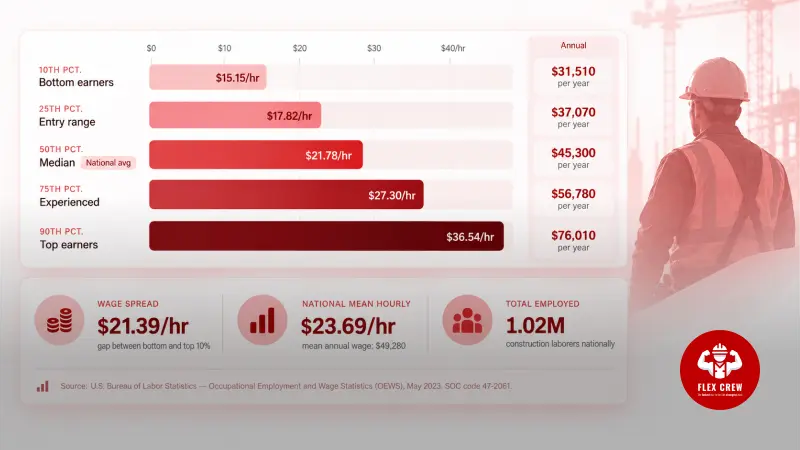
The gap between the 10th and 90th percentile, $15.15 versus $36.54, illustrates why "what does a construction laborer make?" cannot be answered with a single number. Two workers on the same job site can sit $20/hr apart based on trade certification, overtime availability, union status, and years of experience. The average construction labor cost in the US guide explores what these ranges mean from the contractor's budgeting perspective.
How Much Construction Workers Get Paid Per Hour by Trade
Not all construction work pays the same. The BLS tracks wages separately for each specialty, and the differences between a general laborer and a licensed electrician or plumber are significant, often $10 to $14 per hour for the same market.
Mean Hourly and Annual Wages by Construction Trade (BLS, 2023–2025)
Source: U.S. Bureau of Labor Statistics, OEWS May 2023; BLS May 2025 for electrician and plumber figures.
Carpenters and welders sit in the middle of this range, but their earnings vary considerably based on the type of work and the project. How much carpenters make and how much welders make break those trades down in full detail. For workers exploring which path offers the best combination of demand and pay, high-paying construction jobs is worth reading alongside this guide.
How Much Construction Laborers Make Per Hour by State
Location is one of the two biggest levers on construction pay. The BLS state-level data for construction laborers shows a spread of more than $14/hr between the highest and lowest-paying states, for the exact same occupational code.
Construction Laborer Mean Hourly Wage by State (BLS, May 2023)
Source: U.S. Bureau of Labor Statistics, OEWS May 2023. Georgia mean sits approximately $19–$21/hr based on BLS regional data.
Texas, Florida, and Georgia, three of the busiest construction markets in the country, sit below the national mean for general laborers. That figure does not tell the whole story, though. Cost of living in Sun Belt metros is generally lower than Boston, Chicago, or New York, and the volume of available work is consistently higher.
Houston alone employs over 33,000 construction laborers.Dallas-Fort Worth follows at nearly 28,000. Atlanta and the broader Georgia market have expanded steadily, driven by logistics, data center, and residential development.
The more important wage figure in these states is not the laborer rate, it is the skilled trades rate. Electricians and plumbers in Houston, Tampa, and Atlanta earn wages that track closely with national journeyman figures, making trade certification especially valuable in markets where general laborer wages are compressed. If you are actively looking for those roles right now, skilled trades jobs and careers is a direct starting point.
The Mechanics That Quietly Shrink the Check
Understanding how much construction laborers make per hour on paper is one thing. Understanding what actually reaches the bank account is another. Several mechanisms compress take-home pay in ways that most workers do not fully account for until the first real paycheck arrives.
Payroll taxes come first. Every W-2 construction employee pays 7.65% in FICA taxes toward Social Security and Medicare, with the employer covering the matching 7.65%. On a $50,000 income, that is roughly $3,825 out of the worker's check before federal income tax is even calculated. States like Texas and Florida have no state income tax, which meaningfully improves net take-home compared to an equivalent wage in California or Illinois.
Worker misclassification is where the damage gets concentrated, and it is a problem that is specifically common in layered construction subcontracting. When an employer classifies a worker as an independent contractor rather than an employee, the worker loses overtime protections, sick leave eligibility, and unemployment coverage. More immediately, they become responsible for the full 15.3% self-employment tax rather than the 7.65% employee share.
A Department of Labor investigation reported in April 2026 found a California contractor ordered to pay $468,505 in back wages after 137 workers were found to have been underpaid or misclassified, about $3,400 per worker in wages they were owed but never received.
For contractors, understanding these distinctions is not optional, compliance and safety obligations for construction employers covers what proper worker classification actually requires. For a broader look at where labor cost sits on a project budget, construction labor cost per hour is the companion read.
Out-of-pocket costs round out the picture. Many tradespeople are expected to supply their own hand tools, work boots, and in some trades a vehicle. Union dues, where applicable, run between $50 and $200 per month. None of these appear in the headline hourly rate.
How Much Road Construction Workers Make Per Hour
Road construction is a frequently searched variation on this question, and the answer is genuinely different from general laborer pay. According to BLS data, laborers working specifically in highway, street, and bridge construction earn a mean hourly wage of $27.50, meaningfully higher than the $23.69 mean for all construction laborers.
The reason is straightforward. Highway work requires exposure to live traffic, irregular hours, frequent night shifts, and in many cases compliance with prevailing wage requirements under the Davis-Bacon Act on federally funded projects. Workers with commercial driver's licenses and heavy equipment certifications command the highest rates in this segment.
In Georgia and Texas, where road expansion and infrastructure investment have been active, DOT-funded work can offer more consistent hours than private commercial construction, which helps smooth the income volatility that makes annual construction earnings unpredictable.
What Workers in Texas, Florida, and Georgia Should Know
For workers navigating the construction job market in these three states, the most valuable single move a general laborer can make is completing a licensed trade apprenticeship. The wage gap between a laborer and a journeyman electrician or plumber in Houston, Orlando, or Atlanta is often $12 to $16 per hour, a difference that compounds significantly over a career.
Getting started does not require years of experience first. Entry-level construction jobs show how workers without prior trade experience can build toward a real career from day one.
Once you are in the trades, how you present yourself matters more than most people in construction realize. Contractors receive applications constantly. A document that clearly lists your certifications, equipment experience, and project types beats a generic job history every time. FlexCrew's AI resume builder is built specifically for construction and skilled trades workers, helping candidates present their experience the way contractors actually read it. The building a construction resume guide walks through exactly what to include. Workers who document their skills clearly and specifically consistently land better placements at better pay rates, not because they are more skilled, but because they are easier to hire.
The Physical Cost Behind the Wage
Pay is only one side of this conversation. The BLS Census of Fatal Occupational Injuries recorded 1,032 construction and extraction worker deaths in 2024, a fatality rate of 9.2 deaths per 100,000 full-time workers, roughly three times the all-occupation average. Falls, slips, and trips account for close to 40% of those deaths. Transportation incidents and struck-by events follow. Construction site safety is not a compliance checkbox, it is the mechanism that keeps workers earning.
Beyond the acute safety risks, the cumulative physical toll is real. Two decades in structural work accumulates wear on knees, backs, and shoulders in ways that office work simply does not. The decline in union representation has also reduced access to employer-sponsored health insurance and pension plans for a large share of the workforce. These are not arguments against construction careers, the financial upside is real and the trades provide genuine mobility. They are context for evaluating whether a given offer is actually fair compensation for what the body will absorb over a long career.
What This Means If You Are a Contractor Hiring Right Now
For contractors and project managers, the wage data has a direct implication. The tightest labor markets in Texas, Florida, and Georgia are at the journeyman level, electricians and plumbers especially face genuine demand pressure across the Sun Belt. Offering even $1 to $2 above the local average for licensed tradespeople tends to reduce turnover and lower total hiring cost per project.
Staffing through a platform that handles sourcing, compliance, and worker classification correctly removes a significant layer of administrative and legal risk. How to hire construction workers fast covers the practical options for contractors who need to scale a crew quickly. For businesses that want to understand the full cost comparison before committing to a hiring approach, skilled labor staffing for businesses outlines what working with FlexCrew actually looks like end to end.
The Honest Answer
So, how much do construction laborers make per hour? The national median sits at $21.78 for general laborers, rising to $34–$35 for licensed journeymen in electrical, plumbing, and HVAC. In Texas, Florida, and Georgia, general laborer wages average $18 to $20 per hour, while skilled tradespeople in those same markets earn rates that track national journeyman figures much more closely.
Your trade, your license, your union status, your state, and whether your employer classifies you correctly all move that number more than the headline rate on any job posting ever will.
Workers looking for construction and skilled trades placements in Texas, Florida, or Georgia can explore open roles at FlexCrewand build a resume that gets responses using FlexCrew's AI resume builder. Contractors looking to staff a project correctly and quickly can get started at FlexCrew.