
Most people searching for the highest paying construction trades get the same recycled answer: electricians, plumbers, HVAC. Those are legitimate careers, nobody is disputing that. But they represent a fraction of what's actually available in the construction industry.
Median wages across construction and extraction occupations have climbed steadily, and according to the U.S. Bureau of Labor Statistics, the industry is projected to add over 587,000 new jobs through 2035. The money is there. The opportunity is there. Most workers just don't know where to look.
This blog covers the best paid construction trades in the USA, real salary ranges, honest career timelines, and the factors that actually drive pay up. Whether you're a worker figuring out your next move or a contractor trying to understand the market you're hiring into, the numbers here are grounded in BLS data and real conversations from tradespeople across Texas, Florida, Georgia, and beyond.
Key Takeaways
Elevator installers hold the top spot with a BLS median of $106,500, nearly double what many other trades earn.
Union membership is the single biggest salary multiplier across every trade category.
Most of the highest paying construction trades require apprenticeships, not four-year degrees.
Location drives real wage differences, Texas, Florida, and Georgia are among the fastest-growing construction markets in the U.S.
Electricians lead in job growth projections at 11% through 2033, with 84,300 new openings expected.
Certified welders, ironworkers, and boilermakers consistently out-earn their median wages in union or industrial markets.
Workers who present credentials and trade skills clearly get placed faster and at higher rates.
The Real Problem With "Top Trades" Lists
Nearly every "best construction trade jobs" article treats the industry like a short list. Plumber, electrician, HVAC, and that's it. That's not the picture workers need. A steamfitter in Houston working industrial shutdowns can clear $200,000 in a strong year. A certified ironworker on a union commercial project in Atlanta routinely hits $90,000 before overtime. A telecom and security designer in Dallas with a specialty credential earns $100,000 or more from an air-conditioned office.
These aren't edge cases. They reflect what happens when skilled workers find the right trade, the right market, and the right opportunity. The gap between the BLS median and what's actually earnable is real, and it's driven by three things: specialization, location, and union status. Understanding all three is what turns a decent trade career into a genuinely high-earning one.
Highest Paying Construction Trades: Full Salary Breakdown
Here's a clear look at where the earning power actually sits across the major trades. Salary ranges reflect BLS national data combined with union scale and senior-level real-world figures reported by workers.
Sources: U.S. Bureau of Labor Statistics Occupational Outlook Handbook (2024), Reddit r/Construction wage threads, industry wage surveys.
The Trades That Deserve More Attention
Elevator installers sit at the top of every credible salary ranking, and they tend to surprise people who haven't looked closely. The BLS puts the median at $106,500, with senior installers in major metros well above $130,000. The reason is straightforward.
About 95% of elevator work runs through the International Union of Elevator Constructors (IUEC), which gives the trade exceptional collective bargaining power. Add the technical complexity, the work sits at the intersection of mechanical, electrical, and structural systems, and the limited pool of licensed techs, and you get wages that no other field-level construction trade matches.
Boilermakers are another category that rarely shows up on mainstream lists despite consistently strong pay. They work in refineries, power plants, and industrial facilities installing and maintaining pressure vessels and industrial piping. In Gulf Coast Texas, where petrochemical work runs year-round, boilermakers are in near-constant demand. Entry-level pay starts around $60,000 and climbs past $100,000 for experienced journeymen.
If you've been exploring types of construction jobs more broadly, boilermakers represent one of the clearest paths to industrial-level pay without a four-year degree.
Certified ironworkers and structural steelworkers also earn more than median figures suggest once you account for union scale and overtime. A union ironworker on a commercial high-rise project in Atlanta or Tampa, markets that have seen explosive construction activity over the past five years, can push $90,000 or higher annually. The iron worker career in construction is physically demanding, but the income trajectory for workers who commit to the trade is strong and consistent.
What Actually Moves Your Pay
Geography and union status are the two variables that do more work than anything else when it comes to construction wages, and most salary guides barely address either.
Geographic premiums are real: The BLS national median tells part of the story. What it doesn't capture is what's happening in high-growth markets. Dallas, Houston, Tampa, Orlando, Atlanta, these metros have seen construction booms that have driven regional wages measurably above national figures. A journeyman electrician in Houston earns a materially different rate than the $62,350 national median. Florida's combination of population growth, infrastructure spending, and commercial development has kept skilled trades in high demand across the state.
Union membership amplifies every number on the page: This is one of the most consistent findings in any honest look at skilled trades pay. According to BLS union wage data, union workers in construction earn approximately 20–30% more in weekly wages than non-union counterparts on average, and in some trades, the premium is far higher. Elevator installers sit at $106,500 in median wages largely because 95% of the trade is unionized. Union plumbers and steamfitters in active markets routinely report $120,000–$150,000 with overtime and per diem included.
Certifications are the third multiplier: An HVAC technician with EPA 608 certification and experience in industrial-scale systems earns meaningfully more than a residential tech. A welder with AWS certifications in structural steel and pipe earns more across every market segment. Each credential reduces the pool of workers who compete for the same roles, and that scarcity drives compensation up directly. Workers looking to understand how to become a skilled carpenter or advance in any trade will find that certifications are the clearest lever available for moving into higher pay brackets.
Union vs. Non-Union: The Pay Gap in Numbers
For workers weighing the union versus non-union question, here's what the data actually shows across major trades. These are representative figures, actual take-home varies by market, project type, and local agreement, but the direction is consistent.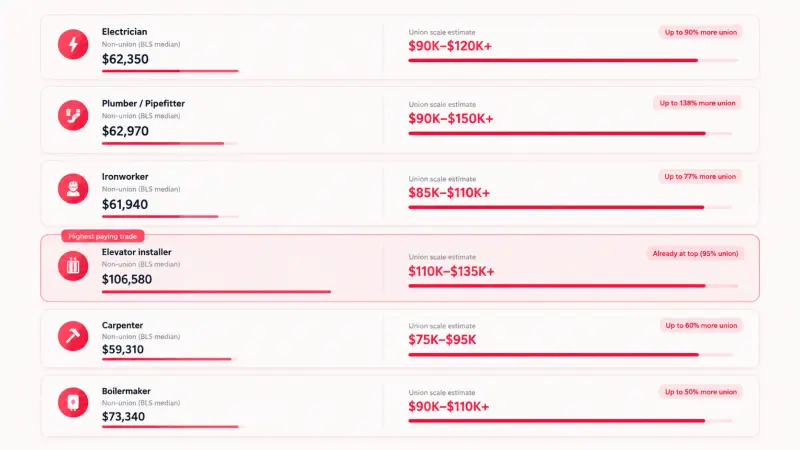
Non-union isn't automatically bad, especially in Texas and Florida, where market demand drives rates upward regardless of union status. But for workers looking at the highest paying construction trades over a 10–20 year career, union pathways consistently produce higher lifetime earnings, better benefits, and more structured advancement.
Getting In: Realistic Timelines Without a Degree
One of the most important, and most underreported, facts about the best paid construction trades is that the majority do not require a four-year degree. The primary pathway is an apprenticeship: a structured, paid training program that combines classroom instruction with on-the-job experience. You earn while you learn. No student debt.
Here's an honest look at how long each major pathway actually takes.
Workers coming from military backgrounds, manufacturing, or any field with hands-on mechanical work often move through training faster than those starting from scratch. The spatial reasoning, tool proficiency, and discipline transfer directly. For anyone wondering how to get hired in construction with no experience, the answer is consistently the same: start with a trade that offers an apprenticeship, and build credentials from there.
One practical note for workers entering the market: how you present your experience matters more than most people realize. FlexCrew's AI Resume Builder helps tradespeople organize certifications, equipment experience, and project history into a format that construction employers actually respond to. Workers who present credentials clearly get placed faster, and at better rates.
High-Demand Markets Right Now
The national headline about construction jobs is positive: the industry added hundreds of thousands of positions over the past three years and is projected to keep growing through the decade. But the real story is regional, and three markets stand out for trades workers right now.
Texas, and Houston and Dallas specifically remains one of the most active construction markets in the country. Infrastructure investment, commercial development, and energy sector projects create year-round demand across electrical, plumbing, welding, ironwork, and HVAC. FlexCrew's construction staffing presence in Houston reflects how active that market has been for skilled trades workers and contractors alike.
Florida is driven by population growth, coastal infrastructure, and a commercial real estate boom that shows no sign of slowing. Tampa, Orlando, and Miami are consistently placing skilled workers, particularly electricians, HVAC techs, and carpenters, at rates that often exceed the national BLS median.
Georgia, centered on Atlanta is one of the fastest-growing construction markets in the South. Commercial construction, data center development, and logistics infrastructure have driven sustained demand for skilled labor. Contractors looking for skilled labor staffing in these markets need a partner who understands the trades, not just general labor placement.
According to Associated Builders and Contractors, the U.S. construction industry faces a shortage of more than 500,000 workers in 2025. That gap between demand and available labor is exactly why skilled workers in the right trade and the right market have more leverage than at almost any other point in the past decade.
What Contractors Need to Know About Skilled Trades Pay
For contractors and construction businesses, understanding where wages sit in the current market isn't just informative, it's operationally essential. Underpaying for skilled trades workers doesn't just create morale problems. It creates turnover, project delays, and rework costs that dwarf any savings on labor rates.
The contractors who build reliable crews understand that pay is one part of the picture. Speed of placement matters too. When a project loses a licensed electrician mid-job in Dallas, or a plumbing crew falls short in Tampa, the cost of downtime compounds quickly.
FlexCrew connects contractors with vetted skilled trades workers across electrical, plumbing, HVAC, welding, and carpentry, on timelines that match actual project demands. The platform also supports professional contract staffing services for longer-term or specialized engagements.
Workers placed through FlexCrew come with verified credentials and trade-specific experience, not just general labor hours. That distinction matters on a job site, and it matters to foremen who need workers they don't have to babysit from day one.
The Bottom Line
Construction is one of the few industries in the United States where a worker can reach six figures without a college degree, without six-figure debt, and often within a decade of starting as an apprentice. The highest paying construction trades reward skill, specialization, and the willingness to pursue credentials that most people overlook.
Elevator installers, boilermakers, union steamfitters, crane operators, and ironworkers all have strong cases for being among the best paid construction trades in the country, and they're consistently underrepresented in the standard lists workers find online. The trades worth knowing about are the ones that combine technical complexity, limited labor supply, and strong union density. That combination produces wages that hold up over a full career.
Whether you're a worker ready to find your next role or a contractor looking to place skilled trades fast in Texas, Florida, or Georgia, FlexCrew is built for exactly this. Explore open skilled trades jobs and careers, use the AI Resume Builder to strengthen your application, or visit FlexCrew to connect with FlexCrew's staffing team directly.