
Every commercial build runs on its carpentry crew. Framing sets the schedule, and finish work sets the first impression. At FlexCrew, we help contractors staff skilled trades across Texas, Florida, Georgia, Tennessee, Indiana, and other growing markets.
One question keeps coming up from general contractors and project managers: what does finding reliable carpenters for commercial projects in Cincinnati actually take right now?
The short answer is that a directory search won't do it alone. The labor market is tight, nearby megaprojects are pulling skilled workers away, and commercial specs leave little room for error. This blog covers where to look, how to vet, what to pay, and how to keep good carpenters once you find them.
Key Takeaways
Finding reliable carpenters for commercial projects in Cincinnati starts with a clear scope: rough framing, metal stud, formwork, or finish work.
Referrals from trusted trades partners often beat cold calls and online listings.
Verify insurance, OSHA training, and recent commercial references before day one.
Plan for one to four weeks to source and onboard a vetted crew.
A construction staffing partner helps you scale crews up or down without long-term overhead.
Why Commercial Carpenters Are Hard to Find in 2026
The national numbers explain a lot of the local frustration. Associated Builders and Contractors estimates the industry must attract an estimated 349,000 net new workers in 2026 to meet labor demand, with an even greater need of 456,000 additional workers projected in 2027, as reported by Construction Executive.
Retirements drive much of that gap. According to ENR, more than half of the 349,000 workers needed in 2026 will be required simply to replace retirees, and about 20% of the construction workforce is over age 55.
Carpentry feels this directly. The U.S. Bureau of Labor Statistics projects about 62,800 openings for carpenters each year, on average, over the decade, with many resulting from the need to replace workers who transfer occupations or retire.
Contractors confirm what the data shows. The Associated General Contractors of America said last year that 92% of construction firms that are hiring reported having trouble finding qualified workers.
Cincinnati sits in a busy Ohio Valley corridor where tenant improvements, healthcare expansions, warehouses, and data centers all compete for the same skilled hands. Carpenters on trade forums openly discuss traveling to Ohio, Kentucky, and Indiana for long-term work. When crews can follow multi-year projects, local contractors feel the squeeze.
Define the Work Before You Start Searching
Reliable hiring starts with a precise scope. Commercial carpentry splits into several specialties, and each one needs a different profile.
Rough carpenters handle framing, blocking, backing, and concrete formwork. Metal stud framers dominate interior commercial buildouts. Finish carpenters install doors, frames, hardware, trim, casework, and millwork to architectural specs. If you're unsure which you need, our guide on framing vs. finish carpenter jobs breaks down the differences.
A strong framer from residential work may not be ready for fire-rated assemblies or commercial door hardware. Write down the trade, crew size, duration, and required certifications before you post a single job. Our breakdown of the best type of carpenter for commercial work can help you match skills to scope.
Where Contractors Actually Find Good Carpenters
Most contractors start with online directories and review sites. These help you compare established subcontractors and read reviews. But they mostly list companies, not available workers. If you need two extra finish carpenters next Monday, a list of firms won't close that gap.
Each sourcing channel has real tradeoffs. Here's how they compare in practice.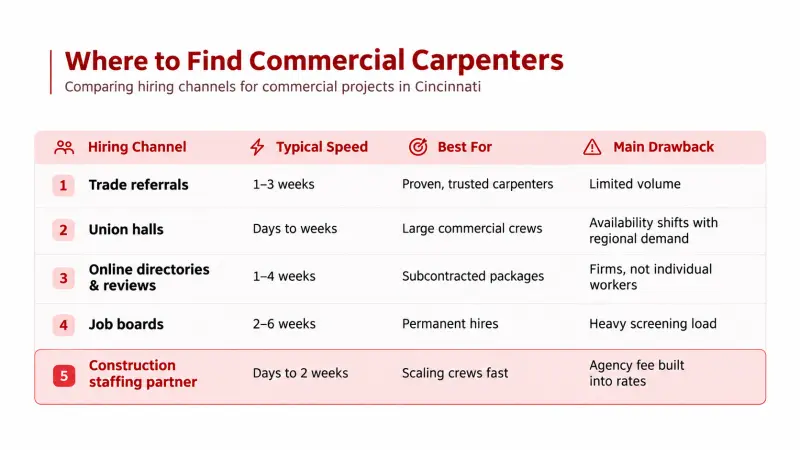
Referrals remain one of the most dependable sources. One remodeling contractor on a construction podcast shared a lesson many will recognize. His cold-call carpenters often talked a good game, then showed skill gaps on site. His best leads came from asking his electrician, HVAC contractor, and drywall installer who they trusted. Tradespeople see each other work every day, so their recommendations carry real weight.
Union halls are another strong channel for larger commercial work. The apprenticeship system produces journeymen with structured training, which BLS notes is common, as unions and contractor associations sponsor apprenticeship programs where apprentices complete technical training and paid on-the-job training each year.
Staffing partners fill the space between those options. A skilled labor staffing partner for businesses pre-screens candidates and can deploy workers faster than most internal hiring processes. If you're weighing the options, see our comparison of direct hiring vs. staffing agency reliability in the trades.
How to Vet Commercial Carpenters the Right Way
This is where finding reliable carpenters for commercial projects in Cincinnati gets serious. A disciplined vetting process protects your schedule, budget, and reputation with the owner.
Safety training is not optional. BLS states that all carpenters must pass the Occupational Safety and Health Administration (OSHA) 10-hour safety course. You can confirm course details through OSHA's Outreach Training Program. Ask for the physical card, not just a yes.
For experience checks, call superintendents or project managers, not just past homeowners. A carpenter who has hung 200 door frames on a hospital job will answer technical questions very differently than someone guessing.
Then test on site. The podcast contractor made a habit of working alongside every new sub for the first full day. Within hours, you'll see layout accuracy, tool habits, pace, and attitude. If something's off, you've caught it before it spreads to other trades.
Red Flags That Signal an Unreliable Hire
Some warning signs show up early. Vague answers about past projects are common. So is reluctance to share insurance certificates or references.
Listen to how candidates describe previous employers. Constant blame often predicts future conflict. Punctuality during hiring matters too. Someone late to an interview is rarely early to a 6 a.m. start.
On site, watch for sloppy layout, careless material handling, and ignored safety rules. Commercial work runs on inspections. One careless framer can trigger costly rework for several trades.
Realistic Timelines and Pay Benchmarks
Contractors often underestimate how long good hiring takes. Here's what typical staffing workflows look like.
You can also check regional data throughO*NET OnLine or our guide onhow much carpenters charge per hour.
Onboarding adds a few days for site orientation, safety paperwork, and badge access. Build that buffer into your schedule. A staffing partner can shorten sourcing, but no honest partner guarantees a perfect crew overnight.
What Keeps Good Carpenters Around
Pay matters, but steady work matters just as much. Experienced trades consistently say they stay with contractors who sequence projects well and keep their plates full. The podcast contractor kept the same lead carpenter for ten years largely because he never left him idle.
Structure arrangements clearly. Many contractors pay subcontractors on fixed bids and hourly carpenters on tracked time. Both work when expectations are in writing. Losing a great carpenter because you left them waiting three weeks is an expensive mistake.
How FlexCrew Supports Commercial Carpentry Hiring
FlexCrew specializes in commercial construction staffing and skilled trades hiring. Carpentry sits alongside the other trades we place, including plumbing, electrical, HVAC, and welding. That cross-trade network helps contractors coordinate full project teams instead of filling one role at a time.
Our contractor hiring process matches skills to scope. We screen for commercial experience, safety training, and work history before candidates reach your site. Contractors in Houston, Dallas, Orlando, Tampa, Atlanta, Nashville, and Indianapolis use this approach to scale crews as project phases change. Our Midwest experience, including finding reliable commercial carpenters in Fort Wayne, shows how these methods apply across the Ohio Valley.
When you're ready to staff up, you can find workers directly or read our tips on how to choose a staffing partner in construction.
Tips for Carpenters Seeking Commercial Work
If you're a carpenter, the hiring side tells you exactly what to highlight. Document commercial projects with names, dates, and scope. Keep your OSHA cards current. Ask past superintendents to serve as references.
Show versatility where you have it. Carpenters who can frame, set formwork, and handle siding often stay busier through slow stretches, a point echoed across union carpenter forums.
Present that experience clearly. FlexCrew's AI Resume Builder turns years of field work into a clean, professional resume in minutes. Then browse skilled trades jobs and careers or temporary jobs for workers across Texas, Florida, Georgia, and beyond.
Conclusion: Finding Reliable Carpenters for Commercial Projects in Cincinnati
Finding reliable carpenters for commercial projects in Cincinnati isn't about luck. It's about a repeatable system. Define the scope, use trusted referral networks, verify every credential, and test new hires before trusting them with critical work.
Set realistic timelines, pay fairly, and keep good people busy. Those habits separate contractors who constantly scramble from those who finish on schedule.
Need help building your crew? Contact FlexCrew to discuss your commercial carpentry staffing needs, or explore our AI Resume Builder if you're a carpenter ready for your next project.