
Drywall quotes rarely match. One contractor bids $2,000. Another bids $4,500 for the same room. Homeowners and contractors alike need a clear drywall installation cost estimate before signing anything, and most generic online calculators don't explain why the numbers swing so wide.
FlexCrew works with construction contractors and skilled tradespeople across Texas, Florida, Georgia, and other active markets, so we see these pricing gaps firsthand every week. This guide breaks down what actually drives the numbers, using real wage data and field-tested pricing logic, so you can budget with confidence instead of guessing.
Drywall pricing is not one flat number. A small patch job prices differently than a full 1,500 sq ft house. Material grade, crew size, and site access all matter. Understanding each piece helps you spot a fair quote versus an inflated one.
Key Takeaways
Drywall installation costs typically range from $1.50 to $5.50 per square foot, depending on finish level.
The U.S. Bureau of Labor Statistics reports a median annual wage of $58,140 for drywall and ceiling tile installers as of May 2024, about $27.95 per hour.
Labor usually makes up 60-70% of total project cost, so crew quality directly affects your final number.
Building material costs have risen 41.6% since the pandemic, according to NAHB, which continues to push drywall pricing upward.
A dependable drywall installation calculator should separate material and labor into distinct line items.
Why Drywall Pricing Varies So Much
Homeowners comparing quotes often get frustrated by wildly different numbers. One contractor says $2 a square foot. Another says $5. Both numbers can be honest.
The gap usually comes down to scope. A finished, taped, and primed wall costs more than a bare hang. Ceiling work costs more than wall work because of overhead labor and safety setup. Small rooms also carry a size premium, since a crew still needs a full day or two regardless of total square footage.
Location matters too. Labor costs in Dallas, Houston, Atlanta, or Miami differ from smaller markets nearby. According to BLS data, wages for drywall and ceiling tile installers range from a low 10th percentile of $37,810 up to $101,380 at the 90th percentile nationally. That spread alone explains a lot of quote variation.
DrywallInstallation Cost Estimate Per Sq Ft: What's Typical
These ranges are directional starting points. A drywall installation cost calculator that factors in your zip code and current material pricing will always beat a flat national table.
Breaking Down the Real Cost: Material First
Start any project budget with material costs, since they're the more predictable half of the equation.
A standard interior wall needs metal or wood studs, top and bottom track, gypsum board, insulation where required, plus screws, tape, and joint compound. For a 200 sq ft wall section, studs might run around $128, track near $80, drywall panels close to $200, and insulation about $160. Add roughly $50 for fasteners and miscellaneous supplies.
That works out to roughly $3 per square foot for material alone in this example. Local suppliers and current gypsum board pricing will move that number up or down, so treat this as a framework, not a fixed price.
Labor: The Part That Trips People Up
Labor is where most confusion happens, and it's the largest chunk of total project cost. Drywall work is production-based. Crews get paid for output, not just hours, which is why estimators use crew composition and production rates together.
A common crew setup includes one foreman, two framers, and two drywall hangers. Using national BLS wage benchmarks as a reference point, loaded labor rates commonly run in the $30 to $50 per hour range per worker depending on role and region. A five-person crew at blended rates near $180 an hour is a realistic planning figure for many markets.
For light framing and hanging, a reasonable production rate is 200 square feet in 6 to 8 hours. At 8 hours and $180 an hour, labor cost lands near $1,440, or about $7.20 per square foot. This is a useful benchmark, not a promise. Every job site, crew skill level, and access condition changes the number.
This is the same logic behind a professional drywall labor estimator. Build one accurate wall section, convert it to a per-square-foot unit cost, then scale it across the full project takeoff.
Crew composition only works if the crew actually shows up. This is where staffing becomes part of the cost conversation, not just a side issue. FlexCrew connects contractors with vetted framers, hangers, and finishers across its active markets, which helps keep production rates like the one above realistic instead of aspirational.
Combining Material and Labor Into One Number
Once you have both halves, add them together for your baseline unit cost. In the example above, roughly $3 per square foot material plus $7.20 per square foot labor lands near $10 per square foot as a raw production cost.
That baseline still needs overhead, profit margin, and general conditions layered on top for a contractor's final bid. Homeowners should expect finished quotes to run higher than raw production cost, and that gap is normal, not automatically a red flag.
How Much to Drywall a 1,500 Sq Ft House
This is one of the most common questions homeowners ask, and it deserves a direct answer.
For a full 1,500 sq ft house, actual drywall surface area is larger than the floor plan, since walls and ceilings both need coverage. The total wall and ceiling surface often runs 2.5 to 3 times the floor square footage.
Using a mid-range figure of $3 to $5 per square foot for combined material and labor, and roughly 4,000 to 4,500 square feet of actual drywall surface, total project cost typically falls between $12,000 and $22,500. High-end finish levels, vaulted ceilings, or extensive texture work can push that higher.
Labor Cost to Hang Drywall Per Sheet
Some contractors and homeowners price by sheet instead of square footage, especially for smaller repair jobs. A standard 4x8 sheet covers 32 square feet.
At $1.50 to $2.50 per square foot for hanging labor alone, that puts per-sheet hanging labor around $48 to $80 per sheet. Finishing labor, tape and mud, typically adds another $20 to $40 per sheet depending on finish level and local rates.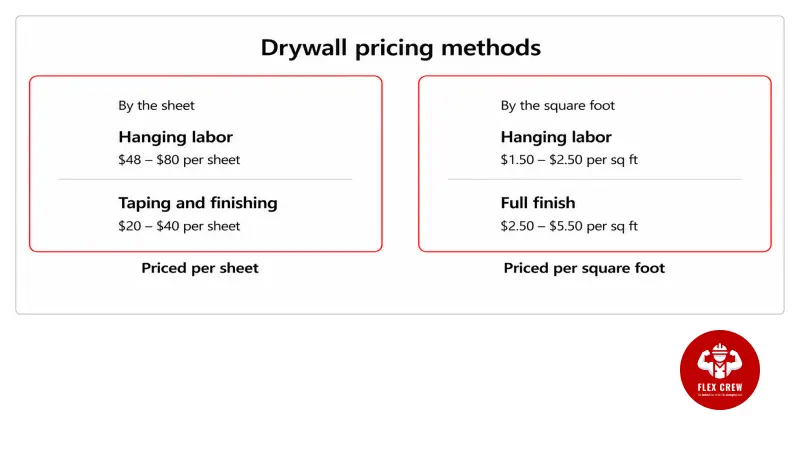
This per-sheet approach helps homeowners sanity-check quotes on smaller patch and repair jobs, where whole-house per-square-foot numbers don't translate cleanly.
Home Depot's Drywall Calculator and Other Estimating Tools
Retail tools, like the Home Depot drywall calculator, are useful for material planning. They estimate sheet count, joint compound, tape, and fasteners based on your room dimensions.
These calculators are strong for material budgeting but weak on labor. Labor is local, contractor-specific, and tied to crew production rates that a retail tool can't know. Use a calculator for material, then get a contractor's quote for labor separately.
Why Skilled Crews Drive Estimating Accuracy
Any cost projection is only as good as the crew executing it. Inexperienced hangers slow production, waste material, and create finish problems that cost more to fix later.
This matters more than ever right now. NAHB-commissioned research from the Home Builders Institute puts the annual economic impact of the skilled construction labor shortage at $10.8 billion nationally, tied to higher carrying costs and lost home production. Builders across the country continue to report shortages in framing, drywall, and finish carpentry crews specifically.
Contractors across Texas, Florida, Georgia, and other FlexCrew markets feel that pressure directly. Renovation season, storm recovery work, and new construction pipelines all spike demand for framers, hangers, and finishers at the same time.
FlexCrew helps contractors close that gap by connecting construction businesses with vetted skilled trades workers, including carpentry, framing, and general construction labor, so crews stay full and job timelines stay on track. For workers looking for consistent placement, FlexCrew also offers job placement support and an AI-driven resume builder that helps tradespeople present their experience clearly to hiring contractors.
Red Flags in a Drywall Quote
A few warning signs suggest a quote deserves a second look. A price with no material and labor breakdown makes it hard to compare bids fairly. A quote that ignores ceiling height, insulation needs, or finish level often changes once work starts.
A number that seems far below every other bid may signal rushed work or inexperienced labor. On the flip side, a higher quote isn't automatically bad. Small jobs, tight access, occupied homes, or high-finish requirements all justify a premium.
Getting a Reliable Estimate
The most reliable path is still a direct site visit. A contractor who sees your framing, ceiling height, and existing conditions can build a real cost projection instead of a rough range.
Bring two or three quotes for comparison. Ask each contractor to separate material and labor. Ask about crew size and expected timeline, since production rate directly affects both cost and schedule.
For businesses managing multiple job sites, staying staffed with dependable framers and hangers keeps these numbers accurate and keeps projects on schedule. FlexCrew works with construction companies across active markets to fill these roles quickly, so estimating stays predictable instead of reactive.
Whether you're a homeowner comparing bids or a contractor building out a crew for the next job, understanding what drives a drywall installation cost estimate puts you in a stronger position. Real numbers, clear breakdowns, and reliable labor make the difference between a budget that works and one that falls apart mid-project.