
When construction projects go up across Texas, Florida, Georgia, and beyond, the quality of every weld is the difference between a structure that stands and one that fails inspection. Choosing the best welding process for construction isn't an abstract decision, it shapes your timeline, your budget, and the structural integrity of everything your crew builds.
At FlexCrew, we connect contractors with certified welders every day across active job sites nationwide. We've seen firsthand what happens when the wrong process meets the wrong application, and what happens when the right welder, armed with the right technique, shows up ready to work.
This blog cuts through the noise. No textbook theory. Just practical, experience-backed guidance on which welding process fits which job, what the structural steel standards require, and what the skilled labor landscape actually looks like.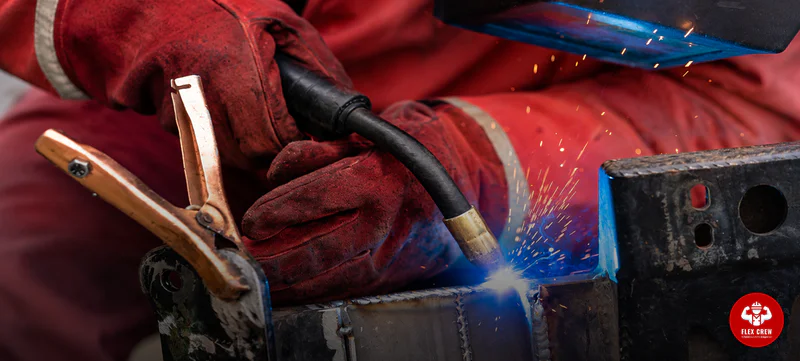
Key Takeaways
Flux core (FCAW) is the most versatile process for outdoor structural steel work and consistently meets AWS D1.1 code requirements.
MIG welding (GMAW) dominates shop fabrication for speed and consistency, ideal when conditions are controlled.
Stick welding (SMAW) remains the most portable and wind-tolerant option for field welding and repair work.
TIG welding (GTAW) is the precision standard for stainless steel pipe, pressure systems, and high-spec mechanical work.
The U.S. faces a shortage of 330,000+ welding professionals by 2028 (AWS), making certified welder sourcing a critical project planning factor.
Matching process to environment, field vs. shop, thick vs. thin material, code-required vs. standard, is the single most important decision before striking an arc.
Why the Best Welding Process for Construction Isn't One-Size-Fits-All
The American Welding Society (AWS) recognizes over 100 welding processes. But on American construction sites, commercial buildings, bridges, industrial facilities, pipelines, a handful carry the workload. The challenge isn't learning what these processes are. It's knowing when to deploy each one.
Construction welding operates under different rules than shop welding. You're working outdoors, often in awkward positions, against weather, under timeline pressure, and with code requirements that don't bend. The governing standard for most structural steel work in the U.S., covering groove welds, fillet welds, prequalified welding procedure specifications (WPS), and inspection requirements. Your welder qualifications, joint preparation, and process selection all have to align with this code before a single bead is laid on a load-bearing joint.
The choice of process also has labor implications. According to the bureau of labor statistics, the median annual wage for welders was $51,000 in May 2024, with specialized roles in pipeline and structural steel reaching significantly higher. Contractors who understand which process their project requires are in a much stronger position to recruit the right certified talent, and to do it fast.
Process at a Glance: Quick Comparison
Before diving into each process, here's a side-by-side view of how the four most common construction welding processes stack up across the factors that matter most on real job sites.
Stick Welding (SMAW): The Field Veteran That Still Earns Its Pay
Ask any experienced welder working in Houston, Jacksonville, or on a bridge crew in Atlanta, stick welding still holds its own on construction sites. Shielded Metal Arc Welding is the most portable process in the trade. All you need is a power source and your two leads. No shielding gas bottle to drag across a job site. No wire feeder to troubleshoot in the rain.
SMAW electrodes come in a wide variety. You can weld carbon steel, stainless, cast iron, and low-alloy steel, and the process tolerates wind conditions where gas-shielded processes fail completely. On outdoor structural steel connections, site repair work, and remote field applications, stick is often the only practical choice.
The trade-off is pace and skill ceiling. Stick welding has a steeper learning curve than MIG, and you're stopping constantly to change electrodes, which adds up on long welds. But welders and field supervisors consistently say the same thing in Reddit welding communities and professional forums: a well-executed SMAW bead on structural steel is tough to beat for reliability and code compliance.
Flux Core Arc Welding (FCAW): The Best Welding Process for Construction Structural Steel
If there is one process that earns top billing as the best welding process for construction across the widest range of commercial and industrial applications, flux core is it. Both self-shielded FCAW and dual-shielded (gas-shielded) FCAW deliver exceptional deposition rates, you're laying more metal, faster, without sacrificing penetration or structural integrity.
Self-shielded FCAW is a field welder's best friend. No gas bottle. Solid out-of-position performance. Wind tolerant. Dual-shielded adds gas to the equation and rewards you with cleaner, smoother welds on heavy structural steel, exactly what you need on large commercial builds in the Gulf Coast region or Central Florida construction corridors.
Flux core is the go-to for thick plate, structural steel beams, platforms, and heavy equipment frames. It's compliant with AWS D1.1 and widely accepted for prequalified weld procedures on carbon and low-alloy steel. On demanding schedules where downtime is expensive, FCAW's combination of speed and out-of-position capability is hard to match.
One thing it demands: run it hot. Slag needs full fusion. Undercutting on a critical weld joint is not a cosmetic problem, it's a structural one.
MIG Welding (GMAW): Production Speed in the Shop and Field
MIG welding is the most common welding process in industry, and the reason is simple: it's fast, consistent, and relatively forgiving for intermediate-level welders. Gas Metal Arc Welding is the backbone of most fabrication shops supporting construction projects. Contractors in Texas and Florida rely on it to pre-fabricate pipe spools, structural frames, brackets, and mechanical assemblies before they ship to site.
For those asking about the best type of welder for beginners entering a construction career, MIG welding is the consistent starting point. Wire feeds automatically. You focus on travel speed, work angle, and distance, not the feeding rod. With good instruction and focused practice, a welder can produce code-compliant work on mild steel in weeks, not months.
On open job sites, MIG's vulnerability shows up: wind disrupts the argon-CO₂ shielding gas, inviting porosity into the weld pool. That's why field crews often use dual-shielded flux core outdoors and keep MIG in the shop where conditions are controlled. The two processes work best as a pair, not competitors.
TIG Welding (GTAW): Where Precision Drives the Specification
TIG welding produces some of the cleanest, most precise welds in the industry. Gas Tungsten Arc Welding uses a non-consumable tungsten electrode and a separately fed filler rod, giving the welder independent, real-time control over heat and metal deposition. It's similar in that sense to oxyacetylene, but with the power and arc stability of an electrical process.
In construction, TIG welding is most commonly specified for stainless steel pipework, pressure vessels, water treatment systems, and mechanical components where corrosion resistance and long service life are non-negotiable. The process is standard in aerospace, motorsports, and high-spec industrial facilities, and any mechanical contractor working on water infrastructure or food-grade processing systems in the Southeast will encounter TIG requirements regularly.
The honest trade-off: TIG is the most difficult process for most welders to learn, and it's the slowest by deposition rate. For heavy structural steel on a production schedule, TIG is not the right call. For critical pipe connections, radiographically tested welds, and dissimilar-metal joints, TIG is the professional standard.
Structural Steel Welding Standards: What the Codes Actually Require
Understanding the best welding process for construction means understanding the codes that govern it. Picking the wrong process for a code-specified joint doesn't just waste time, it can result in failed inspections, structural non-compliance, and costly rework on a job site that's already under deadline pressure.
Here are the primary standards governing construction welding in the U.S.:
All four major processes, SMAW, FCAW, GMAW, and GTAW appear in prequalified weld procedure specifications under AWS D1.1. What the code cares about is joint preparation, welder qualification, electrode/wire classification, and inspection protocol, not which of the four processes you prefer. Get your WPS in order, get your welder certified, and make sure your inspection process matches the joint classification.
The Skilled Welder Shortage: A Real Project Planning Problem
Knowing the best welding process for construction is only half the equation. The other half is finding a certified welder who can actually execute it.
The numbers are stark. According to the American Welding Society, the U.S. needs 330,000 new welding professionals by 2028, with roughly 82,500 welding jobs opening every year between now and then. The Bureau of Labor Statistics projects approximately 45,600 annual job openings for welders through 2034, most driven by retirement attrition, not new positions. The average age of a U.S. welder today is 55.
The pressure is being felt directly in construction. An Associated General Contractors of America workforce survey found that 79% of firms with openings for pipefitters or welders reported challenges finding qualified candidates, up 7 percentage points from the prior year. In the same survey, 94% of contractor respondents had unfilled openings for hourly craft workers.
This is a staffing reality, not a background statistic. Contractors in Houston, Tampa, Atlanta, and across FlexCrew's service footprint are managing real project delays because certified welders, particularly those with structural steel, pipeline, and TIG qualifications, are harder to source every quarter.
Welding Demand by Construction Sector
Not all construction sectors face the same welding requirements. Here's how process demand breaks down across the job types FlexCrew's contractor partners work most:
Where FlexCrew Fits Into This Picture
Here is where process knowledge meets workforce reality. A contractor in Dallas knows they need dual-shielded flux core welders for a structural steel project starting in three weeks. A mechanical subcontractor in Orlando needs two certified TIG welders for stainless pipe work on a water treatment facility. A fabrication shop in Savannah needs to ramp up their MIG capacity for a pre-fab contract that doubled in scope.
These are not hypothetical scenarios. They're what FlexCrew handles on a daily basis. FlexCrew specializes in connecting construction contractors with certified skilled trade workers, including welders qualified across SMAW, FCAW, GMAW, and GTAW across Texas, Florida, Georgia, and its expanding service regions. The focus is on pre-screened, verified talent that can step into a job site role without a long onboarding curve.
For welders looking to land their next role, FlexCrew's AI Resume Builder makes it straightforward to present certifications, process qualifications, and weld positions clearly, so the right contractors see the right credentials from the start. In a market where employers scan for specific certifications (AWS CW, CWI, D1.1 compliance) before anything else, how those credentials are presented matters.
Whether you're staffing a structural steel crew in Houston or sourcing a certified TIG welder for a mechanical project in Jacksonville, FlexCrew moves fast and brings verified skills to the table.
How to Choose the Best Welding Process for Construction: A Decision Framework
Before your crew strikes an arc, work through these four questions:
1. Where is the weld being made? Field/outdoor → SMAW or self-shielded FCAW. Shop/indoor → GMAW or dual-shielded FCAW for structural, GTAW for precision.
2. What is the material and thickness? Heavy carbon steel (structural) → FCAW. Thin carbon/mild steel (fabrication) → GMAW. Stainless/pressure → GTAW. General field steel → SMAW.
3. What does the applicable code require? Check your WPS against AWS D1.1, D1.6, or the project specification before choosing. Some joint configurations have prequalified requirements that narrow your options.
4. What level of welder qualification do you have on your crew? A process your welder can't execute well beats the theoretically superior process on paper. Match the process to your certified talent, not the other way around.
Know the Process, Staff the Right Welder
The best welding process for construction comes down to four variables: your material, your position, your environment, and your code. Flux core dominates the field. MIG runs the shop. Stick holds its place in tough, portable conditions. TIG handles what nothing else can on precision and high-spec work.
What the process can't do is compensate for unqualified hands. In a market where 79% of contractors can't find the certified welders they need, the process decision and the staffing decision have to be made together, not sequentially.
If you're a contractor who needs certified welding talent in Texas, Florida, Georgia, or surrounding states, or a welder ready for your next structural steel, pipeline, or fabrication placement, connect with FlexCrew and let's get to work.