
Anyone who owns, manages, or bids on commercial property eventually asks the same question: what is the average cost to paint a commercial building? The answer isn't one flat number. It depends on square footage, materials, building condition, and labor availability in your market. That last factor, labor, is where FlexCrew comes in.
FlexCrew is a staffing partner connecting contractors with skilled trades and light industrial workers across Texas, Florida, Georgia, and other growing regions, and it sees firsthand how crew availability shapes what a painting project actually costs. This blog breaks down real numbers, real ranges, and the practical steps behind an accurate estimate.
Key Takeaways
The average cost to paint a commercial building typically runs $2 to $6 per square foot, depending on finish level and building condition.
Labor drives roughly 65-75% of total project cost, according to industry cost-breakdown patterns, not materials.
The national median wage for construction and maintenance painters was $48,660 per year in May 2024, per the U.S. Bureau of Labor Statistics.
Building size, surface prep, location, and paint quality are the biggest cost drivers.
Labor shortages can delay projects and raise costs in fast-growing markets like Texas, Florida, and Georgia.
What Drives the Average Cost to Paint a Commercial Building
Before anyone can quote a number, they need to understand what's actually being priced. Painting contractors and facility managers both look at the same core variables. Skipping any of them leads to bad estimates.
The first factor is material quality. A property manager repainting an apartment complex between tenants doesn't need premium finishes. Budget-friendly paint lines keep repaint costs closer to $1 per square foot. A retail storefront or medical office lobby is a different story. Higher-end finishes, including specialty options like Venetian plaster, can push costs several times higher because they're labor-intensive and require skilled application.
The second factor is building condition. Older commercial buildings often need drywall repair, plaster patching, or extensive scraping before a single coat goes on. This prep work adds hours, and hours are what really drive the average cost to paint a commercial building upward. A dilapidated property that looks like a bargain on paper can end up costing more once painting and repair costs are factored in.
The third factor is location. If a project sits far from a labor pool, contractors have to factor in travel time, per diem, and possibly lodging for crews. This is especially relevant in spread-out regions where commercial properties may be an hour or more from the nearest available painting crew.
The fourth factor is simply square footage. Larger buildings cost more in total dollars but often see a lower per-square-foot rate because fixed costs like equipment setup get spread across more areas.
Average Cost to Paint a Commercial Building Per Square Foot
Most contractors and industry pricing guides land in a similar range. The table below breaks the average cost to paint a commercial building per square foot down by project type, based on common industry benchmarks and labor cost patterns.
For a rough gut-check, a widely used rule of thumb is to expect finishing costs, including paint and minor repairs, to run around 10% of a property's overall value. That figure varies by project, but it's a useful sanity check when a bid seems unusually high or low.
Where the Painting Dollar Actually Goes
Materials get most of the attention in conversation, but labor is what really moves the average cost to paint a commercial building. The breakdown below reflects common industry cost-allocation patterns used by painting contractors when building a bid.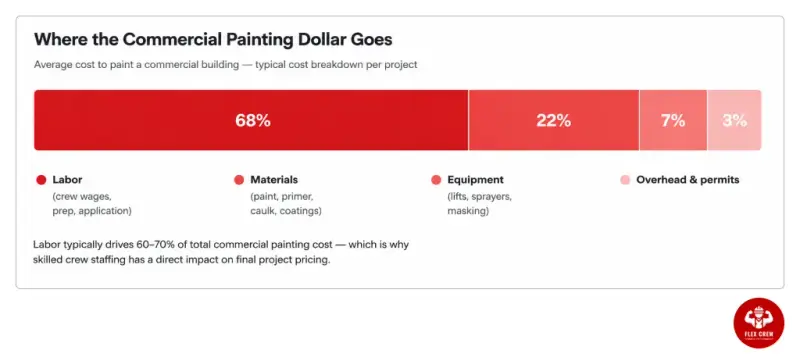
This is exactly why labor availability matters as much as paint pricing. When skilled painters are hard to find, hours stretch, timelines slip, and the final invoice climbs even if material costs stay flat.
Cost to Paint Commercial Building Interior vs. Exterior
Interior and exterior painting carry different cost structures, and lumping them together is a common mistake.
Exterior painting deals with weather exposure, height, and access equipment like lifts or scaffolding. These add both time and equipment rental costs. The average cost to paint a commercial building's exterior often includes power washing, caulking, and repairing weather damage before paint is applied.
Interior painting deals less with weather but more with occupancy. Painting an active retail space, restaurant, or medical office often means working after hours or in phases to avoid disrupting business. That scheduling complexity adds labor cost even when the square footage is small.
The cost to paint a commercial building interior typically runs slightly lower per square foot than exterior work on the material side, but labor costs can be comparable or higher once scheduling constraints are factored in.
Commercial Painting Cost Calculator: How the Math Works
A simple commercial painting cost calculator approach uses four building blocks: labor hours, labor rate, material gallons, and markup.
First, estimate labor hours. Break the building into prep work, wall or siding area, and trim. Prep is the hardest to standardize because it depends heavily on building age and past maintenance.
Second, estimate material cost. Multiply the number of gallons needed by the price per gallon at your supplier. A common industry approach ties gallons needed for body painting directly to the labor hours estimated, since coverage rates and painting speed are closely related.
Third, add labor and material costs together to get the base cost of the job.
Fourth, apply a markup. Many contractors use a multiplier around 2.2 to 2.4 times the base cost to target a healthy gross profit margin after accounting for overhead, discounts, and miscellaneous supplies like tape, plastic, and caulking.
This average cost to paint a commercial building calculator method won't be perfect on the first try. But tracking actual hours and material use after each job sharpens accuracy over time.
Average Cost to Paint a Commercial Building: Real-World Examples
Real numbers help more than formulas alone. Painting professionals and property owners in trade communities often share their own math.
One commonly used approach: take total square footage, divide by 250 to estimate gallons needed per coat, then double that for two coats. Multiply gallons by the price per gallon for material cost. Labor is then estimated at roughly three times the material cost, since labor is consistently the largest line item in most bids.
For a 30,000 square foot storage facility, that formula produces a total in the range of $30,000 to $36,000, or right around $1 per square foot. That number lines up closely with industry averages for straightforward exterior commercial work using standard materials.
Smaller or more detailed projects, like a 6,000 square foot retail space with heavy trim, custom colors, or interior finish work, can push per-square-foot costs noticeably higher.
Why Labor Availability Affects the Average Cost to Paint a Commercial Building
Material pricing is fairly predictable. Labor availability is not, and it's often the bigger wildcard in any bid.
Nonresidential construction spending in the United States has been running at a seasonally adjusted annual rate of roughly $738.7 billion, part of a total U.S. construction market spending about $2.2 trillion annually and employing 8.3 million people. That kind of sustained building activity keeps steady demand on painting crews, especially in high-growth states.
On the labor side, the U.S. Bureau of Labor Statistics reports that construction and maintenance painters earned a median annual wage of $48,660 in May 2024, with the lowest 10% earning less than $36,680 and the highest 10% earning more than $76,550. Demand for painters is also projected to keep growing, with employment expected to rise 4% from 2024 to 2034, adding about 28,100 openings each year nationally.
In fast-growing markets across Texas, Florida, and Georgia, commercial construction and renovation activity has stayed strong even as national nonresidential spending has leveled off. That demand puts pressure on the local painting labor pool. When skilled painters and reliable crew members are hard to find, timelines stretch and labor rates climb, which directly raises the average cost to paint a commercial building in that region.
This is where staffing plays a bigger role than people expect. Contractors bidding commercial jobs need dependable crews they can scale up or down based on project size. FlexCrew works with painting contractors and general contractors to fill light industrial and skilled trades roles, including painters, laborers, and finish crews, so projects stay on schedule instead of stalling for lack of manpower.
For workers looking to get into commercial painting or related trades, having a strong resume matters just as much as having the right skills. FlexCrew's AI-driven resume builder helps job seekers put together a clear, professional resume quickly, which can make the difference in landing steady work with a reputable crew.
Steps to Get an Accurate Commercial Painting Estimate
Getting a reliable number takes more than a phone call and a guess. A few practical steps make a real difference.
Start by measuring the building accurately, including wall area, trim length, and any specialty surfaces. Walk the property and note damage, water stains, or areas needing repair before painting begins. Get at least three bids from contractors who have handled similar commercial projects in your area. Ask each bidder how they calculate labor hours and material coverage, since vague answers often signal an inexperienced estimate. Confirm whether the quote includes prep work, primer, and two coats, since some lowball bids quietly leave these out.
For contractors themselves, tracking actual job costs after each project is the single best way to refine future bids. The gap between estimated and actual hours shrinks fast once real data starts feeding back into the process.
Budgeting Tips for Property Owners and Facility Managers
Property owners don't need to become painting experts, but a few habits keep budgets realistic.
Set aside a contingency of 10-15% above the initial quote for older buildings, since hidden repair needs are common. Ask contractors directly what finish level is included, since "commercial grade" paint can mean very different things between suppliers. Time large exterior projects around seasonal weather patterns common in your region, since delays from rain or extreme heat can add cost. Consider phased painting for occupied buildings to avoid disrupting tenants or customers, even if it slightly raises labor cost.
None of these tips eliminate cost, but they reduce the chance of budget-blowing surprises mid-project.
Final Thoughts on the Average Cost to Paint a Commercial Building
There's no single number that answers what a commercial paint job should cost. The average cost to paint a commercial building depends on size, condition, finish quality, and local labor availability. What stays consistent, and what the data backs up, is that labor drives most of the total bill, not paint.
For contractors and property managers across Texas, Florida, Georgia, and other active markets, having access to reliable skilled trades workers is often the real key to controlling costs and keeping projects on schedule. FlexCrew connects businesses with light industrial and skilled trades talent, including painters and finish crews, while helping job seekers put their best resume forward with its AI-driven resume builder.
If you're planning a commercial painting project, or looking to build a crew that can handle one, FlexCrew can help you find the right people for the job.