
Every construction project hits the drywall phase eventually, and when it does, the first question is always the same. What's the average cost of drywall installation, and is the quote on the table actually fair? Whether you're building a home in Houston, finishing a commercial space in Tampa, or managing a renovation crew in Atlanta, getting that answer right matters.
At FlexCrew, we work daily with contractors and skilled drywall workers across Texas, Florida, Georgia, and beyond, which gives us a clear, ground-level view of what this work actually costs, where projects lose money, and what separates a realistic budget from a rude surprise.
This blog breaks it all down, with real numbers from credible sources.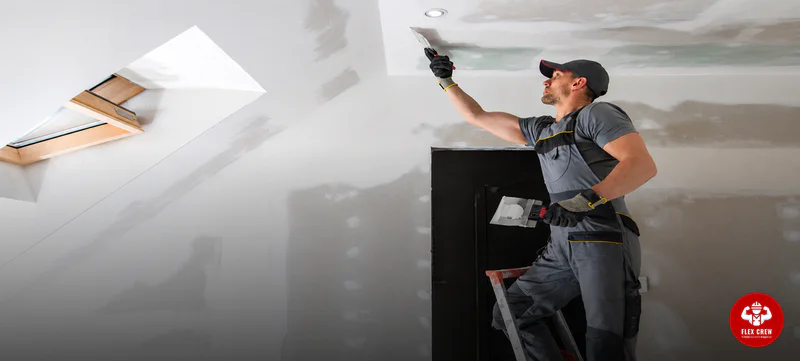
Key Takeaways
The national average cost of drywall installation runs $1.50 to $3.50 per square foot, fully installed (materials + labor + finishing).
Labor accounts for about 70% of the total drywall installation cost, making workforce quality the single biggest variable in your final number.
Ceiling drywall consistently costs 20–40% more per square foot than wall work due to increased physical difficulty and equipment requirements.
Drywall type, finish level (Level 0–5), and ceiling height are the three factors that swing costs most dramatically on any given job.
The median annual wage for drywall and ceiling tile installers was $58,140 in May 2024, according to the U.S. Bureau of Labor Statistics, meaning experienced crews command real market rates.
A 3,000 sq ft house with 9-foot ceilings can run $13,000–$17,000 fully installed. A 1,500 sq ft house typically lands between $6,500 and $11,000.
Always get at least three quotes. Labor rates for the same project can vary by $25–$40 per sheet depending on your market and the contractor's experience level.
What Is the Average Price for Drywall Installation in 2026?
The average cost to install drywall, including materials and labor runs between $1.50 and $3 per square foot, which works out to about $60 to $90 per drywall panel. For most residential jobs, the realistic midpoint sits around $2.20 to $2.65 per square foot when you factor in hanging, taping, mudding, and sanding at a standard Level 4 finish.
As of May 2026, the estimated national average cost to install drywall starts at $2.26 to $2.69 per square foot. That range reflects standard conditions, it moves higher for specialty drywall, high ceilings, or complex room geometry.
For full-house projects, the numbers scale fast. A 3,000 sq ft home with 9-foot ceilings, a build scenario documented in detail across homebuilder communities runs roughly $13,500 to $15,000 all-in: approximately $7,150 in materials and $6,400 in labor at around $25 per sheet for 256 sheets. That's a rural or mid-market pricing scenario. Major metros in Texas and Florida will push those labor figures noticeably higher.
Average Cost of Drywall Installation by Project Size (2026)
Breaking Down the Average Cost to Hang and Finish Drywall
There are two genuinely separate trades inside every drywall job: hanging and finishing. Contractors often bundle them into a single per-sheet or per-square-foot quote, but understanding both helps you read any proposal more accurately, and spot where a low bid might be cutting corners.
Hanging is the physical work of measuring, cutting, and fastening panels to studs. In 2026, hanging labor averages $0.85 to $1.25 per square foot, while finishing which covers taping, mudding, and sanding costs $1.00 to $1.50 per square foot.
Finishing is where the skill gap shows up most clearly on a job site. Getting seams invisible, corners clean, and surface ready for paint is a craft that takes years to develop. In competitive markets like Dallas–Fort Worth or South Florida, experienced finishers charge $30 to $40 per sheet or more. In rural markets, $25 per sheet is realistic. The spread on a 256-sheet house is over $3,800, real money that a single good quote comparison can save.
Hiring a local drywall installer typically costs $1 to $2.10 per square foot in labor, totaling $690 to $2,200 on average. Complex installations with curved walls, high ceilings, or intricate architectural details require more time and expertise, increasing labor costs.
Labor Cost to Hang and Finish Drywall; By Task (2026)
What Drives the Average Cost of Drywall Installation Up or Down?
Several variables move the final number more than most people expect heading into a project. Here are the ones that consistently matter most.
Drywall type: A standard half-inch gypsum board is the base case and the most affordable option. Moisture-resistant board, required in bathrooms and kitchens, costs roughly 25–30% more than standard. Mold-resistant boards run 35–45% more. Fire-resistant or moisture-resistant varieties add 20–35% to material costs. Fire-rated 5/8-inch drywall is code-required in garages that share a wall with living space. A typical 3,000 sq ft build often requires four different drywall types, standard, 54-inch for 9-foot walls, moisture-resistant, and fire-rated, each carrying its own unit cost.
Finish level: Levels 0 through 5 define the quality of the finished surface. Level 0 means drywall is hung and nothing more. Level 5 is a full skim-coated surface ready for gloss or enamel paint, requiring an additional labor-intensive pass. Most residential work lands at Level 4. Level 5 finishes can add $2.00 to $4.00 or more per square foot over basic hanging costs, due to the labor-intensive skim, sanding, and time required.
Ceiling height and complexity: Nine-foot ceilings require 54-inch drywall to limit wall seams. Ten-foot-plus ceilings typically require scaffolding or a drywall lift, both of which add time and cost. Arched openings, curved walls, cathedral peaks, and octagonal rooms all demand extra cutting time and specialized compound work. Drywall ceiling installation costs 20–40% more per square foot than wall installation, averaging $2.00 to $4.50 per square foot in 2026, with the increased cost reflecting more challenging labor, additional safety measures, and frequently required scaffolding or specialized lifts.
Location and market: Labor rates vary significantly by region. Skilled labor costs increased 22% in construction-heavy states like Texas and Florida over recent years, and this trend continues into 2026. Urban metros in those states, Houston, Miami, Tampa, Atlanta, consistently price higher than rural markets. Always calibrate your budget expectations to your specific geography, not national averages alone.
Age of the home: If your home is over 40 years old, asbestos or lead paint may be present. If either is found, you could end up paying anywhere from $1,000 to $3,000 or more for lead, mold, or asbestos removal before any hanging begins.
Labor Cost to Hang and Finish Drywall Ceiling: Why It Always Costs More
Ceiling drywall is consistently the most expensive part of any installation, and the reason is straightforward. Every cut, every panel lift, every screw is done overhead. Workers fatigue faster. Productivity per hour drops. Mistakes are harder to fix once the board is up. Any ceiling above standard height demands either a drywall lift or scaffolding, adding equipment and setup time to the labor cost.
For commercial projects, offices, healthcare facilities, retail spaces, ceiling complexity goes further still. Drop-ceiling frames, recessed lighting cutouts, HVAC integration, and multi-angle intersections all demand workers with real experience on commercial finishes.
A drywall installer who handles residential walls competently may not be the right person for a commercial ceiling job. That distinction matters both for quality and for cost. Hiring workers who are matched to the actual complexity of a job is one of the most consistent ways contractors control rework expenses.
The Workforce Factor: Why Drywall Labor Is Getting More Expensive
The numbers behind drywall pricing don't exist in a vacuum. There's a structural workforce dynamic pushing labor costs upward, and it's worth understanding if you're budgeting a project in 2026.
Overall employment of drywall installers, ceiling tile installers, and tapers is projected to grow 4 percent from 2024 to 2034, with about 8,800 openings projected each year on average over the decade, many of them resulting from retirements rather than industry growth.
According to Associated Builders and Contractors, the construction industry needed to attract an estimated 349,000 net new workers in 2026 just to keep up with demand, with that number rising to 456,000 in 2027 as spending growth is poised to resume.
Industry leaders specifically cite drywall installers and finishing carpenters as among the hardest skilled roles to fill right now. That scarcity directly translates into higher per-sheet quotes, longer lead times for finding available crews, and more pressure on project timelines.
For contractors managing active job sites in Texas, Florida, and Georgia, this is the daily operational reality. Finding reliable, experienced drywall crews, especially finishers, on short notice is often the biggest variable in whether a project stays on schedule. That's where construction staffing support becomes a practical tool rather than a luxury.
FlexCrew connects contractors across these markets with pre-vetted drywall workers who are ready to step in when a project timeline demands it, without the weeks-long hiring process of going it alone.
Drywall Type Comparison: Materials Cost at a Glance
Not all drywall is priced the same. Choosing the wrong type, or failing to budget for specialty boards in bathrooms, garages, or high-moisture areas is one of the most common sources of budget overrun on residential and commercial jobs alike.
Drywall Material Cost by Type (Per Sheet, 2026)
Standard 1/2-inch drywall runs $10 to $14 per sheet in 2026. Moisture-resistant (green board) costs 25–30% more, and mold-resistant (purple board) runs 35–45% more. Always budget a 10–15% waste factor on top of your sheet count, cuts, damage, and layout adjustments eat into every order.
What Workers Should Know About Drywall Pay and Job Placement
For drywall workers themselves, understanding the market rate for your skills puts you in a stronger negotiating position. The median annual wage for drywall and ceiling tile installers was $58,140 in May 2024, while the median annual wage for tapers and finishing specialists was $64,700, according to the U.S. Bureau of Labor Statistics. Tapers earn more because their work is harder to do well, more visually unforgiving, and in shorter supply.
For workers entering or advancing in drywall trades across Texas, Florida, and Georgia, clearly communicating your specific skill set, hanging versus taping versus finishing, Level 3 versus Level 5 work, residential versus commercial experience is what gets you placed on higher-paying projects.
FlexCrew's AI Resume Builder is built specifically for construction workers in this position. It translates real job site experience into a format that contractors and hiring managers actually respond to, which means faster placement and better-matched opportunities.
Getting a Fair Quote: Practical Steps Before You Commit
Getting the average cost of drywall installation right for your specific project comes down to a few consistent practices. Always collect at least three quotes before committing. The YouTube homebuilder breakdown referenced earlier showed quotes ranging from $25 to $34 per sheet for the same 256-sheet job, a spread of more than $2,300 on identical work.
When you receive a quote, ask the contractor to separate hanging and finishing line items. Ask which finish level they're pricing. Ask about specialty drywall recommendations and why they're specifying that type. A contractor who can explain those decisions clearly, not just hand over a total is one who knows the trade and is less likely to surprise you mid-project.
Budget a 10–15% contingency on top of your material count for waste and adjustments. If your home is older, budget separately for any hazardous material inspection before hanging begins. And if you're managing a project in Texas, Florida, or Georgia where skilled drywall labor is tight right now, factor in lead time as part of your schedule, or work with a staffing partner who can close that gap faster.
The average cost of drywall installation in 2026 is real money. Getting the right people on the job from the first day is what keeps it from becoming more.
Planning a drywall project in Texas, Florida, or Georgia? Need reliable, experienced drywall crews without the long hiring wait?
Visit FlexCrew to find pre-vetted construction labor fast. And if you're a skilled drywall worker ready for your next placement, FlexCrew's AI Resume Builder helps you stand out from day one.